


Most DTC brands start on a payment facilitator. You sign up for Stripe or switch on Shopify Payments, take your first order the same day, and never think about acquirers, underwriting or MIDs. For the first year or two, that is the right call.
The question comes later, usually at an awkward moment: a payout hold before a big launch, a reserve you didn't agree to, or a subscription base that has grown so large that losing the account would stop the business. That is when operators ask whether they should have their own merchant account, and what it would take to get there without breaking renewals.
This guide is a decision framework for that move. It explains how a PayFac account differs from a dedicated merchant account (your own MID), the six signals that it is time to switch, when staying put is the better answer, and a step-by-step migration plan for subscription brands. Rules and prices are as of November 2026.
Key takeaways
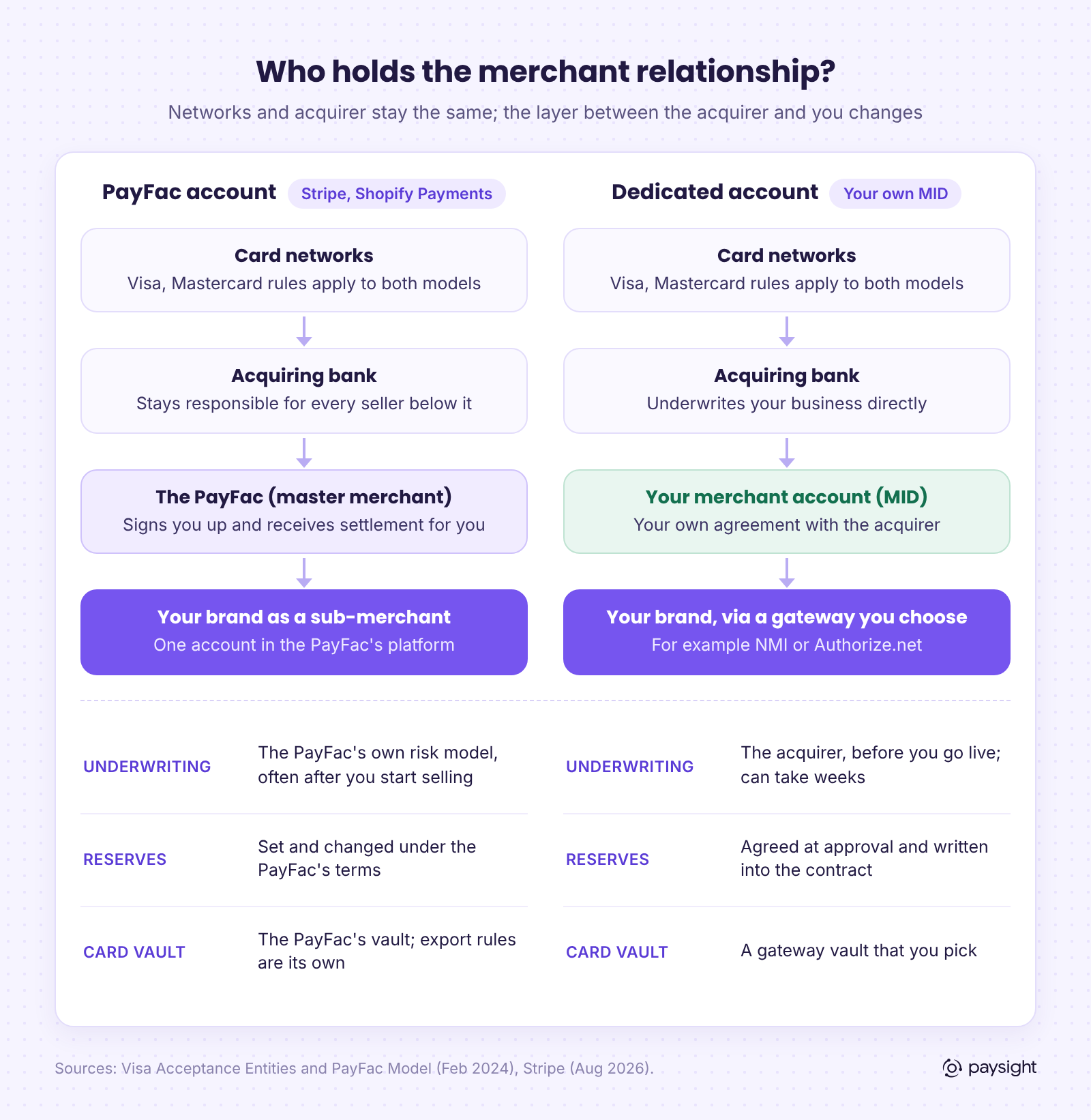
- On Stripe or Shopify Payments you are a sub-merchant inside the facilitator's merchant relationship with its acquirer. With a dedicated merchant account, the acquirer underwrites you and you hold your own MID.
- Visa and Mastercard both set a US$1 million annual volume line for sub-merchants, but it requires a direct agreement with the acquirer, not a move off the facilitator. Treat it as a signal, not a deadline.
- The strongest reasons to move are concentration risk (one account carries all revenue), reserve and payout terms you can negotiate in writing, and owning where your card vault lives.
- Card data is the hard part. Stripe exports card numbers to another PCI DSS Level 1 processor on request; Shopify support has told merchants it cannot transfer payment details off Shopify Payments.
- Plan for what does not move: payment history, subscription objects, network tokens, account updater enrolment and Visa CE 3.0 history all restart at the new provider.
PayFac vs dedicated merchant account: what actually changes
A payment facilitator (PayFac) is, in Visa's words, a third party that can "sign a merchant acceptance agreement with a seller on behalf of an acquirer" and "receive settlement proceeds from an acquirer, on behalf of the underlying seller" (Visa Acceptance Entities, February 2024). The seller is called a sponsored merchant or sub-merchant. Stripe describes itself as operating "as both a payment processor and a payfac", and Shopify Payments is powered by Stripe.
A dedicated merchant account is the traditional route. An acquiring bank, often through an ISO or a processor, underwrites your business directly and issues you a merchant ID (MID). You then connect that MID to a gateway such as NMI, Authorize.net or a processor's own platform. If you want the full application walkthrough, our guide to getting approved for a merchant account covers the documents and checks.
One thing does not change: in both models the acquirer stays responsible to the card networks. Visa states that "the acquirer remains responsible for the acts and obligations" of sellers and of any entity between the acquirer and the seller. What changes is who sits between you and that acquirer, and whose rules decide your payouts.
The $1 million line in the card network rules
Both card networks draw a line at US$1 million. Visa's acceptance guide says PayFacs "must ensure that the acquirer is added to the merchant acceptance agreement" when a sponsored merchant's annual Visa sales exceed a set volume, which its footnote gives as "US $1,000,000 or local currency equivalent". Mastercard raised its own sub-merchant threshold from $100,000 to $1 million in annual Mastercard volume in an October 2014 acquirer bulletin (Digital Transactions, November 2014).
Many operators read this as "past $1 million you must leave Stripe". That is not what the rule says. Visa's PayFac model notes that sponsored merchants above the line "can maintain the PF relationship for payment acceptance & settlement services" (Visa, February 2024). In practice the facilitator handles the extra agreement, and you keep processing.
The line is still useful as a marker. Past roughly $1 million a year per network, you are large enough that an acquirer will underwrite you directly, your pricing is worth negotiating, and an unplanned hold on one account becomes a business-level risk. That is the point to start the evaluation below, not the point to switch.
Six signals it is time to move to your own MID
1. One account carries all your revenue
On a PayFac, every order, renewal and payout depends on one account and one risk model. If that account is paused, closed or put on payout hold, there is no second path. For a subscription brand with thousands of renewals a day, the cost is not one lost sale but a whole billing cycle. If your answer to "what happens if this account is closed tomorrow" is "we stop", you have outgrown a single PayFac account, whatever your volume.
2. Reserves and payout timing are decided for you
PayFacs can introduce reserves or slow payouts when their models flag a change, such as a launch spike or a rise in disputes. Stripe's own guide describes rolling reserves as withholding "usually 5%–15%" of each transaction for a rolling period, with holds "commonly ranging from six months to a year" (Stripe, August 2024). Merchant Maverick puts the usual range at 5–10% held for 6–12 months (September 2025).
A dedicated account can carry a reserve too, especially in the first months. The difference is that the percentage, the hold period and the release schedule are agreed at approval and written into the contract, so you can plan cash around them.
3. Your volume justifies negotiated pricing
Stripe's standard US rate is "2.9% + 30¢ per successful transaction for domestic cards", plus 1.5% for international cards and 1% when currency conversion is needed. Its custom plan, "available for businesses with large payments volume or unique business models", lists IC+ pricing and volume discounts (Stripe pricing, November 2026). A dedicated account is usually priced as interchange-plus or a negotiated blended rate.
So pricing alone is rarely the reason to move: ask your PayFac for custom pricing first. If it won't negotiate at your volume, or its custom rate still trails written quotes from acquirers, that gap becomes one more signal.
4. You run on Shopify Payments and want another provider inside Shopify checkout
Shopify charges an extra transaction fee when you use a third-party payment provider in its checkout: 2% on Basic, 1% on Grow, 0.6% on Advanced and 0.2% on Plus, on top of the provider's own fee (Qualimero, July 2026). Shopify Payments' own online rates run from 2.9% + 30¢ on Basic down to 2.5% + 30¢ on Advanced (NerdWallet, March 2026). On lower plans, that fee usually outweighs any saving from your own MID inside Shopify checkout. Brands that move tend to do it on Plus, or for the subscription and funnel volume they already run outside Shopify's checkout.
5. You need to control where your card vault lives
For subscription brands, the stored cards are the business. Who holds them decides how hard it is to leave later. Stripe will transfer card data "to another PCI DSS Level 1-compliant payment processor" on request (Stripe docs). Shopify Payments is different: in a Shopify Community thread, Shopify support told a subscription merchant it was "not able to transfer payment details", and suggested asking customers to re-enter cards. Merchants were still asking for a route in February 2026 (Shopify Community, 2022–2026).
If most of your recurring base sits in a vault you cannot export, every month you wait adds more cards you may have to collect again. That alone can justify starting the move early.
6. Your category or risk profile no longer fits the PayFac's terms
Some categories (supplements with trials, nutraceuticals, certain digital subscriptions) sit at the edge of what PayFacs accept. If your growth depends on offers your PayFac restricts, a dedicated account from an acquirer that underwrites your category is the stable route. Our merchant account approval guide lists what acquirers check for those applications.
When staying on a PayFac is the better answer
Moving too early has real costs: underwriting time, gateway fees, a migration project and, often, a reserve on the new account. Staying is usually right when:
- Annual card volume is well under the $1 million line and growing.
- You don't run subscriptions, or the recurring base is small enough to re-collect cards without much churn.
- Your dispute rate is low and you have never had a hold or reserve.
- You sell inside Shopify checkout on Basic or Grow, where the third-party fee outweighs any saving.
- Your PayFac has offered custom pricing that matches acquirer quotes.
How to move to your own MID without breaking renewals
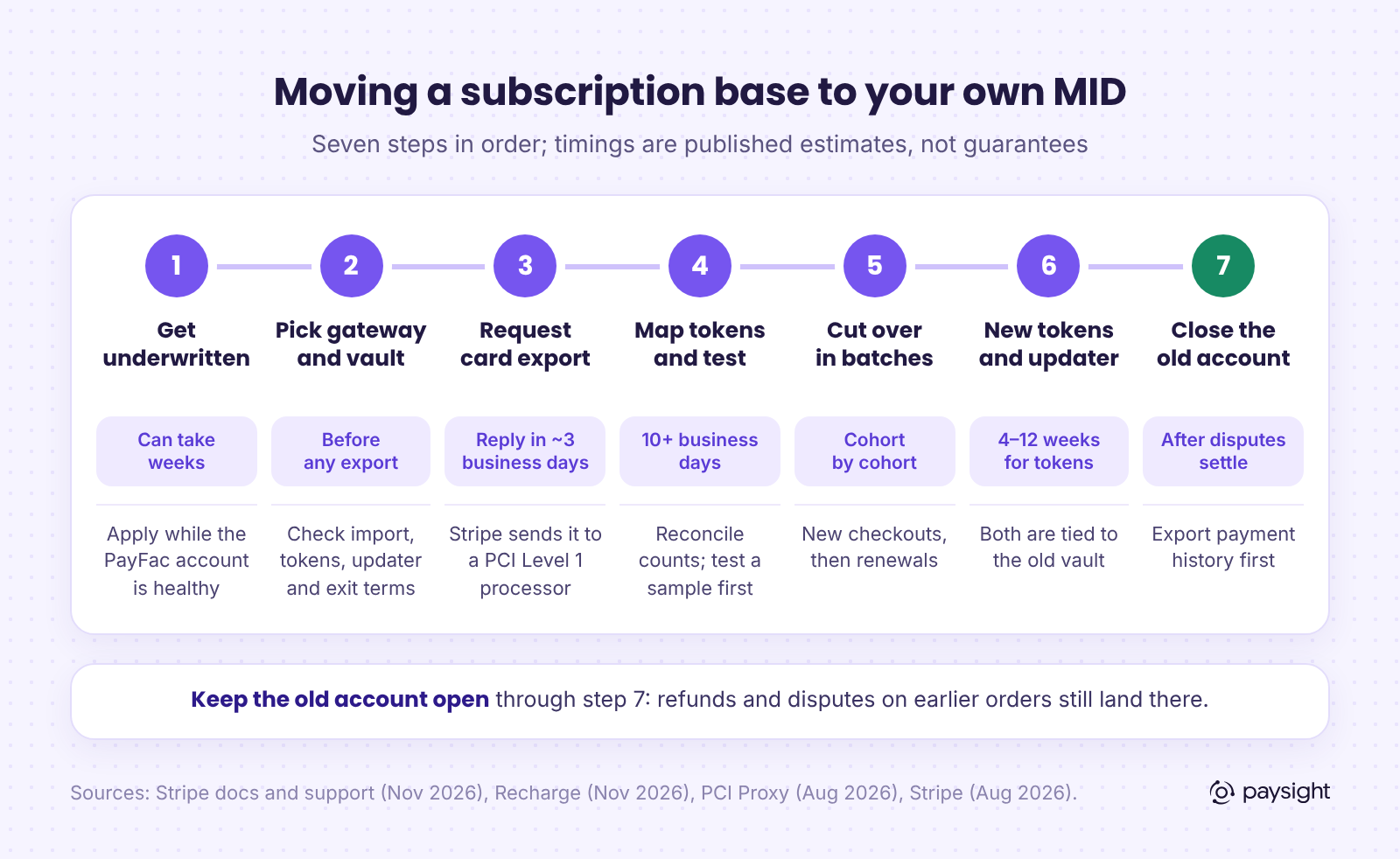
The move is a project, not a switch. Card data, tokens and dispute history each follow their own timeline, so plan it as a sequence and keep the old account running until the last renewal has moved.
Step 1: Get underwritten before you need the account
Apply while your PayFac account is healthy. Acquirers ask for processing statements, and three to six clean months on Stripe or Shopify Payments are your best evidence. Agree the reserve, payout schedule and any volume caps in writing.
Step 2: Pick a gateway and decide where the vault lives
Your MID needs a gateway. Check that it can receive an encrypted card import, that it supports network tokens and an account updater, and that it will export cards again if you ever leave. That last check is the one brands skip the first time.
Step 3: Request the card export
From Stripe, the receiving processor must show a current PCI Attestation of Compliance or a listing on Visa's Global Registry of Service Providers, and provide a PGP key of at least 4,096 bits. Stripe then prepares an encrypted JSON file and arranges a secure transfer. Requests go through a support form, and Stripe says it follows up "within the next three business days" (Stripe Support). Two exclusions matter: Stripe "doesn't export your account's payment history, subscriptions, or other objects", and cards saved through Link are left out.
Step 4: Map old tokens to new ones and test
The new gateway returns a file that maps each old customer or card ID to a new token. Your subscription platform uses it to repoint every subscription. Recharge, for example, says to expect at least 10 business days for this kind of gateway transfer, and to avoid manual charges or refunds on existing customers while it runs (Recharge). Reconcile counts against the source vault and test a sample before any live renewal moves.
Step 5: Cut over renewals in batches
Move new checkouts first, then renewals by cohort, and watch approval rates per batch. Your statement descriptor will likely change with the new MID, so tell subscribers what the charge will look like. An unfamiliar descriptor is a classic cause of "I don't recognise this" disputes.
Step 6: Re-enrol network tokens and the account updater
Network tokens belong to a token requestor, so tokens your PayFac requested usually don't come with you; the new gateway re-tokenizes from card numbers. PCI Proxy puts scheme-level token relinking at "four to twelve weeks once the paperwork starts moving", and notes that the old provider's account updater was "tied to its own vault" (PCI Proxy, August 2026). Our guide to network tokens for subscriptions explains why this affects approval rates.
Step 7: Keep the old account open, then close it
Refunds and disputes on old orders still land on the old account for months. Stripe says you can keep using its Dashboard and API after you stop processing "as long as you don't close or delete your account". Export your payment history before you close anything, since it does not travel with the card file.
What doesn't move with your cards
Where Paysight fits
Paysight is not a payment processor or an acquirer, and it does not underwrite merchant accounts or hold funds. Your MID still comes from an acquirer, and your approval still depends on your own underwriting file. Paysight is a platform to launch and manage subscriptions on the gateways and merchant accounts you connect, such as Stripe, NMI and Finix.
That matters for this decision in three ways:
- Your subscriptions sit above the gateway. With Paysight Payment Orchestration, you can keep Stripe connected while you add your own MID, and set routing rules plus cascading and retries across the gateways you connect. Its connectivity covers tokenization and network tokens, card updater services and 3DS tools.
- One record through the move. Paysight Payment CRM keeps transactions, subscriptions and customers in one place, so renewals, refunds and decline reasons stay visible on both the old and new account during the cutover.
- Fewer cards lost after the switch. Paysight's Card Account Updater refreshes expired and reissued cards before the next billing attempt.
Multiple gateways are for redundancy and approval rates. They are not a way to spread disputes or fraud across MIDs, and acquirers treat that kind of load balancing as a violation. If you are planning a move, talk to our team about which gateway connections fit your setup.
Sources
- Visa: Visa Acceptance Entities (February 2024)
- Visa: The Visa Payment Facilitator Model (February 2024)
- Digital Transactions: MasterCard sub-merchants don't need to own accounts until volume hits $1 million (November 2014)
- Stripe: Payment processor vs payment facilitator (updated August 2026)
- Stripe: Pricing (checked November 2026)
- Stripe: Rolling reserves 101 (August 2024)
- Merchant Maverick: The complete guide to rolling reserves (September 2025)
- Qualimero: Shopify transaction fees in 2026 (updated July 2026)
- NerdWallet: Shopify pricing and plans 2026 (March 2026)
- Stripe Docs: Request a payment data export (checked November 2026)
- Stripe Support: Request a data migration (checked November 2026)
- Shopify Community: Transferring customer payment data off Shopify Payments (July 2022 to February 2026)
- Recharge: Consolidating legacy payment gateways before migrating existing subscribers (checked November 2026)
- PCI Proxy: What happens to stored cards when you switch PSP? (August 2026)
- Paysight: Payment Orchestration (checked November 2026)
A payment facilitator such as Stripe or Shopify Payments signs you up as a sub-merchant under its own relationship with an acquirer, so it underwrites you with its own risk model and sets your holds and reserves. With a dedicated merchant account, the acquirer underwrites your business directly and issues you your own MID, with reserves and payout terms written into your agreement.
No. Visa and Mastercard both use a US$1 million annual volume line for sub-merchants, but above it the acquirer must be added to your merchant agreement. Visa says sponsored merchants above the line can keep the facilitator relationship for acceptance and settlement. The line is a good moment to evaluate your setup, not a deadline to move.
From Stripe, yes: it transfers card numbers, expiry dates and billing addresses to another PCI DSS Level 1 processor on request, as an encrypted file. It does not export payment history, subscriptions or cards saved through Link. Shopify support has told merchants it cannot transfer payment details off Shopify Payments, so check the route before you plan a move.
Plan for weeks, not days. Underwriting with an acquirer can take weeks, Stripe replies to card export requests within about three business days, and subscription platforms such as Recharge quote at least 10 business days for a gateway transfer. Network token relinking can take four to twelve weeks. Keep the old account open for refunds and disputes until every renewal has moved.
Often, at higher volumes, because dedicated accounts are usually priced as interchange-plus or a negotiated rate. But Stripe also offers IC+ pricing and volume discounts on custom plans, and Shopify adds a 0.2% to 2% fee when you use a third-party provider in its checkout. Compare written quotes against your PayFac's custom offer before you decide on price alone.
No. Paysight is not a payment processor or acquirer and does not underwrite accounts or hold funds. It is a platform to launch and manage subscriptions on the gateways and merchant accounts you connect, such as Stripe, NMI and Finix. Paysight Payment Orchestration lets you keep Stripe connected while you add your own MID, with routing, cascading and retries across those gateways, and Payment CRM keeps transactions and subscriptions in one record during the move.








Company Reg. No. 760371
VAT No. IE4280069RH


