


The most frustrating chargeback a subscription brand gets is the one coded as fraud by a customer who has paid you happily for months. The card is the same, the delivery address is the same, the login is the same. Then a renewal shows up on a statement, the customer doesn't recognise it, and the bank files it as "card-absent fraud".
Before April 2023, fighting that dispute meant assembling evidence and hoping the issuer accepted it. Visa's Compelling Evidence 3.0 (CE 3.0) replaced the guesswork with a rule: if you can show at least two earlier undisputed purchases on the same card with matching customer data, liability moves back to the issuer and the fraud report is removed.
Subscription businesses hit specific gaps in the rule: renewals charged without the customer present carry no IP address, the history window rules out new and annual subscribers, and many renewal disputes aren't coded as fraud at all. This guide covers the rules as of November 2026, where subscription brands fall short, and the data to capture so more of your disputes qualify.
Key takeaways
- CE 3.0 applies to one Visa dispute condition only: 10.4, Other Fraud – Card-Absent Environment. It does not help with "cancelled recurring" or "not as described" disputes.
- To qualify you need at least two undisputed transactions on the same card from 120 to 365 days before the dispute, matching on at least two of four data elements, one of which must be the IP address or a device ID/fingerprint.
- Renewals can qualify. For merchant-initiated renewals, Visa lets you use the data captured when the customer signed up, so store that data and link it to every renewal.
- A monthly subscriber usually has enough qualifying history by the sixth charge. An annual-only subscriber rarely does on your history alone.
- A successful CE 3.0 case removes the fraud report (TC40), and Visa's VAMP ratio excludes fraud reports that qualify for CE 3.0. Since 17 April 2026, Visa charges a fee for successful qualifications.
- Mastercard's closest equivalent is the First-Party Trust program, live in the US since 2024 and reaching Europe in July 2027.
What Compelling Evidence 3.0 is
Compelling Evidence 3.0 is a Visa rule for one dispute condition: 10.4, Other Fraud – Card-Absent Environment. It took effect for pre-arbitration attempts processed on or after 15 April 2023, applies to all Visa issuers globally and to every merchant category code VisaNet supports, according to Visa's merchant FAQ and Verifi.
The idea is simple. If a cardholder says "I didn't make this purchase", but the same card has bought from you before without any fraud claim, from the same device or IP address and the same account, the "fraud" is very likely first-party misuse: a purchase the cardholder made, or a renewal they agreed to, and later disputed. When your evidence meets the rule, the issuer can no longer push the loss back to you, and the related fraud report (TC40) is removed.
The scale is real. Visa processed 106 million disputes in 2025, up 35% since 2019, according to its April 2026 press release. Visa estimates first-party misuse at around 20% of fraudulent disputes globally, and up to 30% for high-volume online merchants (Visa, citing its 2025 eCommerce Payments & Fraud Report). For subscription brands, a large share of those disputes are renewals the customer forgot about.
The qualification rules
Every CE 3.0 case is checked against the same criteria. The table summarises them as Visa's FAQ states them, with the notes that matter for subscriptions.
Two details trip teams up. First, device ID and device fingerprint together do not count as two separate matches; Stripe states that this combination "isn't a valid evidence combination" (Stripe docs). Second, sources disagree on the edge of the window: Visa's FAQ says up to 365 days, while Stripe's documentation says 120 to 364 days. Don't build your process on the last day of the window.
Email is another grey area. Stripe accepts email as a "secondary" element alongside shipping address and account ID, while Chargebacks911 wrote in November 2026 that "email address and phone number no longer count" under the current rules (Chargebacks911). Visa's own FAQ lists only the four elements above. Collect email anyway, but don't rely on it as one of your two matches.
How renewals qualify, and when they can't yet
CE 3.0 is available for recurring transactions. Visa's FAQ says that for merchant-initiated recurring charges, the IP address from the first customer-initiated transaction can be used, and that the merchant must provide the data elements from the initial setup for both the earlier transactions and the disputed one. In practice: the IP address, device data and account ID you captured at checkout follow every renewal of that subscription, as long as you stored them and can link them to each charge.
The harder limit is time. Two charges have to be more than 120 days old on the day the dispute is processed, and no more than 365 days old. For a monthly subscription that means the first renewals can't be defended with CE 3.0, however clean the history.
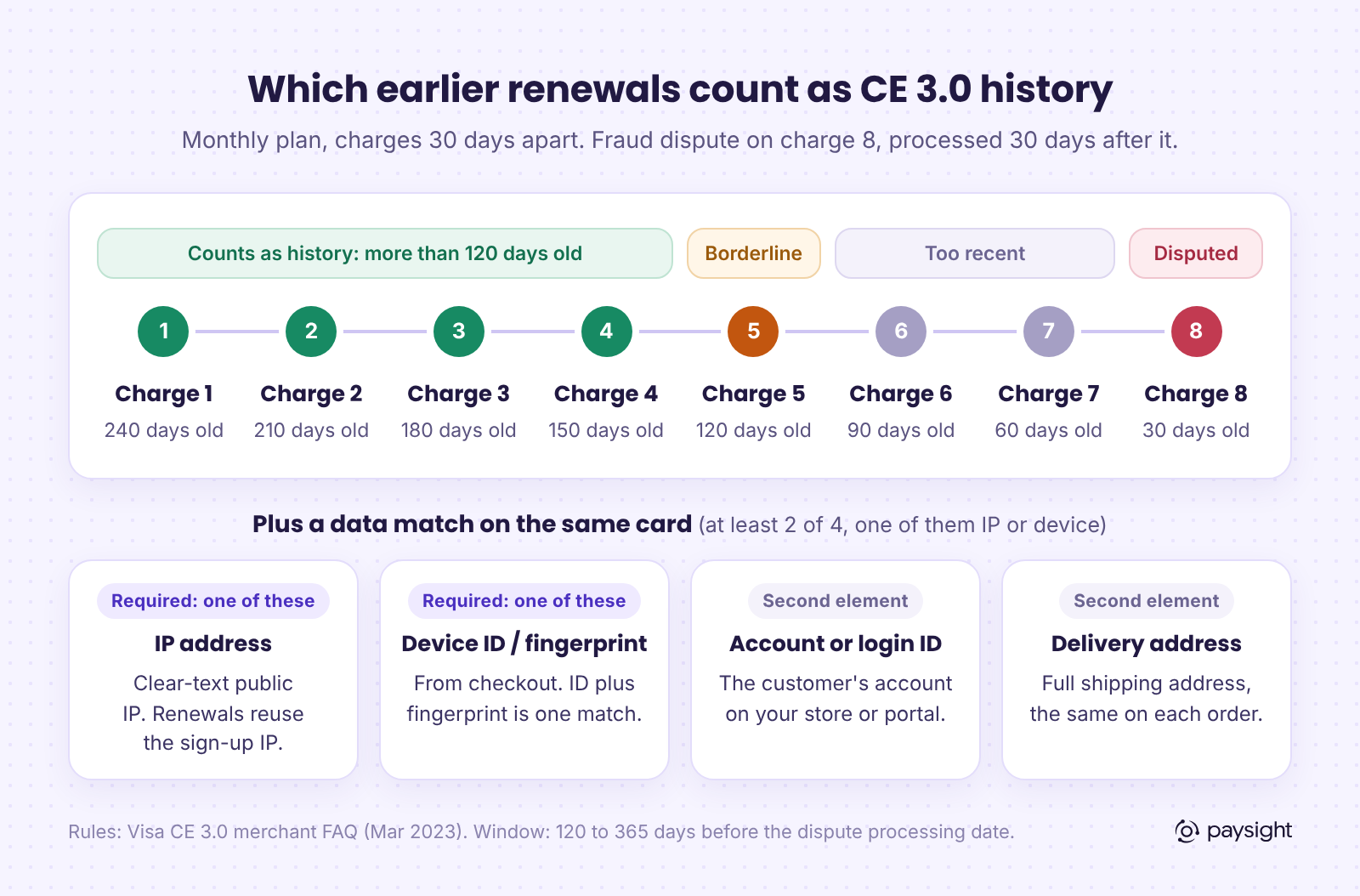
Assuming 30-day billing months and a dispute processed about 30 days after the charge (it varies by issuer and customer), this is when each billing cadence first has two charges inside the window:
This is also why first-renewal disputes are hard to win: they arrive before any history exists. The work there is prevention, which we cover in the first renewal playbook.
One change helps the gaps above. From 24 October 2026, Visa's rules allow the qualifying history to come from the cardholder's undisputed purchases at other merchants as well, on the same card or a credential linked to it such as a token, according to summaries of the April 2026 Visa Rules by Pulse and Chargeflow. That history sits with Visa, not with you, so it mainly helps on the pre-dispute route described below. The same update limits pre-arbitration: an acquirer may only submit transaction data it accepted and processed itself. We haven't seen Visa's own text of this change, so confirm the details with your acquirer.
Two routes: before the dispute and after it
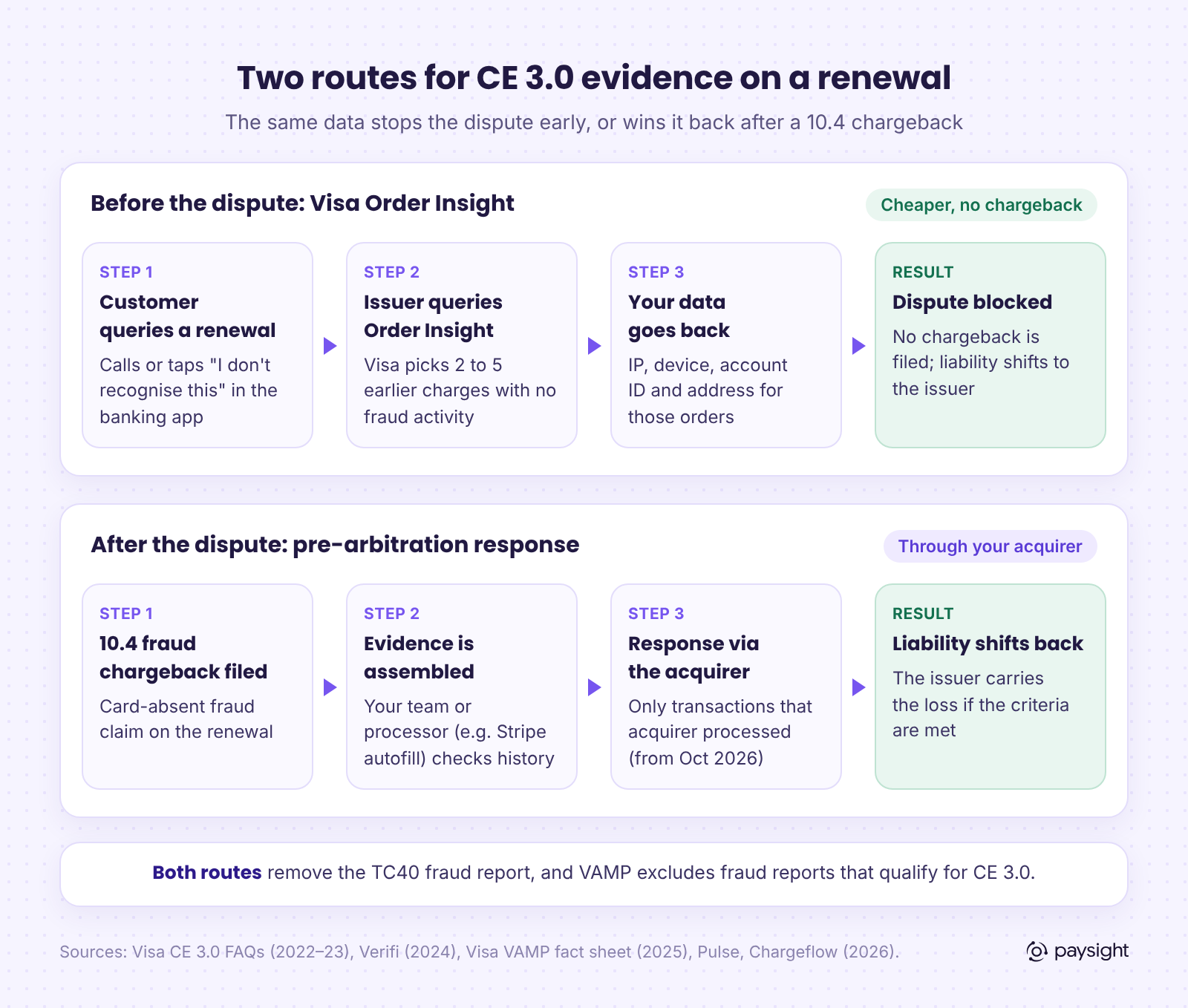
CE 3.0 evidence can reach the issuer at two points, and the cheaper one is earlier.
Before the dispute, through Visa Order Insight. When a cardholder questions a charge, the issuer queries Order Insight (run by Verifi, a Visa company). Visa pre-selects two to five earlier transactions with no fraud activity, and your systems return the data elements for them automatically. If the criteria are met, "the pre-dispute will be blocked and liability for the transaction will shift to the issuer" (Verifi). The dispute never becomes a chargeback and doesn't add to your dispute counts.
After the dispute, in your pre-arbitration response. If a 10.4 chargeback is already filed, the same evidence can be sent through your acquirer in the response. Some processors do this for you: Stripe queries your past transactions and autofills CE 3.0 evidence, and if it doesn't qualify, the evidence goes through the standard dispute flow (Stripe support). Stripe requires that it processed all the earlier transactions itself.
There is a third, narrower route. From 17 October 2025, Visa began automatically qualifying transactions for CE 3.0 through Visa Secure (3-D Secure) in the US region, per Visa's merchant news digest. Renewals charged without the customer present aren't authenticated with 3-D Secure, so this route is unlikely to cover them; it applies to orders where the customer authenticated.
What it costs, and how it affects VAMP
CE 3.0 is not free. Visa announced that "effective 17 April 2026, Visa will introduce an associated fee for successful qualifications" (Visa digest, October 2025). Visa hasn't published the amount; one industry summary reported $6 per dispute closed this way (Verisave, May 2026), and your acquirer passes it through. Order Insight has its own per-inquiry fee, reported at $0.20 from January 2025 (Chargeblast, October 2024), and alert partners may charge on top. Check your acquirer's and provider's price sheets; these are secondary figures.
Against that, a successful case protects your monitoring ratio. Visa's VAMP fact sheet says the ratio "excludes TC 40 fraud qualified for Compelling Evidence 3.0, contingent on the timing of the data extract", and also excludes disputes resolved through pre-dispute solutions (Visa VAMP fact sheet). VAMP counts fraud reports and disputes together, so for a brand close to the threshold, the TC40 removal can matter as much as the money recovered. Our VAMP and ECM guide covers the thresholds.
Mastercard's equivalent: First-Party Trust
Mastercard doesn't have a CE 3.0 rule, but its First-Party Trust program (run with Ethoca) does a similar job. It launched in the US in 2024, expanded to Canada, Latin America and Asia Pacific in June 2025, reached Eastern Europe, the Middle East and Africa in October 2026, and is due "across Europe in July 2027" (Mastercard, 22 October 2026).
The data you capture for CE 3.0 (IP, device, account ID, delivery address, email) covers most of what Mastercard asks for, so one capture plan serves both networks.
A CE 3.0 checklist for subscription operators
- Capture the four elements at sign-up. Public IP address in clear text, a device ID or fingerprint, the customer's account or login ID, and the full delivery address. Add email for Stripe and Mastercard.
- Link sign-up data to every renewal. Each renewal should point to the customer-initiated transaction that set up the subscription, so the data can be returned for it.
- Refresh data when the customer acts. Portal logins, plan changes and one-off orders are customer-initiated, and give you newer IP and device data on the same card.
- Keep data long enough. Verifi asks for data in an operational database for up to 365 days. Because disputes arrive weeks after the charge, keeping 18 to 24 months is a safer working rule (our guidance, not a Visa requirement).
- Connect Order Insight or a provider that does. The pre-dispute route is cheaper than fighting a chargeback, and Visa reports Order Insight deflected 40–45% of confirmed first-party-misuse disputes on average, with some subscription merchants reaching 90% (Visa, Verifi data Oct 2023–Sep 2024).
- Write descriptions customers recognise. Plan name, cadence and your brand, matching the descriptor and the confirmation email.
- Don't stop at fraud codes. CE 3.0 does nothing for 13.2 Cancelled Recurring. For those you need a clear cancellation flow and records (see our automatic renewal laws checklist), plus chargeback alerts for disputes already in motion (see Ethoca vs Verifi CDRN vs RDR).
- Check your history after a gateway change. Processors such as Stripe only use transactions they processed, and acquirers may only submit their own data in pre-arbitration. If you move subscribers to a new gateway, expect fewer qualifying cases there for the first months.
How Resolvo and Paysight help with CE 3.0
Paysight is not a processor or an acquirer: brands connect their own gateways and merchant accounts, and disputes are decided by the card networks and issuers. What Paysight provides is the data and the workflow around them.
Resolvo, Paysight's chargeback product, covers the full dispute timeline in one place: deflection that gives cardholders clearer transaction information before they dispute, real-time Ethoca and Verifi alerts to refund before a chargeback is filed, prevention workflows that include Visa Compelling Evidence 3.0, and recovery and representment for the chargebacks that still get through.
The evidence itself depends on data, and that is where the platform helps. Paysight's Payment CRM keeps customer, subscription and transaction records together across the gateways you connect, and its transaction detail includes session data, address information and subscription details (Paysight docs). That is the link CE 3.0 needs between a renewal and the sign-up that started it. Which CE 3.0 route applies to your setup depends on your acquirers and gateways, so ask our team to map it with you.
Sources
- Visa: Evolution of Compelling Evidence, merchant FAQ (March 2023)
- Visa: Evolution of Compelling Evidence, acquirer FAQ (March 2023)
- Verifi: Compelling Evidence 3.0 (updated May 2024)
- Visa Merchant Business News Digest (October 2025 item: Visa Secure qualification and the April 2026 fee)
- Visa Acquirer Monitoring Program fact sheet (2025)
- Visa press release on dispute volumes (1 April 2026)
- Visa: friendly fraud insights (accessed November 2026)
- Visa: Order Insight (accessed November 2026)
- Stripe docs: Visa Compelling Evidence 3.0 (accessed November 2026)
- Stripe support: how Stripe supports CE 3.0 (accessed November 2026)
- Pulse: the October 2026 multi-merchant change (24 September 2026)
- Chargeflow: Visa Compelling Evidence 3.0 explained (updated 20 October 2026)
- Chargebacks911: Visa Compelling Evidence 3.0 (November 2026)
- Verisave: April 2026 rate and rule changes (6 May 2026)
- Chargeblast: Verifi price changes (17 October 2024)
- Mastercard: First-Party Trust expands to Europe (22 October 2026)
- Mastercard: First-Party Trust program (accessed November 2026)
- Paysight: Resolvo and Paysight docs: transaction detail
Compelling Evidence 3.0 (CE 3.0) is a Visa rule, in effect since April 2023, for card-absent fraud disputes (condition 10.4). If the merchant shows at least two earlier undisputed purchases on the same card, 120 to 365 days before the dispute, with matching customer data, liability shifts back to the issuer and the related fraud report (TC40) is removed.
Only Visa dispute condition 10.4, Other Fraud – Card-Absent Environment. It does not apply to processing errors or consumer disputes such as 13.2 Cancelled Recurring or 13.3 Not as Described. For those, subscription brands need clear cancellation records, recognisable descriptors and chargeback alerts.
Yes. Visa says CE 3.0 is available for recurring transactions. Because merchant-initiated renewals carry no IP address or device data, Visa lets you use the data from the customer-initiated sign-up transaction. That only works if you stored the sign-up IP, device, account and address data and can link it to every renewal.
Two earlier undisputed charges that are more than 120 and no more than 365 days old when the dispute is processed. On a monthly plan, with a dispute processed about 30 days after the charge, that usually means the sixth charge or later. Annual-only subscribers rarely qualify on your own history because the previous charge is about 13 months old.
Yes. Visa's VAMP fact sheet says the ratio excludes TC40 fraud reports that qualify for Compelling Evidence 3.0, depending on when Visa extracts the data, and also excludes disputes resolved through pre-dispute solutions such as Order Insight. Since 17 April 2026 Visa charges a fee for each successful qualification; Visa hasn't published the amount.
Mastercard's closest equivalent is the First-Party Trust program run with Ethoca. It launched in the US in 2024, expanded to Canada, Latin America and Asia Pacific in 2025 and to Eastern Europe, the Middle East and Africa in October 2026, and is due across Europe in July 2027. It asks for a device factor, a delivery factor (which can be email or phone) and a third identity element.
Resolvo, Paysight's chargeback product, includes Visa Compelling Evidence 3.0 in its prevention workflows, alongside deflection, Ethoca and Verifi alerts, and recovery and representment. Paysight itself is not a processor: it keeps customer, subscription and transaction data together across the gateways you connect, which is the data CE 3.0 evidence is built from. Which route applies depends on your acquirers, so our team maps it with you.






Company Reg. No. 760371
VAT No. IE4280069RH


