


Failed payments are not one problem. A mistyped card number, an expired credential, an issuer risk decision, a processor outage, and an unsuccessful subscription renewal can all produce the same result on a dashboard: payment failed. The correct response is different in every case.
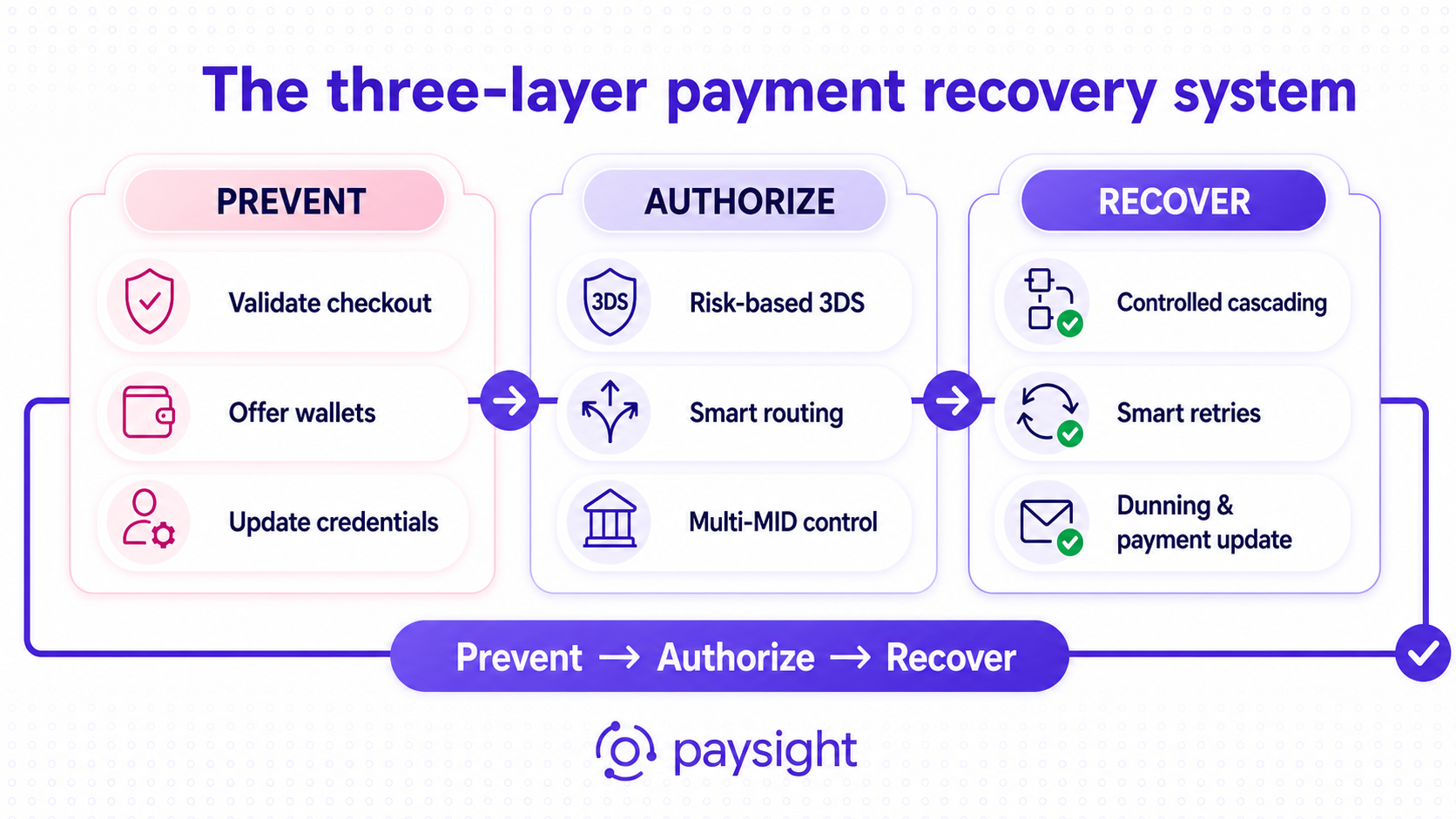
That is why a generic retry schedule rarely solves the whole problem. Reducing failed payments in ecommerce requires a system that prevents avoidable errors before authorization, chooses the right path during authorization, and recovers eligible transactions after a decline.
This guide explains how to build that system. It covers one-time checkout payments and recurring charges, and shows where payment orchestration, card account updating, smart retries, customer communication, and real-time reporting fit together.
Key takeaways
Diagnose before optimizing: separate customer-input errors, credential problems, issuer declines, fraud decisions, and infrastructure failures instead of treating every failure as identical.
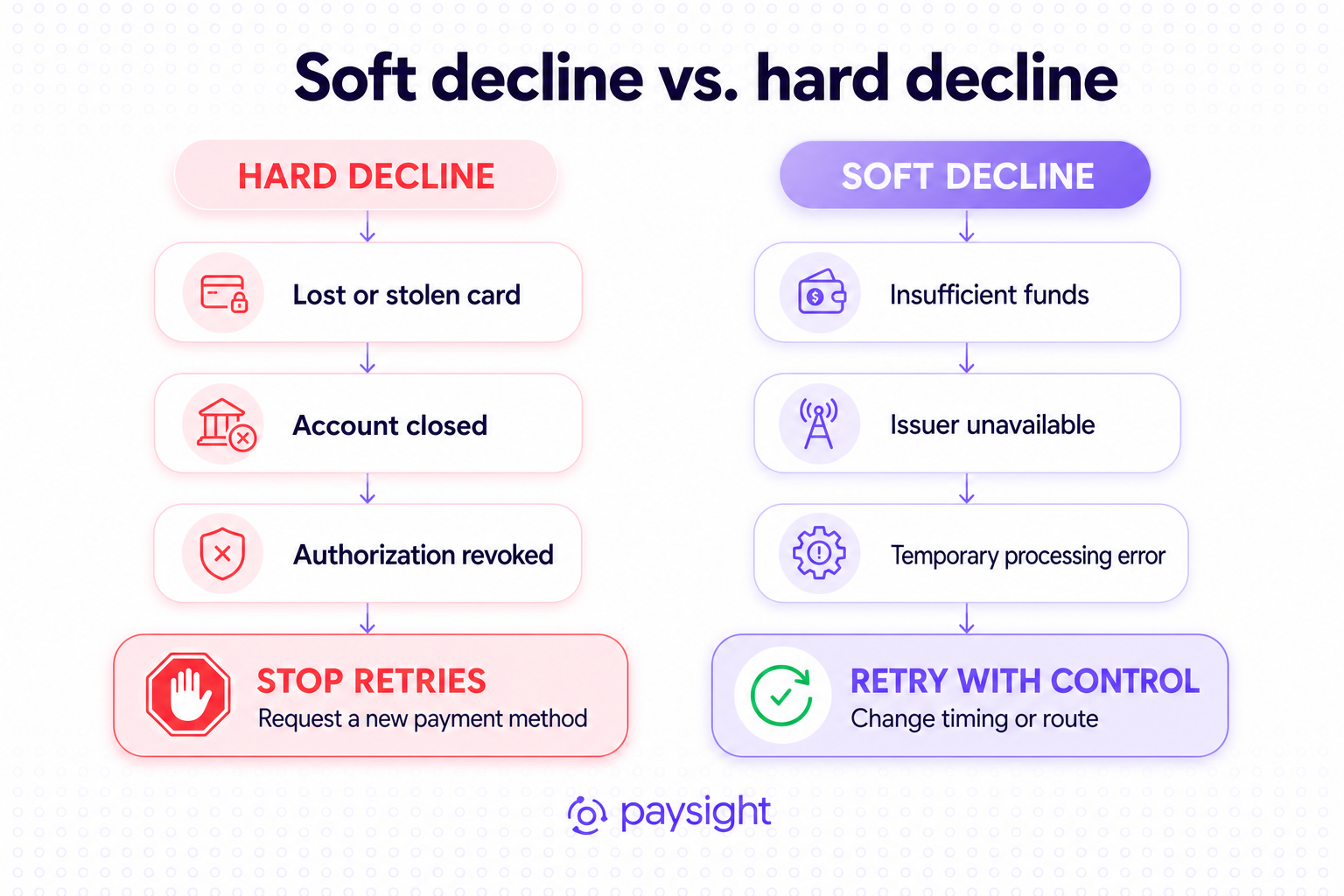
Retry selectively: soft declines may recover with better timing or routing; hard declines normally require a different payment method or customer action.
Protect the full payment lifecycle: checkout improvements prevent some failures, orchestration improves the authorization path, and recovery workflows rescue eligible transactions afterward.
Measure unique payment outcomes, not raw attempts: more retries can make the attempt-level approval rate look worse even while revenue recovery improves.
What is a failed ecommerce payment?
A failed payment is any payment attempt that does not complete successfully. It may be rejected before reaching the issuer, declined by the issuing bank, blocked by a fraud system, interrupted by a technical error, or left incomplete because the customer abandons an authentication step.
A decline is a specific type of failure: an issuer, processor, or risk system actively refuses the authorization. That distinction matters. A malformed request should be fixed, an unavailable processor may justify another route, and an expired card may need updated credentials. None of those situations should be handled like a stolen-card response.
For reporting, keep at least four outcomes separate:
- Checkout or validation failure: the request never becomes a valid authorization.
- Issuer or risk decline: the authorization reaches a decision-maker and is refused.
- Technical failure: a timeout, outage, integration error, or unavailable route prevents completion.
- Customer-action failure: authentication, payment-method selection, or a payment update is not completed.
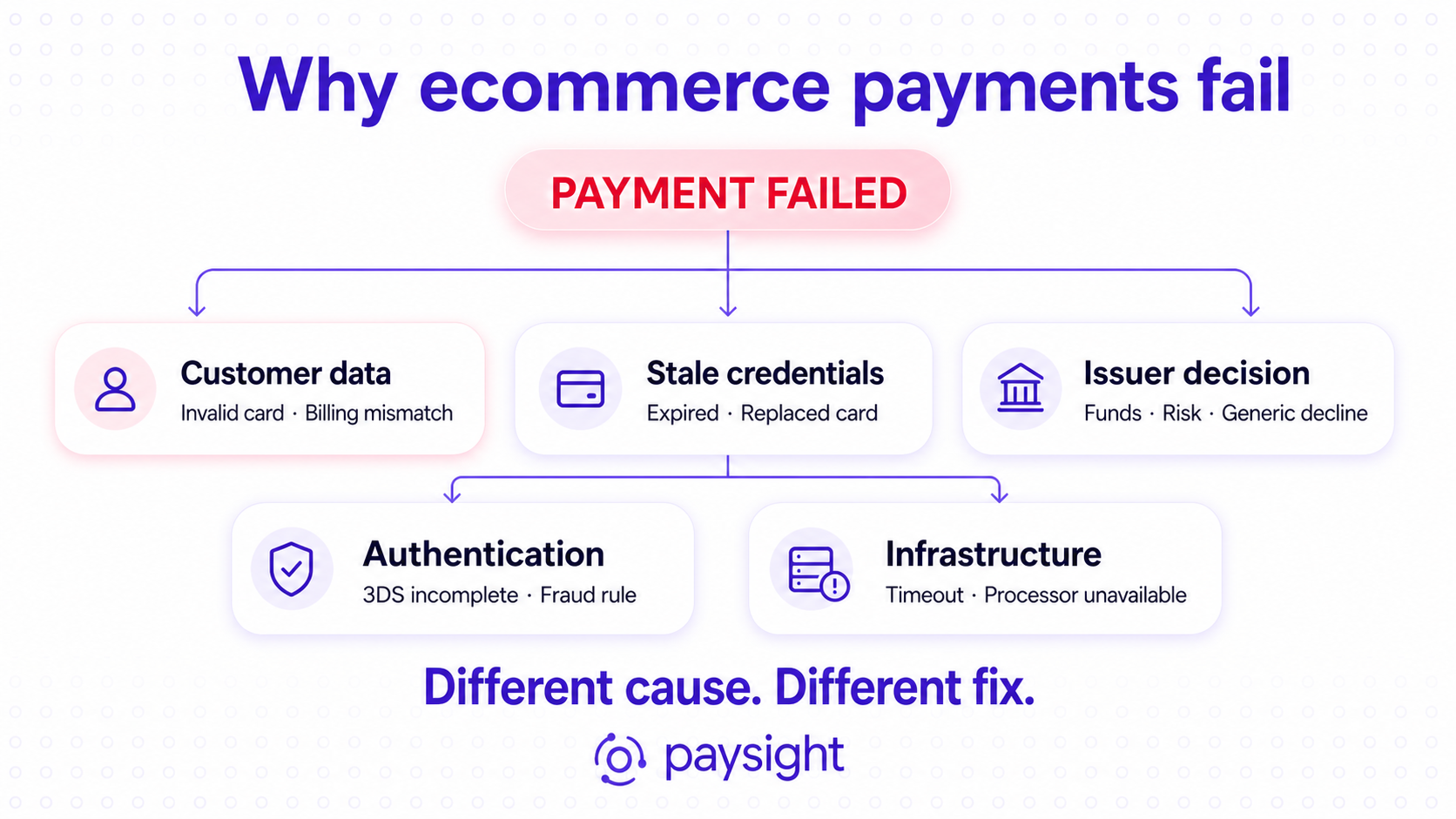
Why ecommerce payments fail
Incorrect or incomplete payment data
Customers mistype card numbers, use an outdated billing address, enter the wrong security code, or leave an authentication flow. These failures are especially visible on mobile, where long forms and unclear errors make recovery harder.
Good checkout design reduces this category, but it cannot eliminate issuer declines or infrastructure problems. Treat checkout optimization as one layer of the system, not the entire payment strategy.
Expired, replaced, or stale credentials
Stored credentials change over time. Cards expire, issuers replace compromised cards, and account numbers may change when portfolios move. This is a structural problem for subscriptions and other credential-on-file businesses because the customer may still want the product while the stored payment credential has silently become invalid.
Visa Account Updater and Mastercard Automatic Billing Updater exist to exchange eligible account changes through participating issuers and acquirers. Network tokens can also keep payment credentials aligned with changes to the underlying card. A card account updater is therefore a prevention tool, not merely a recovery feature.
Temporary issuer declines
Insufficient funds, issuer unavailability, velocity controls, and generic issuer responses can be temporary. These are commonly described as soft declines. A later attempt may succeed, but repeatedly submitting the same request through the same route is not an intelligent recovery strategy.
Timing, transaction context, and processor selection all influence whether another attempt is appropriate. The objective is not to retry more. It is to retry only when the failure is recoverable and to change the condition that caused the first attempt to fail.
Hard declines and restricted transactions
Lost or stolen cards, revoked authorization, closed accounts, and transactions that are not permitted are examples of hard failures. These normally require a new payment method, customer contact, or no further attempt at all.
Processor documentation explicitly distinguishes hard declines that should not be retried automatically. Ignoring that distinction can create unnecessary fees, poor customer experiences, and additional network scrutiny.
Fraud controls and authentication friction
Fraud prevention can stop bad transactions and good customers at the same time. Rules that are too broad may reject legitimate orders, while forcing every shopper through the same authentication challenge adds friction to low-risk purchases.
EMV 3-D Secure supports richer information exchange between merchants and issuers so the issuer can assess the transaction and request additional authentication when needed. The practical goal is risk-based authentication: apply stronger verification where the risk warrants it without treating every customer as suspicious.
Processor, gateway, and routing failures
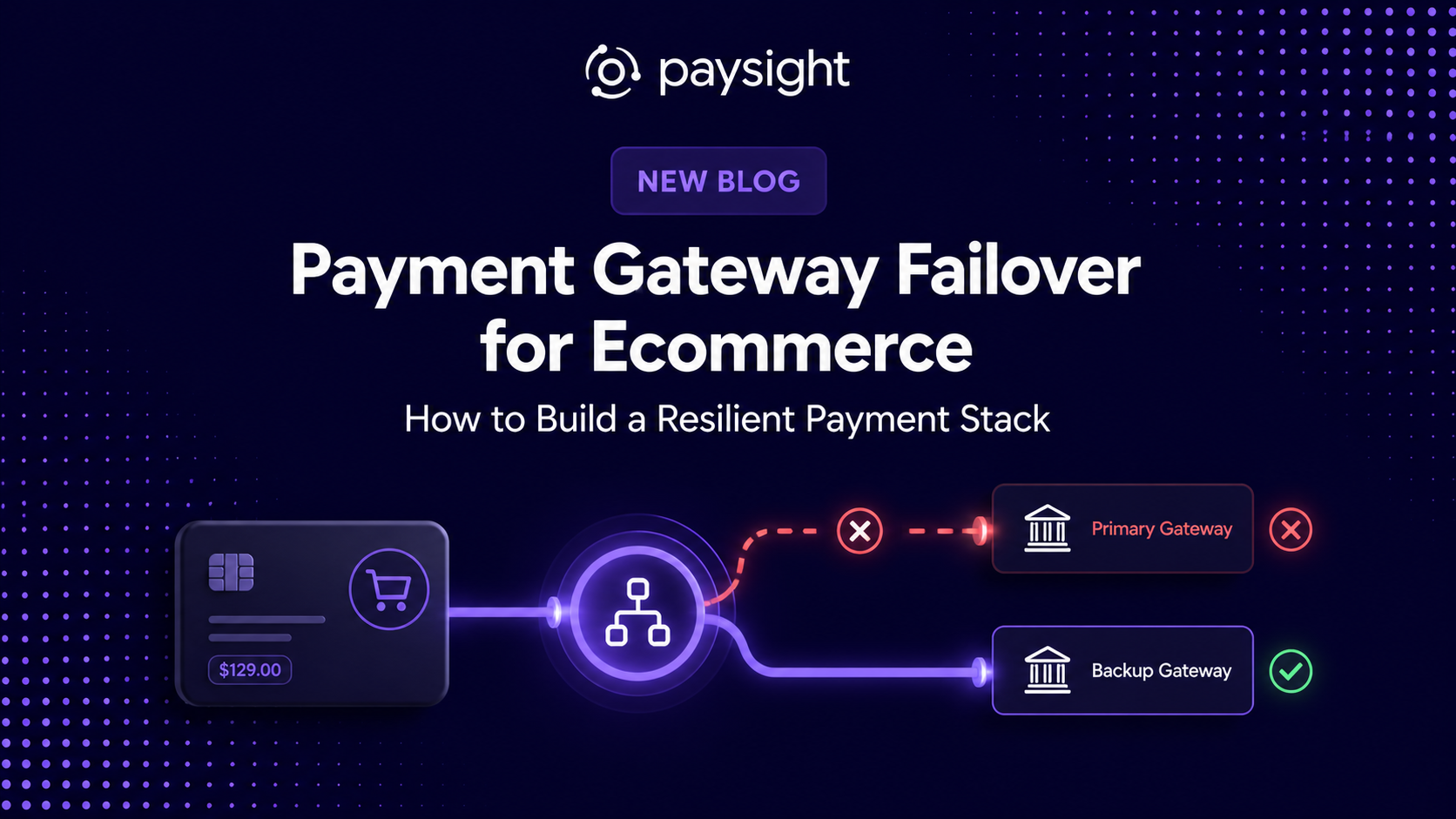
Some payments fail even though the customer and card are valid. A processor may be unavailable, a route may perform poorly for a particular geography or card segment, or an integration may time out. A single-processor setup turns that local problem into a complete dead end.
This is where payment orchestration becomes operational infrastructure rather than a reporting layer. Multiple processors only create resilience when transactions can be routed, cascaded, monitored, and reconciled consistently.
How to reduce failed payments in ecommerce
1. Build a decline taxonomy before changing anything
Start with the data your current stack already returns. Normalize gateway-specific messages into useful operational groups: input error, expired credential, insufficient funds, authentication required, suspected fraud, issuer unavailable, processor error, and hard decline.
Then segment the results by customer-initiated versus merchant-initiated transactions, processor or MID, payment method, country, currency, issuer or BIN range, device, and first attempt versus retry. An overall failure rate can tell you that a problem exists. Segmentation tells you which lever can fix it.
Do not assume every generic response has the same root cause. Compare patterns across routes and cohorts. If one processor underperforms only for a specific region or card segment, the problem may be routing rather than customer quality.
2. Remove preventable checkout errors
Use inline validation, clear field labels, mobile-friendly inputs, and specific recovery messages. If the card number is invalid, say so before submission. If the issuer declines the payment, let the customer try another method without rebuilding the order.
Offer payment methods that match the market and customer context. Wallets can reduce manual data entry because the customer uses a stored credential. Alternative or local methods may provide a valid path when a card is unavailable, but adding every possible method is not automatically better. Prioritize methods your customers actually use and monitor their completion rates.
Keep the payment page fast and preserve the cart after a failure. A customer who has already decided to buy should not lose their order because one authorization did not succeed.
3. Send issuers complete, consistent transaction data
Issuers make decisions using the information they receive. Missing billing data, inconsistent merchant descriptors, incorrect transaction indicators, and weak recurring-payment setup can make a legitimate authorization harder to recognize.
Audit the fields sent by every processor and MID. Confirm that customer-initiated and merchant-initiated transactions are correctly identified, stored-credential consent is recorded, recurring references are preserved, and descriptors remain recognizable. Better data does not guarantee approval, but inconsistent data creates avoidable uncertainty.
4. Use authentication according to risk
Apply 3-D Secure and other verification controls according to regulation, issuer expectations, and transaction risk. A high-risk cross-border order may justify a challenge. A familiar low-risk returning customer may qualify for a smoother path, depending on the applicable rules and issuer decision.
Measure authentication completion separately from authorization approval. If customers abandon the challenge, that is not the same problem as an issuer decline. The fix may be user experience, device compatibility, or authentication configuration rather than routing.
5. Keep stored credentials current
Use card account updater services and network tokens where they are available. Visa describes its updater as a secure exchange of account changes for credential-on-file merchants, while Mastercard recommends regular updater use before authorization and an additional inquiry before retrying certain declined transactions.
For multi-processor environments, check where the updated credential is stored. If a refreshed token exists only inside one processor's vault, another processor may still receive stale data. An orchestration-layer approach can make the updated credential usable across eligible routes rather than locking the benefit to one provider.
6. Route each payment to the best available path
Smart routing uses transaction context and current operating conditions to select an eligible processor or MID. Useful inputs can include geography, currency, BIN, payment method, transaction type, risk profile, cost, capacity, and recent performance.
Routing rules should have explicit priorities and safeguards. A route that improves authorization but violates processor policy, merchant-category restrictions, or regional requirements is not a valid optimization. The goal is controlled resilience: send each transaction through an appropriate path and retain a clear decision trail.
With Paysight payment orchestration, merchants can manage smart routing, MID distribution, processor connectivity, and recovery logic from a common layer.
7. Cascade eligible failures without repeating the same mistake
Cascading sends an eligible failed transaction to another approved route. It is useful when the original failure is related to processor availability, route performance, or another condition that a different path can change.
Do not cascade hard declines, invalid data, suspected stolen cards, or transactions that the customer or issuer has explicitly stopped. Define which response groups are eligible, how many attempts are allowed, which routes can follow, and when customer authentication must occur again.
The recovery path should also prevent duplicate captures. Use idempotency, consistent order identifiers, and reconciliation across processors so a delayed response from the first route cannot create a second successful charge.
8. Use smart retries for recurring payments
Recurring payments need a different recovery policy from a live checkout. The customer is not present, so the system must decide whether and when another attempt is appropriate.
Classify the decline first. For recoverable responses, schedule retries using the failure reason, billing cadence, customer history, local time, and prior attempt outcomes. For hard declines, stop automated retries and request a new payment method. Stripe's billing documentation follows this same principle: recoverable failures may be retried, while specified hard declines require updated payment details before another payment can execute.
Set a retry ceiling and measure marginal recovery by attempt number. If the fourth attempt adds almost no recovered revenue, it may only add cost and customer frustration.
9. Pair retries with dunning and customer choice
Retries work best when customers have a simple way to resolve the underlying problem. Send a clear notification, explain what action is needed, and link directly to a secure payment-update flow. Let the customer choose another eligible method without repeating unrelated checkout steps.
For subscriptions, use a grace period that matches the product. A digital service may preserve limited access while recovery continues; a physical replenishment order may pause fulfillment until payment succeeds. The message, timing, and consequence should be clear.
This is also where subscription-management infrastructure protects more than a single charge. It coordinates retries, customer communication, fulfillment status, and cancellation logic so a temporary payment issue does not become accidental churn.
10. Monitor payment health in real time
A weekly report is too slow for a broken integration or failing processor route. Set alerts for sudden changes in failure rate, authentication abandonment, timeout volume, and approval performance by processor or MID.
Use a unified transaction view so operators can see the original attempt, route decision, decline reason, retry, customer action, and final outcome. Paysight's transaction and decline tooling is designed to centralize that context instead of forcing teams to investigate separate processor dashboards.
What not to do after a payment fails
- Do not retry every decline. Some responses require customer action or must not be retried.
- Do not fire several immediate retries through the same route. Nothing meaningful has changed.
- Do not hide failures inside one blended approval rate. Segment by transaction type, processor, geography, payment method, and attempt number.
- Do not cancel a subscription after the first recoverable failure. Use a defined recovery and communication window.
- Do not add a second processor without reconciliation, routing rules, and duplicate-payment controls.
The metrics that show whether recovery is working
Track payment performance at the order or invoice level as well as the attempt level. More recovery attempts increase the denominator of an attempt-based approval rate, so that metric can fall even while more unique orders are successfully paid.
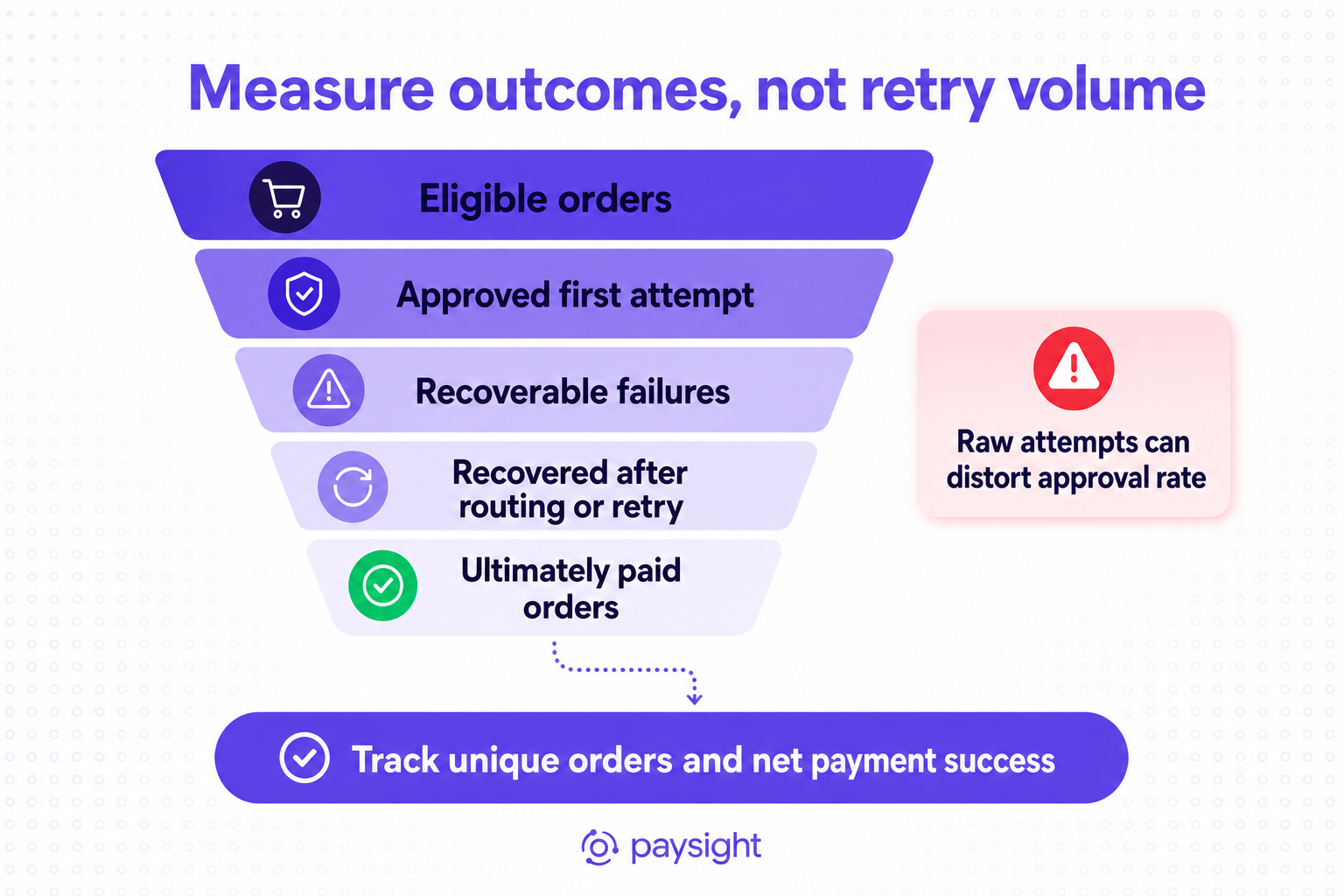
The core operating metrics are:
- First-attempt approval rate: unique payments approved on their first eligible attempt divided by all eligible first attempts.
- Recovery rate: initially failed payments later recovered divided by recoverable failed payments.
- Net payment success rate: unique orders or invoices ultimately paid divided by all eligible orders or invoices.
- Retry efficiency: recovered payments divided by retry attempts, segmented by retry number and decline group.
- Involuntary churn rate: customers lost because payment recovery failed divided by active recurring customers.
- Failure concentration: the share of failures attributable to each processor, MID, decline group, country, payment method, and transaction type.
Review revenue recovered as well as transaction count. Recovering one high-value invoice may matter more than several low-value charges, but high-value retries may also need tighter risk and customer-contact rules.
A 30-day failed-payment improvement plan
Week 1: Establish the baseline
Export recent payment attempts, normalize decline reasons, separate one-time and recurring transactions, and identify the largest failure concentrations. Confirm that the team can trace an order across the initial attempt and every subsequent action.
Week 2: Prevent avoidable failures
Fix checkout validation and error messages, review mobile payment flows, audit stored-credential and recurring indicators, confirm descriptor consistency, and enable appropriate updater or token services.
Week 3: Add controlled recovery
Define eligible cascade responses, routing priorities, retry schedules, maximum attempts, and customer-update flows. Test duplicate protection and reconciliation before moving traffic.
Week 4: Measure and tune
Compare first-attempt approval, recovery, and net payment success by segment. Remove low-value retries, investigate route-specific problems, and establish alerts for sudden operational changes.
How Paysight helps reduce failed payments
Paysight brings the main payment-performance layers into one operating system for ecommerce teams:
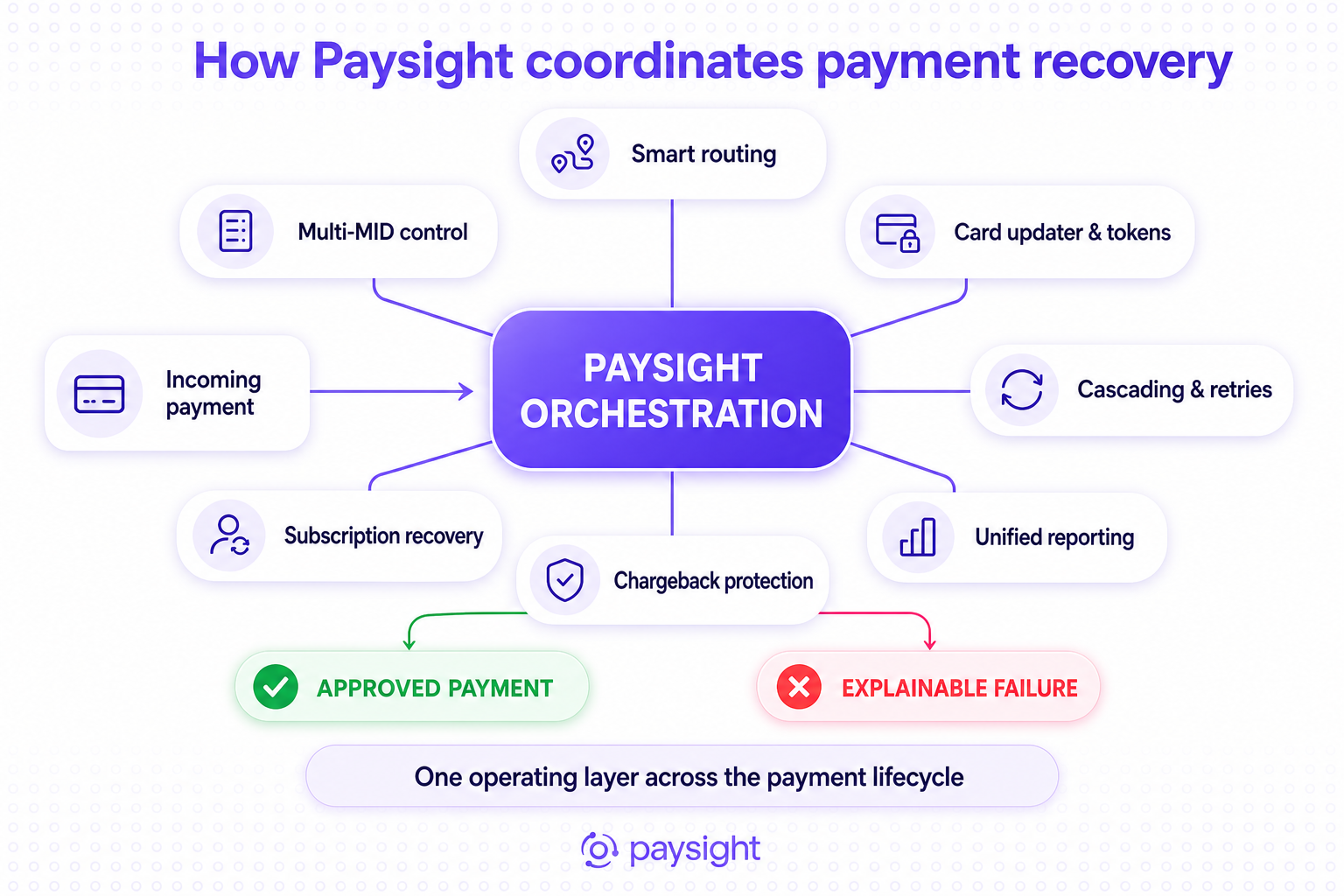
- Smart routing directs transactions across eligible processors and MIDs using merchant-defined logic and real-time conditions.
- Cascading and retry strategies recover appropriate one-time and recurring failures without treating every decline the same way.
- Card updater services and tokenization help keep stored credentials current for recurring and credential-on-file payments.
- Subscription management connects payment recovery with dunning, customer updates, fulfillment, and cancellation logic.
- Unified transaction reporting gives teams one place to investigate declines, route decisions, retries, refunds, and disputes.
- Chargeback alerts and dispute tooling help protect the processing relationships on which authorization performance depends.
The result is not a promise that every declined transaction can be approved. Some payments should fail. The objective is to remove avoidable failures, recover legitimate transactions when the conditions can be improved, and make every outcome explainable.
If you want to understand where your payment failures are concentrated, talk to the Paysight team. We can review your current routes, decline mix, recurring-payment setup, and recovery logic and identify the changes most likely to protect revenue.
The main causes are incorrect payment data, expired or replaced cards, insufficient funds, issuer risk decisions, authentication failures, fraud controls, and processor or integration problems. The mix varies by merchant, geography, payment method, and whether the transaction is one-time or recurring.
A failed payment is any attempt that does not complete. A declined payment is specifically refused by an issuer, processor, or risk system. Timeouts, invalid requests, and abandoned authentication flows are failures but are not necessarily declines.
No. Recoverable soft declines and temporary technical failures may be eligible for another attempt. Hard declines, invalid card details, stolen-card responses, revoked authorization, and transactions that are not permitted generally require customer action or no further retry.
Smart retries classify the failure and choose an appropriate time for another attempt based on factors such as the decline reason, billing cadence, customer history, and previous outcomes. They stop or request new payment details when the failure is not recoverable.
A card account updater obtains eligible account-number or expiration-date changes from participating card networks and issuers. Updating stored credentials before the next charge prevents some recurring and credential-on-file payments from failing because the old card data is stale.
It can, when the processors are connected through controlled routing, cascading, reconciliation, and duplicate-payment protection. Simply adding another processor does not improve outcomes unless the system knows which transactions are eligible for each route and how to recover failures safely.
Paysight combines smart routing, multi-MID management, cascading and retry logic, card updater connectivity, subscription management, and unified transaction reporting. This lets ecommerce teams prevent avoidable failures, recover eligible transactions, and investigate payment performance from a common operating layer.
.png)


.svg)







Company Reg. No. 760371
VAT No. IE4280069RH


