


A customer reaches checkout, submits a valid payment method, and intends to buy. If the transaction is declined, the revenue is lost at the last possible moment - after the business has already paid to acquire the visitor, merchandise the product, and operate the checkout.
That makes payment approval rate one of the most direct revenue metrics in ecommerce. A one-percentage-point improvement means one more approved payment for every 100 attempts, before any change in traffic or conversion earlier in the funnel. But improving the number is not as simple as retrying every decline or loosening fraud rules.
Different failures require different actions. Incorrect card data should be corrected. An authentication-required response needs an authentication flow. An expired credential may need an account updater or a new payment method. A temporary issuer or processing problem may justify a controlled retry. A hard decline should stop. A route-specific failure may be recoverable through another eligible processor or merchant account.
This guide explains seven practical ways to improve ecommerce payment approval rates, with a decline-aware framework for deciding what to prevent, retry, reroute, or return to the customer.
Key takeaways
- Track first-attempt approval, eventual approval, and unique-order conversion separately. A retry can improve recovery while making an attempt-based rate look worse.
- Normalize decline responses into operational categories. Raw processor codes are useful evidence, but the category and next eligible action are what teams need.
- Improve the authorization request before adding retries. Accurate data, appropriate authentication, current credentials, local payment options, and suitable routing prevent avoidable declines.
- Do not retry every failure. Hard declines, invalid credentials, fraud signals, and stop-advice responses require a different payment method or no further attempt.
- Treat payment optimization as a controlled system. Measure approval together with fraud, chargebacks, duplicate attempts, processing cost, and customer experience.
What is an ecommerce payment approval rate?
Payment approval rate is the percentage of submitted payment attempts that receive an approval. At its simplest:
Approved payment attempts / total submitted payment attempts x 100
If 9,000 of 10,000 submitted attempts are approved, the attempt-based approval rate is 90%. If the average order value is $75, one percentage point represents 100 additional approved attempts and $7,500 in gross sales for that period, assuming each added approval corresponds to a valid order and no later reversal.
The formula is easy. The denominator is not. A store that retries the same order three times can report a different rate from a store that counts each order once, even if both ultimately collect the same revenue. Fraud-screened attempts, 3D Secure failures, technical timeouts, and duplicate submissions may also be included or excluded differently across providers.
Use first-attempt approval to evaluate the initial payment path. Use eventual approval to understand recovery. Use unique-order conversion to connect payment performance to commercial outcomes. Then reconcile approved payments to captured and settled revenue so authorizations do not become an inflated success metric.
There is no universal approval-rate target that is meaningful without context. Results vary by country, issuer, card type, business model, transaction type, risk profile, customer mix, and whether the metric is deduplicated. Visa reports that ecommerce approval rates trail in-person transactions in its cited data, which is a useful reminder that card-not-present payments carry different data and fraud challenges. Benchmark against comparable traffic and your own historical cohorts rather than a generic number.
Start with decline rates, not one blended approval number
An overall rate tells you how much is failing. It does not tell you what to change.
Segment payment performance by processor, MID, issuer or BIN range, card brand, country, currency, device, payment method, transaction type, amount band, first purchase versus renewal, and first attempt versus recovery attempt. A stable blended rate can hide a serious decline spike in one country or on one processor because higher-performing traffic elsewhere offsets it.
Decline rate is the inverse view of approval rate, but it becomes actionable only after classification. Processor messages often normalize issuer responses differently. Some results are precise, while others - such as a generic decline or do-not-honor response - provide limited detail. Stripe's decline-code documentation illustrates how responses can range from incorrect card data and insufficient funds to authentication requirements, suspected fraud, expired credentials, and unknown issuer decisions.
The categories are operational, not absolute. A single raw code may need additional context, network advice, transaction history, or processor-specific interpretation. The important design choice is to preserve the original response while adding a normalized category and an allowed next action.
1. Measure the right approval rates
Before changing the payment stack, make the metric trustworthy.
Start by separating customer-initiated payments from recurring merchant-initiated transactions. Separate first attempts from retries and cascades. Deduplicate attempts that belong to the same order or invoice. Exclude test traffic and clearly identify technical requests that never reached an issuer.
At minimum, monitor:
- First-attempt approval rate
- Eventual approval rate after eligible recovery
- Unique-order payment conversion
- Soft-decline and hard-decline rates
- Authentication completion and post-authentication approval
- Approval by processor, MID, issuer geography, card type, currency, and transaction model
- Recovery rate by retry number and recovery method
- Capture, settlement, refund, and chargeback outcomes
For example, imagine 1,000 orders create 1,150 authorization attempts. Nine hundred orders are approved on the first attempt, 30 more are recovered, and 70 are never approved. The first-attempt approval rate is 90%. Eventual unique-order approval is 93%. Attempt-based approval across all attempts may be only about 81%, depending on the exact successful-attempt count. None of those numbers is inherently wrong; they answer different questions.
Payment optimization becomes dangerous when a team celebrates a higher eventual approval rate without noticing that duplicate attempts, fraud losses, or chargebacks also increased. Every approval-rate dashboard should sit beside guardrail metrics.
2. Send complete, consistent authorization data
Issuers make decisions using the transaction context they receive. Missing, contradictory, or incorrectly formatted data can reduce confidence in an otherwise legitimate payment.
Validate card fields and billing information before submission. Pass the correct transaction type and stored-credential indicators. Keep merchant descriptors, merchant category data, currency, amount, customer-initiated versus merchant-initiated status, and recurring-payment references consistent with the actual purchase. Preserve prior network transaction references when required for subsequent transactions.
Richer data does not mean copying every customer attribute into an authorization request. It means sending the relevant fields supported by the processor, network, and regulatory context, accurately and consistently. Visa's Digital Commerce Authentication Program describes the authorization value of enhanced ecommerce data sharing. The principle is straightforward: better context can help the issuer distinguish a valid customer from a risky transaction.
Data quality should be measured as an operational metric. Track missing postal codes where applicable, malformed addresses, inconsistent country and currency combinations, missing stored-credential indicators, and configuration errors by integration version.
3. Tune fraud controls and authentication together
Fraud prevention and approval optimization are not opposing goals. Poorly tuned controls can block good customers, while weak controls may increase fraud, disputes, and issuer distrust.
Review fraud-rule declines separately from issuer declines. Measure false-positive indicators by rule, customer cohort, device, geography, product, and order value. Replace broad static blocks with layered decisions where appropriate: allow, review, authenticate, request more information, or decline.
Use 3D Secure and other authentication tools according to market, issuer, transaction risk, and regulatory requirements. Authentication is not successful merely because a challenge was displayed. Track the full funnel: eligibility, frictionless result, challenge rate, challenge completion, technical failure, and authorization after authentication.
Visa's authentication guidance recommends monitoring authorization, tokenization, soft declines, false positives, and frictionless versus challenged flows together. That combined view prevents a common mistake: increasing challenges so aggressively that fraud falls but good-customer conversion deteriorates.
When the issuer says authentication is required, sending the same unauthenticated payment again is not a recovery strategy. The next action is to complete the appropriate authentication flow or return the customer to an on-session experience.
4. Keep stored credentials current
Expired and replaced cards are a major source of avoidable failure for subscriptions and repeat purchases. The customer may still want the service, but the credential stored months earlier is no longer valid.
Card account updater services can retrieve eligible changes such as a new expiry date or replacement account information. Network tokens can remain aligned with underlying credential lifecycle changes and reduce dependence on static card details. Stripe's payments-optimization documentation describes account updater and network-token recovery as distinct authorization tools.
The operational details matter:
- Run updater coverage before the renewal date where the service permits it.
- Distinguish an updated credential from a customer-supplied new payment method.
- Preserve the authorization and stored-credential references required for later merchant-initiated transactions.
- Measure approval for updated, tokenized, and unchanged credentials separately.
- Do not keep retrying an invalid or revoked credential while waiting for an update that may never arrive.
A card updater is not a substitute for dunning. When no valid update exists, the customer needs a clear, secure path to replace the payment method.
5. Localize the payment path
Cross-border payments can fail because the route, currency, payment method, or acquiring setup does not match local customer and issuer expectations.
Offer payment methods that customers in the market actually use. Present supported currencies accurately. Route through eligible local or regional acquiring relationships when that improves issuer familiarity and complies with the merchant's contracts, entities, and underwriting scope.
Localization is not a blanket instruction to add every payment method. Measure checkout share, approval, cost, refund behavior, settlement timing, and operational complexity for each method. A local method with strong approval can improve conversion, but only if reconciliation, customer support, refunds, and risk processes are ready for it.
Segment cross-border and domestic performance. If one country has a high issuer-decline rate, compare local cards, international cards, wallets, and processors before changing the global checkout. The problem may be concentrated in one route rather than in the customer experience as a whole.
6. Route payments across suitable processors and MIDs
One processor is rarely the best route for every issuer, geography, currency, card type, transaction model, and risk profile. Payment orchestration creates a control layer that can choose among eligible processors and merchant accounts based on rules, performance, cost, and operational constraints.
Smart routing begins with eligibility. A route must support the market, payment method, currency, transaction type, authentication state, product category, and merchant agreement. Only then should performance influence the decision.
Use routing to solve specific patterns:
- Send domestic traffic to an eligible local acquirer.
- Preserve a route that has strong issuer performance for a defined cohort.
- Move traffic away from a degraded connection or capacity-constrained MID.
- Route recurring transactions only to processors configured for stored credentials.
- Keep high-risk or specially underwritten products within approved merchant accounts.
Paysight's payment orchestration platform supports routing by rules and real-time conditions, MID distribution, and recovery across payment routes. The purpose is not to spray the same transaction across every processor. It is to give each eligible payment a controlled path and maintain visibility across the complete attempt history.
Routing performance should be evaluated using comparable cohorts. If processor A receives familiar domestic traffic while processor B receives the hardest cross-border attempts, their raw approval rates are not directly comparable. Use controlled traffic allocation or cohort-adjusted analysis before declaring a winner.
7. Recover declines with the right action - not the same retry
Recovery is where decline intelligence becomes operational. The next step should be determined by the reason for failure, the payment context, and the advice returned by the issuer or network.
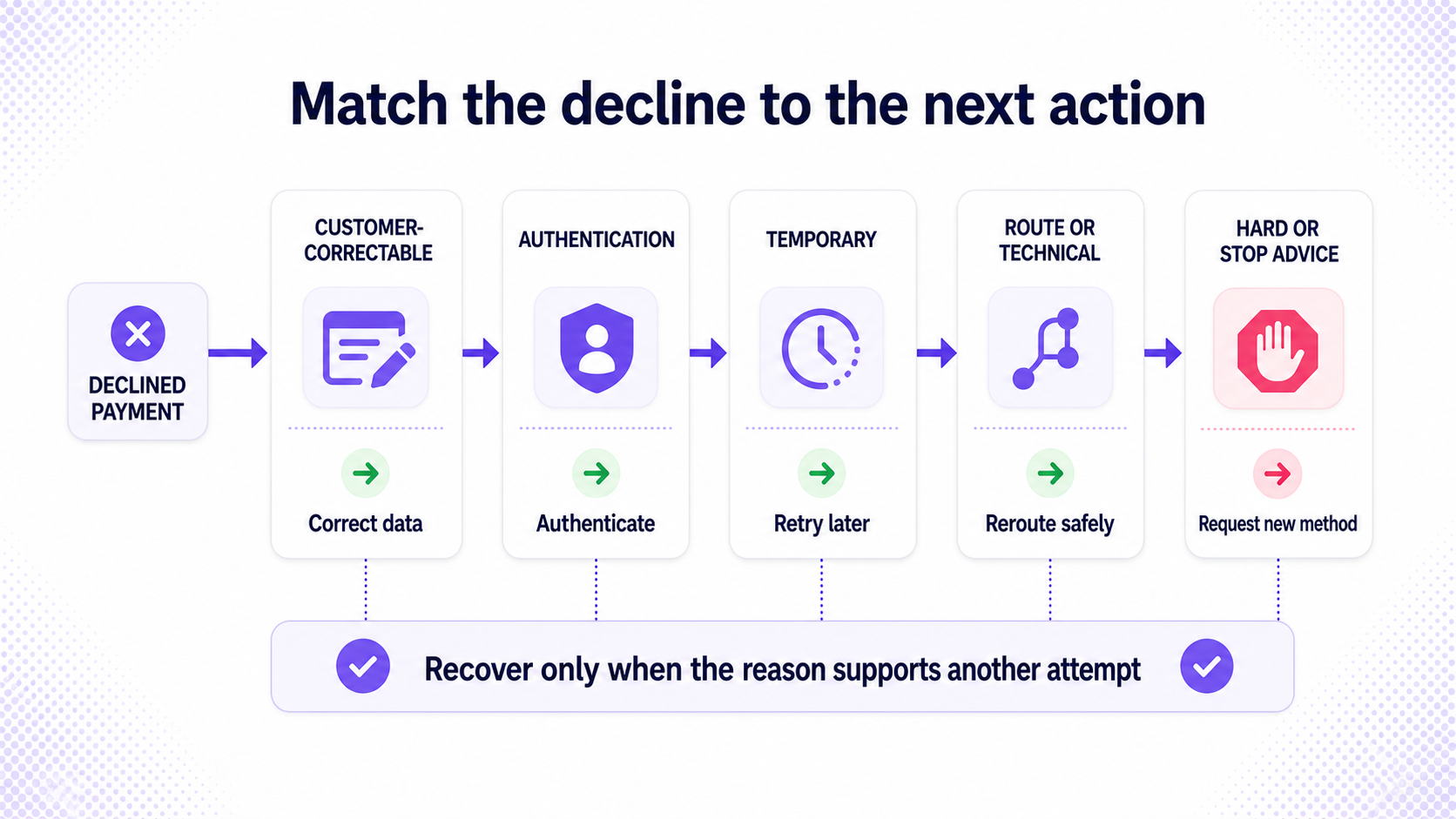
A useful policy distinguishes at least five actions:
- Correct and resubmit. Use when the customer can repair invalid card, expiry, CVC, postal, or billing information.
- Authenticate and resubmit. Use when the issuer requires authentication and the transaction is eligible for an authentication flow.
- Retry later. Use for temporary or recoverable responses when network advice, processor guidance, and retry limits allow another attempt after an appropriate interval.
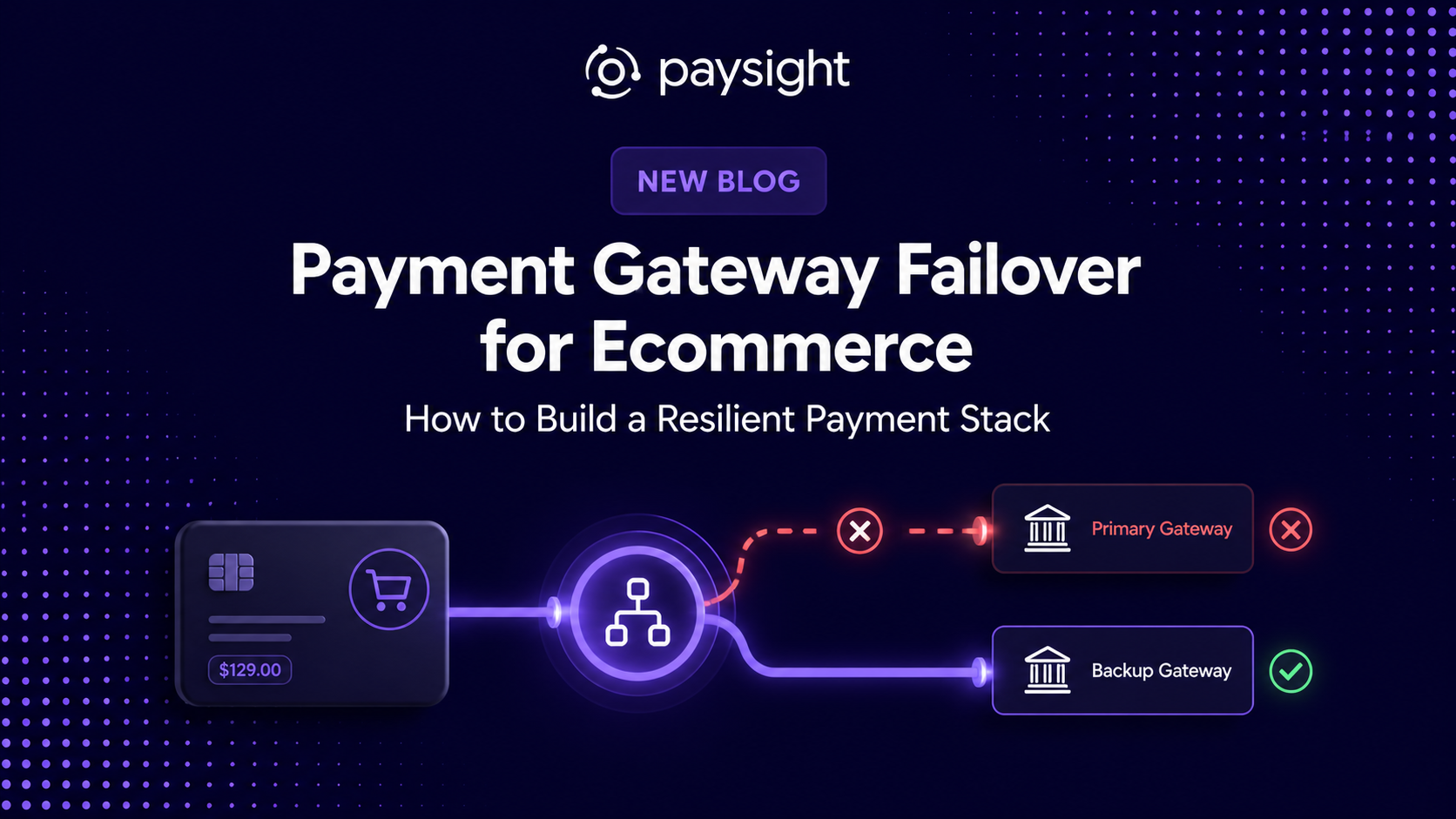
- Reroute or cascade. Use when the failure is route-specific or technical and another eligible route can safely process the same commercial transaction.
- Stop and request another method. Use for hard declines, revoked authorization, lost or stolen cards, explicit do-not-retry advice, or repeated failures that have reached the retry ceiling.
Mastercard Merchant Advice Codes provide a useful example of why timing and action matter. Public documentation exposed through payment providers includes advice such as try again later, do not try again, use updated information, and wait a specified period. Braintree's Merchant Advice Code reference lists distinct retry intervals and stop instructions. Stripe's Smart Retries documentation likewise notes that hard declines cannot execute again without a new payment method.
Immediate retries are often the wrong default. If nothing in the request, route, authentication state, or credential has changed, the issuer may make the same decision. Repeated attempts can add cost, create customer confusion, trigger network controls, and obscure the true order outcome.
For recurring payments, use the billing cadence, decline class, customer history, local time, prior attempt results, and network advice to schedule controlled recovery. Measure incremental recovery by attempt number. If the fourth retry recovers almost nothing, it may be creating more harm than value.
For live checkout, recovery must fit the customer session. Correct field errors immediately. Trigger required authentication. Offer another payment method. If a secondary processor is eligible and the initial outcome is definitively declined, a controlled cascade may preserve the sale. If the result is a timeout or unknown status, verify the original transaction before attempting again to prevent duplicate charges.
A practical decline-rate dashboard
The dashboard should answer three questions: where are payments failing, why are they failing, and what action changes the outcome?
Start with a daily and weekly view of:
- First-attempt approval and eventual approval
- Decline share by normalized category
- Top raw codes within each category
- Approval and decline rate by processor, MID, issuer country, card type, currency, and payment model
- Authentication-required rate, challenge completion, and post-authentication approval
- Recovery by method: corrected data, authentication, retry, cascade, updater, token, or alternative payment method
- Technical error and ambiguous-status rate
- Duplicate-attempt prevention
- Fraud, chargeback, refund, and processing-cost guardrails
Do not rank teams or providers from small samples. Show transaction volume beside every percentage and use rolling windows where daily traffic is volatile. Investigate sudden shifts before optimizing long-term averages.
How Paysight improves payment approval rates
Paysight connects payment CRM and orchestration so merchants can see decline reasons, segment performance, route eligible transactions across processors and MIDs, and apply controlled recovery logic for one-time and recurring payments.
The advantage is not one isolated feature. Approval improvement requires a loop:
- Observe the full payment path across attempts and providers.
- Normalize outcomes into categories that operators can act on.
- Route each transaction through an eligible path.
- Recover only when the decline and context support another action.
- Return the final outcome to orders, subscriptions, support, and reporting.
That loop helps teams improve approvals without losing control of duplicate risk, fraud, chargebacks, processor constraints, or customer communication.
Build an approval strategy around the reason for failure
The strongest payment-approval program does not begin with a universal benchmark or a larger retry count. It begins with clean measurement and a decline taxonomy.
Once the failure is understood, the appropriate lever becomes clearer: improve the data, authenticate, update the credential, localize the payment method, select a stronger eligible route, retry at the right time, or stop and ask the customer for another method.
Seven levers are useful because they turn one blended metric into an operating system. The first six reduce avoidable failure before and during authorization. The seventh recovers the subset that remains recoverable. Together, they help convert more legitimate customer intent into settled revenue.
If you want to understand where your approval rate is leaking and which routes or recovery rules could improve it, talk to Paysight.
Payment approval rate is the percentage of submitted payment attempts that receive an approval. Merchants should define whether the metric counts every authorization attempt or deduplicates attempts by order, because retries can materially change the denominator.
There is no universal target because approval varies by market, issuer, payment method, business model, risk profile, transaction type, and measurement method. Compare equivalent cohorts, monitor your own trend, and segment the result rather than relying on one generic benchmark.
First-attempt approval measures the initial authorization path. Eventual approval measures whether an order or invoice becomes approved after eligible recovery such as corrected data, authentication, a controlled retry, an updated credential, or another eligible route.
No. Temporary or recoverable responses may support another attempt, but hard declines, lost or stolen cards, revoked authorization, invalid credentials, fraud or policy declines, and explicit do-not-retry advice usually require stopping or obtaining a new payment method.
Payment routing selects among eligible processors and merchant accounts using factors such as market, currency, card type, transaction model, route health, and cohort performance. It can avoid unsuitable or degraded paths, but it should not send the same payment indiscriminately across every processor.
Account updater services can retrieve eligible changes to stored card details, while network tokens can remain aligned with lifecycle changes to the underlying credential. Both can reduce failures caused by expired or replaced cards, particularly for subscriptions and repeat purchases.
Paysight centralizes payment visibility, normalizes decline outcomes, routes eligible transactions across processors and MIDs, and supports controlled recovery for one-time and recurring payments. This gives operators one view of the complete payment path and the tools to act on the reason for failure.


.svg)

.png)




Company Reg. No. 760371
VAT No. IE4280069RH


