


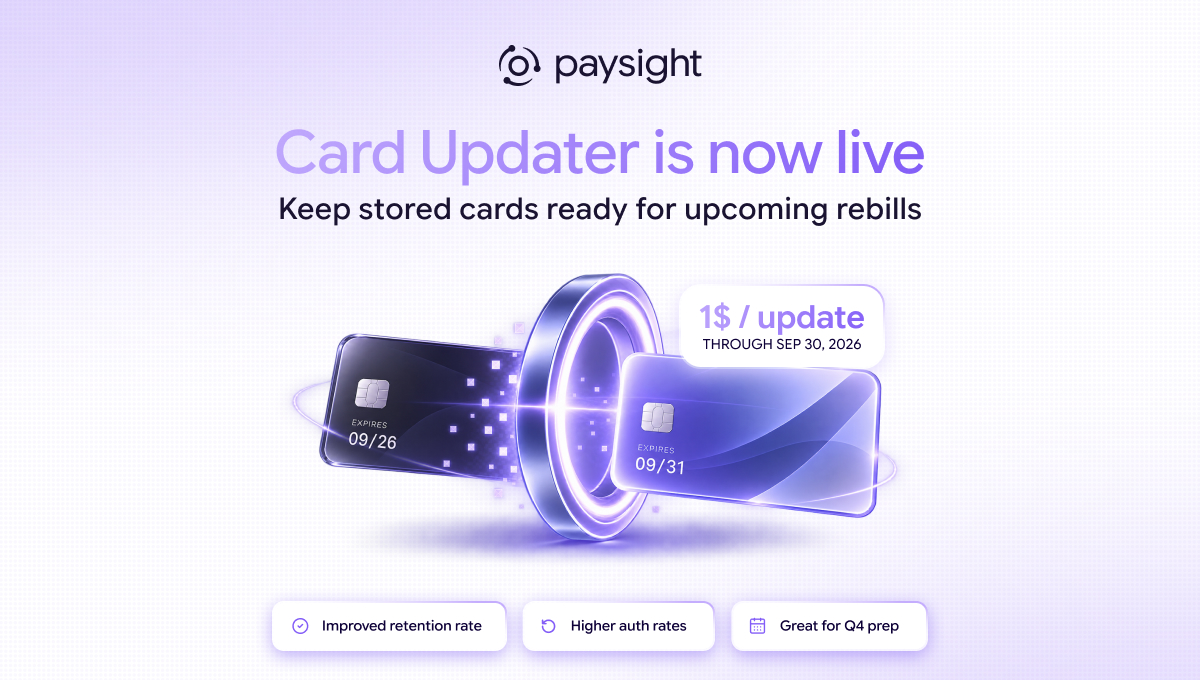
One of the features still missing from many recurring payment setups is now available in Paysight.
Card Account Updater helps keep stored card details current, giving more rebills a usable payment credential when the next billing date arrives.
That makes it particularly relevant before Q4. More customers, more subscribers and more upcoming rebills also mean more opportunities for outdated cards to cause avoidable payment failures.
After months of testing, refining the rollout and working out the fairest way to charge for it, we are ready to make Card Account Updater available to more Paysight merchants.
What does it do?
When a card expires or is replaced by the bank, the details stored by a merchant can become outdated.
With Card Account Updater, selected eligible cards are proactively registered with the card networks. When new details become available, such as a new expiry date or replacement card, Paysight can refresh the card on file before a future billing attempt.
The customer doesn’t need to return and enter the new details manually.
You can read our full explanation of how Card Account Updaters work.
How we got here
We ran live tests with participating ecommerce and digital-services merchants.
We tracked the cards that were updated, the approved transactions that followed and the GMV attributed to those cards. Then we compared that GMV with the cost of the updates to understand the payback period.
The results helped us answer two important questions:
- How quickly does the attributed GMV catch up with the update fees?
- How much additional value can continue to accumulate afterwards?
You can find the cohort results, methodology and pricing calculations in the full report.
Read the Card Account Updater report →
A simpler and fairer pricing model
We considered three different ways to structure the pricing.
The goal was to keep it transparent, predictable and easy for each merchant to evaluate against their own margins.
We decided on a fixed fee for every card that is actually updated.
You are not charged simply because a card was submitted or checked. You pay when an update is returned.
For the launch period, the price is $1 per updated card until September 30.
The standard price afterwards will be $1.50 per updated card.
Run the numbers for your business
In the report, we use GMV unlocked to describe the GMV attributed to cards after they were updated.
GMV is not the same as profit. To estimate the result for your business, multiply the unlocked GMV by your gross margin and compare it with the update fees.
You can calculate it yourself, use a spreadsheet, or give the report data and your margins to Claude, Codex, or whichever AI tool you prefer.
Spoiler: the test results looked good. Your exact profit payback period will depend on your margins, card mix and billing cadence.
Get ready before Q4
Q4 can be a gold mine for rebills, but only if the payment credentials are ready when those rebills happen.
If you already use Paysight, talk to your account manager about enabling Card Account Updater.
If you are not a Paysight customer yet, book a demo and let’s talk.



.svg)




%25201.jpeg)
.png)

Company Reg. No. 760371
VAT No. IE4280069RH


