


Most DTC brands start on Stripe because it takes ten minutes to go live. Somewhere past the first million in annual volume, the questions change. A bank offers a dedicated merchant account with better pricing, a second acquirer is needed for a launch, or a risk review makes the team realise that every subscriber's card sits in one provider's vault. That is usually when NMI and Authorize.net come up.
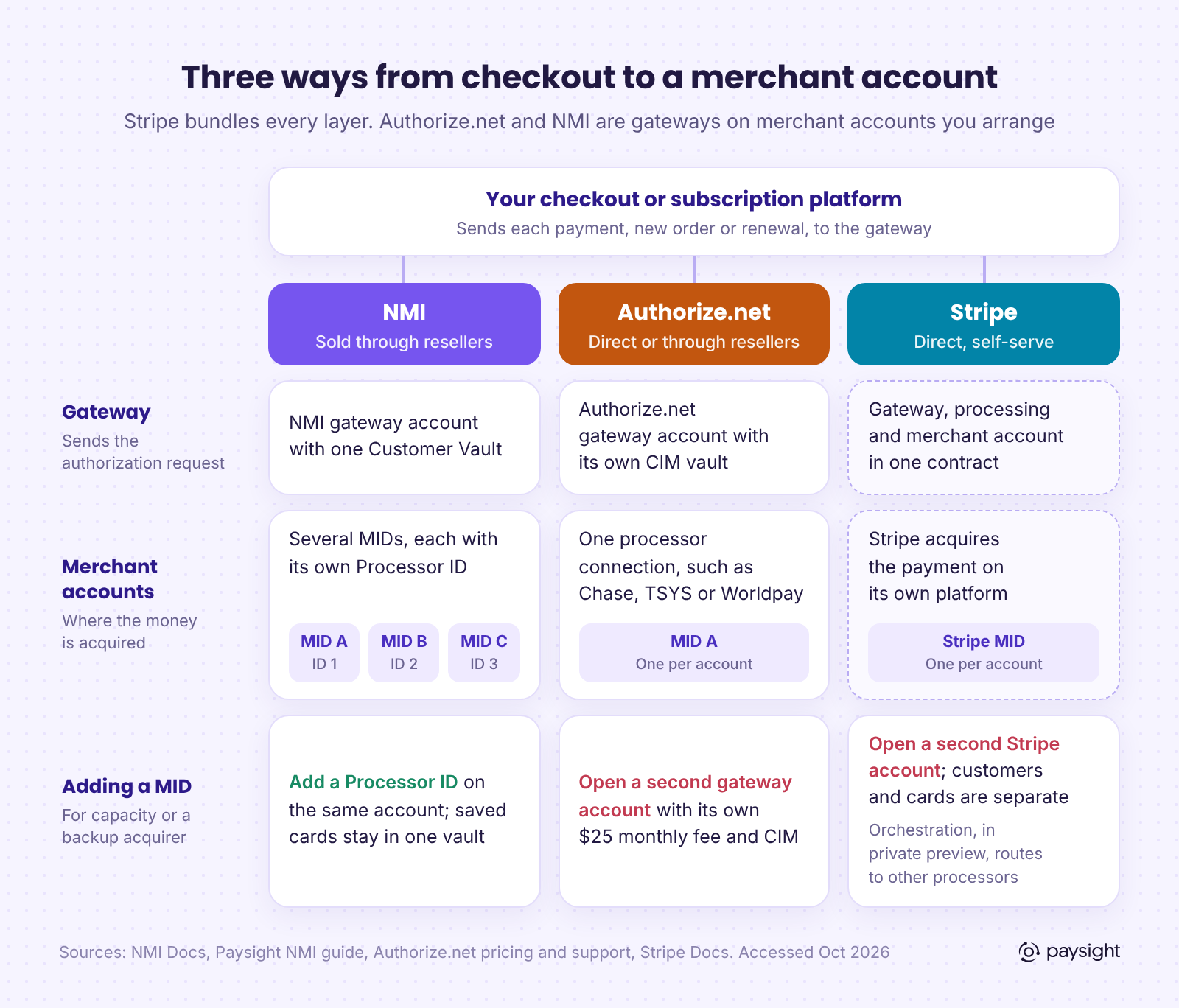
The three names get compared as if they were the same kind of product. They are not. Stripe sells the gateway, the processing and the merchant account as one package. Authorize.net and NMI are gateways: they sit on top of a merchant account you get from a processor or bank. That single difference decides your pricing model, how many MIDs you can run, and how hard it is to move your saved cards later.
This guide compares them on the points that matter for high-volume subscription and DTC brands, using published pricing and documentation as of October 2026.
Key takeaways
- Stripe is gateway plus processor. One Stripe account gives you one Stripe MID, and the 2.9% + 30¢ US list price covers both gateway and processing. You cannot plug your own bank's merchant account into standard Stripe.
- Authorize.net is a gateway with one processor per account. The Gateway Only plan costs $25 a month plus 10¢ per transaction and a 10¢ daily batch fee. A second MID means a second gateway account.
- NMI is a reseller-sold gateway built for multiple MIDs. Each MID gets a Processor ID on one gateway account, and pricing comes from the reseller, not from NMI.
- Recurring modules behave differently on failure. Authorize.net ARB suspends a subscription after a decline; Stripe Billing retries automatically; NMI's docs leave retry logic to your platform.
- Leaving has a price. NMI charges $0.50 per exported record with a $500 minimum. Stripe exports to any PCI DSS-compliant processor. Subscription schedules do not move in any of the three, so plan to rebuild them.
Gateway vs processor: the difference that decides everything
A payment gateway takes the card details from your checkout or your subscription system, sends the authorization request and returns the answer. The processor (acquirer) holds your merchant account, moves the money through the card networks and pays you out. You need both for every card payment. The question is whether you buy them together or separately.
Stripe: the all-in-one aggregator
Stripe is both layers in one contract. You sign up, Stripe underwrites you under its own terms, and your account gets its own MID. Stripe's own migration docs make the point that "your Stripe account has its own merchant identifier (MID)", which is why issuers may decline more often for a while after you move cards to it. You don't choose the acquirer and you can't connect a merchant account from your bank.
Stripe has started to open this up. Stripe Orchestration routes payments, including Billing renewals, to third-party processors and can retry a failed payment on another processor. As of October 2026 it is in private preview, it doesn't cover disputes or settlement for those processors, and the third-party processor's own terms and fees still apply.
Authorize.net: a gateway on your merchant account
Authorize.net is a Visa-owned gateway that connects to a merchant account from a supported processor. Its US processor list includes Chase, Elavon, First Data (Fiserv), Global Payments, Heartland, North American Bancard, TSYS and Worldpay. You can also buy it bundled (the All-in-One plan), in which case Authorize.net arranges the merchant account.
Each gateway account connects to one processor at a time. Switching is a support request that usually completes in one to two days. Transactions authorized before the switch still settle with the old processor, and refunds on them go through the new one.
NMI: a white-label gateway for many MIDs
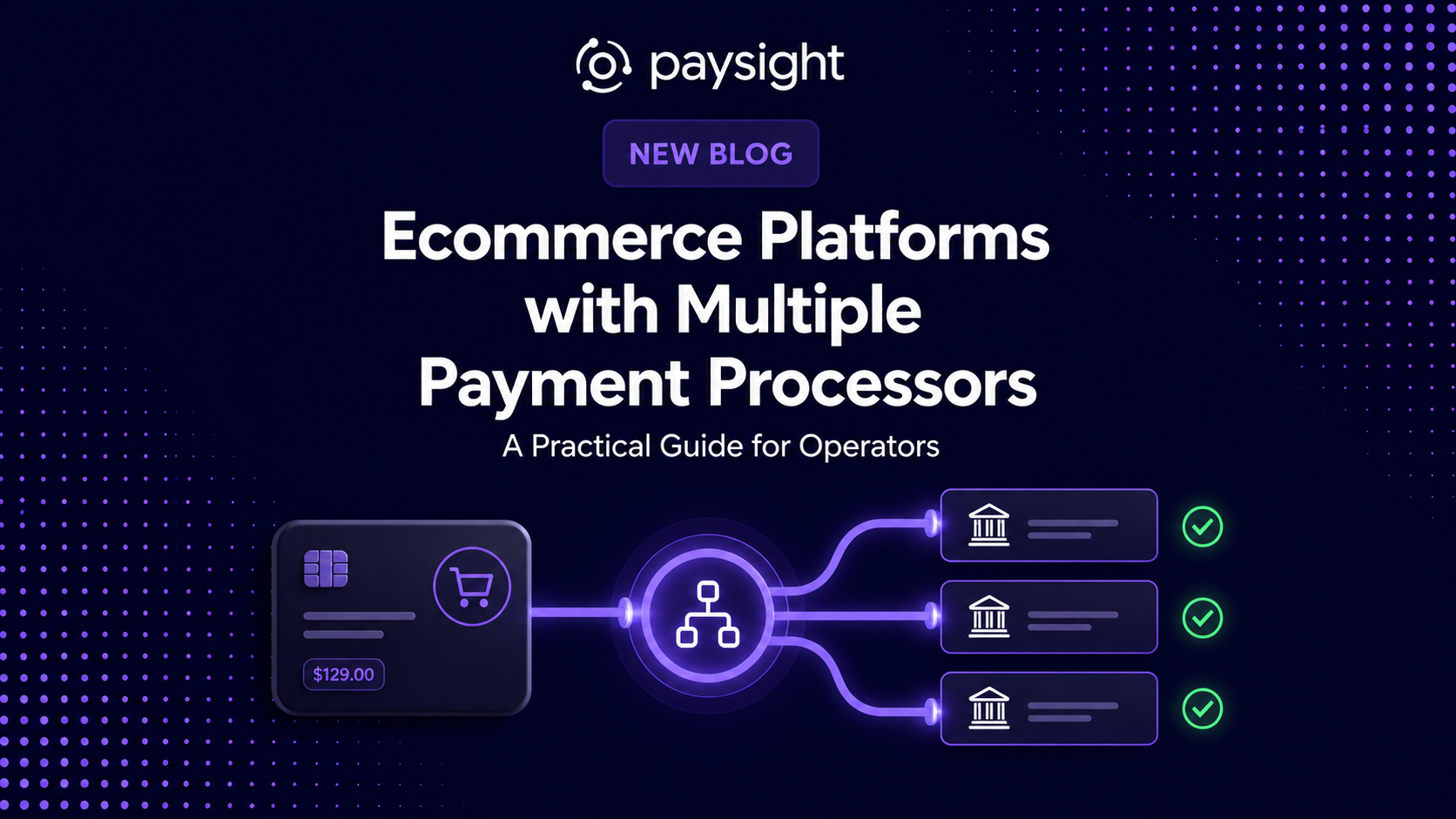
NMI is also a gateway, but you rarely buy it from NMI. It's sold through resellers (ISOs, banks and payment providers), often under their own brand, so some brands run NMI without knowing it. PaymentCloud says it links up with "almost 90% of all merchant processors". The feature that matters most for scaling brands is MID routing: one NMI gateway account can hold several merchant accounts, each with its own Processor ID, and every transaction can be sent to a specific MID.
NMI vs Authorize.net vs Stripe at a glance
Pricing as of October 2026
Only two of the three publish prices, and they price different things. Stripe's rate includes processing. Authorize.net's Gateway Only plan and any NMI quote cover the gateway alone, and your merchant account charges processing on top, usually as interchange-plus. Compare like with like: Stripe's rate against your merchant account's effective rate plus the gateway fee. Our guide to calculating your effective processing rate shows how to work that out from a statement.
At volume, the per-transaction gateway fee adds up. A brand running 20,000 card transactions a month on Authorize.net Gateway Only pays $25 + $2,000 + about $3 in batch fees, so roughly $2,028 a month before processing. At a $60 average order that is about 0.17% of volume. NMI reseller pricing is negotiable, so get a written quote at your real transaction count and ask whether the vault, recurring and card updater are included or billed per record.
Multiple MIDs: where NMI pulls ahead
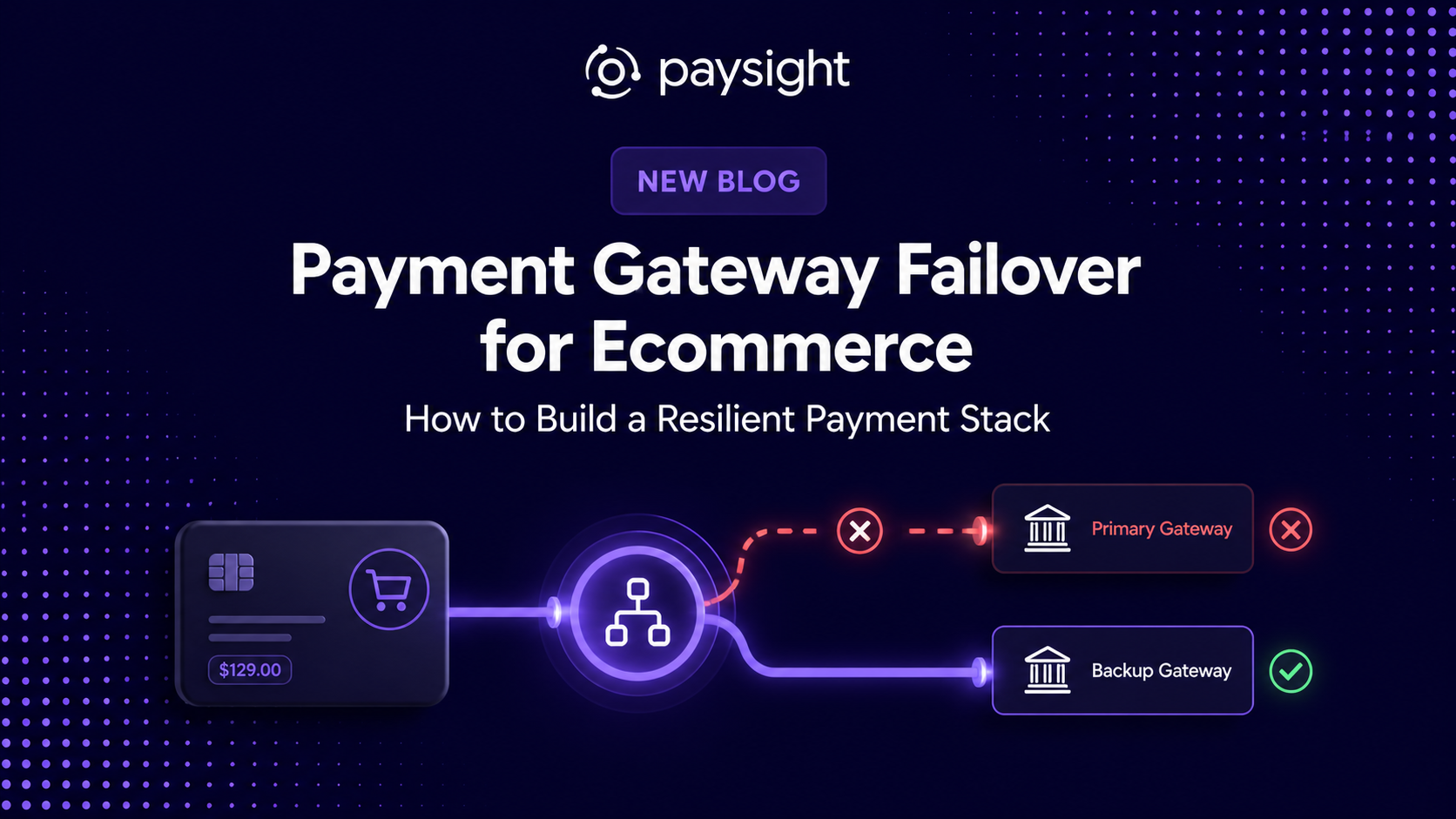
For a brand with one merchant account, Authorize.net and NMI do similar jobs. The gap opens when you add a second or third MID, for example when one acquirer caps your monthly volume or you want a backup for when one account has an outage.
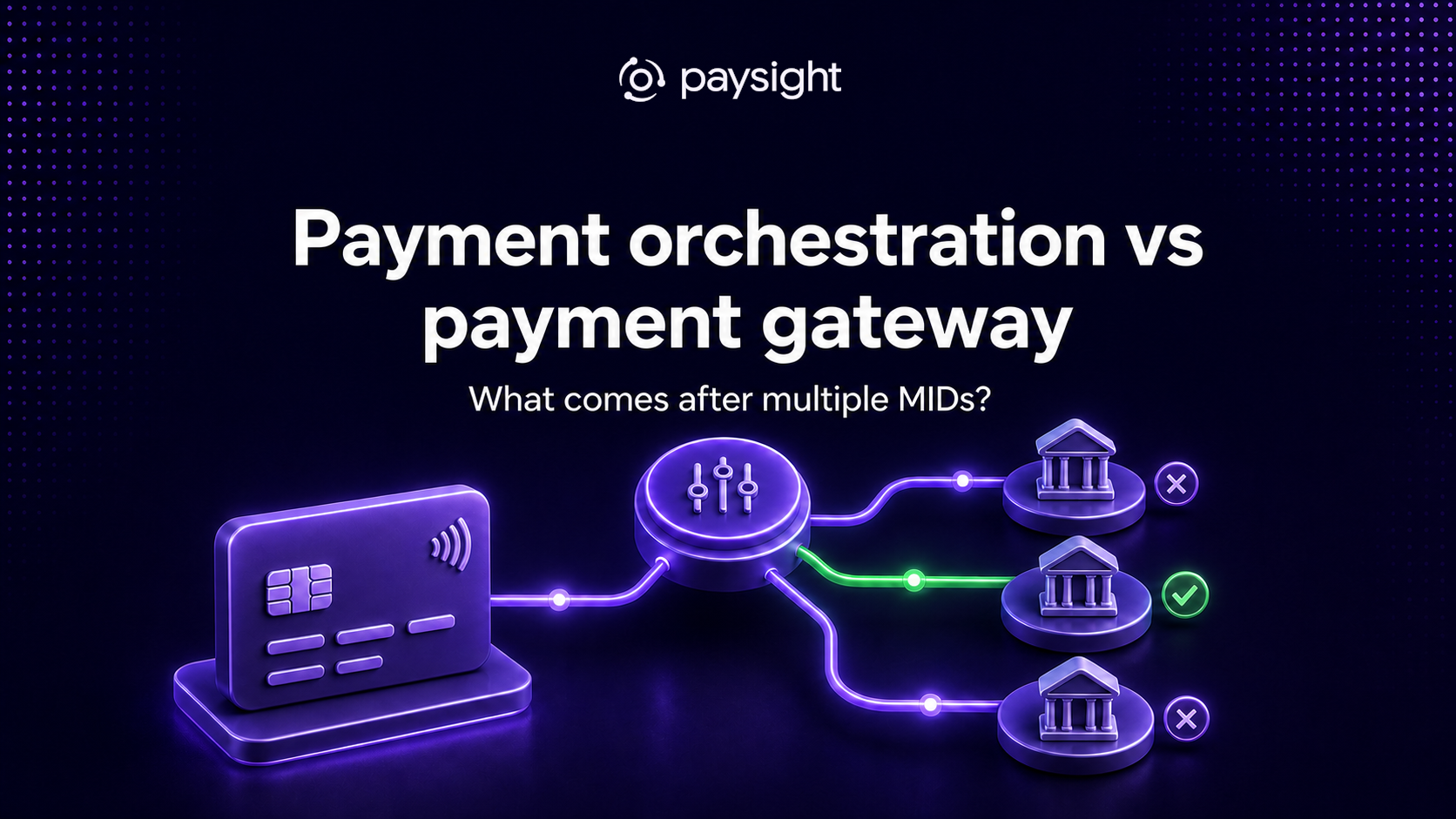
On NMI, each MID appears under Transaction Routing with its own Processor ID. A platform connected to your NMI account can send each payment to the right MID by passing that ID, and anything sent without an ID goes to your default MID. The MIDs share that gateway account's Customer Vault, so you manage one set of saved cards instead of one per MID. Ask your reseller to confirm how vault charges are routed when you pass a Processor ID.
On Authorize.net, a second MID means a second gateway account, with its own $25 monthly fee, its own API keys and its own CIM. Cards saved in one account's CIM can't be charged through the other, so subscribers end up tied to the MID they signed up on. On Stripe, a second Stripe account is a second MID with a separate customer list, and cards can only move between accounts with Stripe's copy tool.
One rule applies whichever gateway you use: run additional MIDs for capacity, redundancy and approval rates, never to spread disputes so each account stays under a monitoring threshold. Acquirers and card networks treat that as load balancing, and it can cost you every account at once. Our breakdown of Visa VAMP and Mastercard ECM thresholds explains how those ratios are counted.
Recurring billing: what happens when a renewal fails
All three have a built-in recurring engine, and all three can charge a saved card on a schedule. The difference shows up on the day a renewal is declined.
For a subscription brand, that suspended state on Authorize.net matters. A soft decline such as insufficient funds would often clear on a retry a few days later, but ARB waits for new card details instead. Most brands on Authorize.net or NMI end up running renewals and retries from their own subscription platform and use the gateway only to charge the vaulted card. If you build that logic yourself, our guide to soft vs hard declines covers which decline codes are worth retrying and when.
Who holds your cards, and what it costs to leave
Your vault is the part of a gateway decision that is hardest to undo. Every subscriber's card sits in it, and moving to a new provider means a PCI-controlled export, not a CSV download.
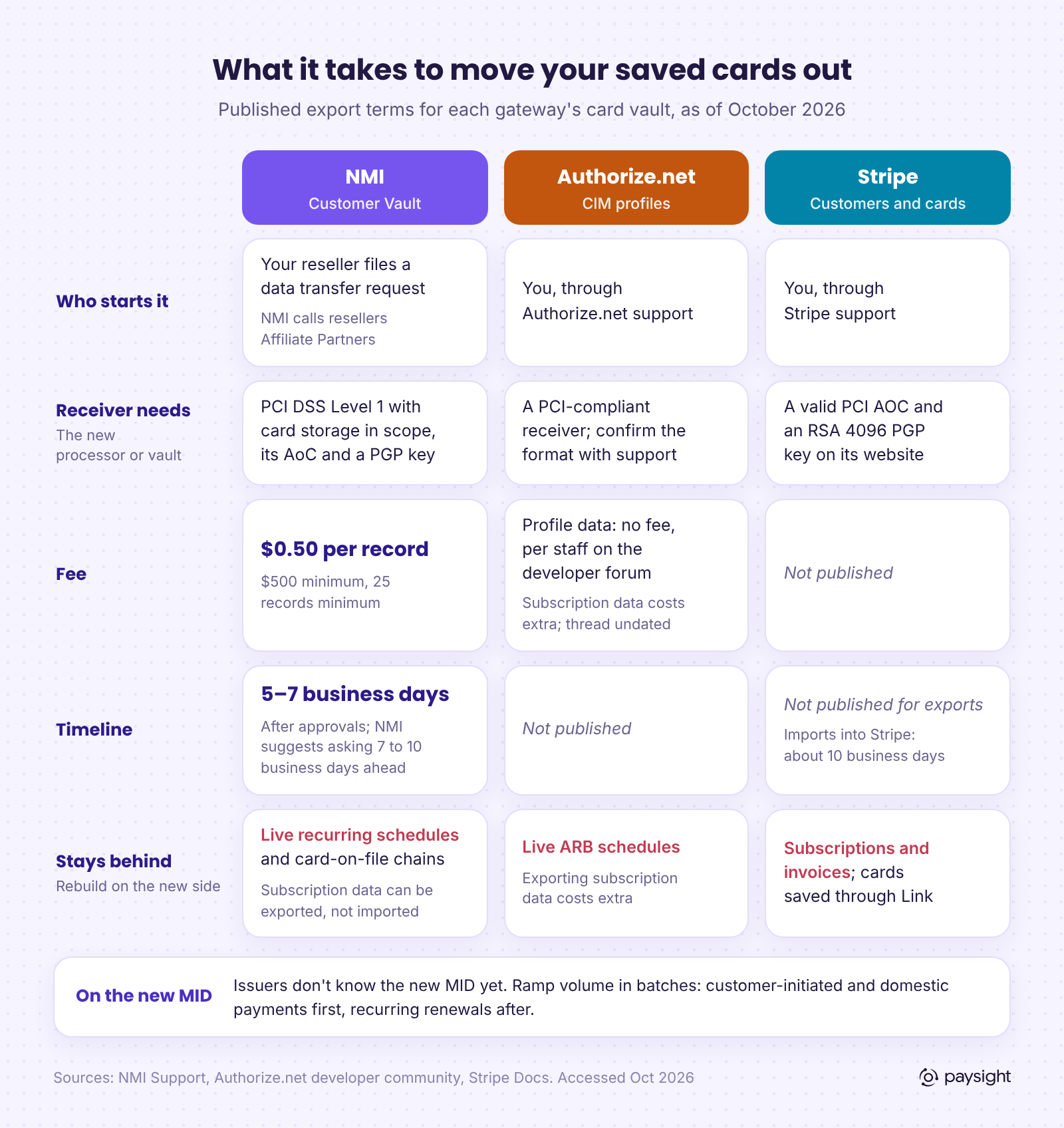
- NMI: exports are started by your reseller (NMI calls them Affiliate Partners). The receiver must be PCI DSS Level 1 with card storage in scope and send its Attestation of Compliance. The fee is $0.50 per record or $500, whichever is higher, with a 25-record minimum and 5 to 7 business days once approved. If you only want to change reseller and stay on NMI, a gateway move keeps the vault, keys and recurring setup intact.
- Authorize.net: CIM exports go through support. Authorize.net staff have said on its developer forum that exporting customer profile data should carry no fee and that subscription data costs extra; the thread is undated, so confirm current terms before you rely on it.
- Stripe: exports to any PCI-compliant processor that provides a valid AOC and an RSA 4096 PGP key hosted on its website. Imports into Stripe usually complete within 10 business days after Stripe receives valid data, but the old processor's export can take days to months.
Two things don't move in any of these transfers: the subscription schedules themselves, and the card-on-file history with the issuer. Expect a temporary dip in approvals on a new MID and ramp volume gradually. Stripe's own guidance is to start with customer-initiated and domestic payments before moving recurring renewals.
Network tokens are the other portability question. Stripe requests them automatically for Stripe payments, and NMI says its Customer Token Vault uses network tokens. Authorize.net's public feature pages list Account Updater for Visa and Mastercard but don't describe network tokens on CIM profiles, so ask your reseller. Our explainer on network tokens for subscriptions covers why they lift approval rates on renewals.
Which one fits your brand
None of these gateways makes a product acceptable that the card networks or your acquirer prohibit. Stripe publishes its restricted businesses list, and a dedicated merchant account still goes through its own underwriting.
A switching checklist for high-volume brands
- Ask for a written quote that lists monthly, per-transaction, batch, vault, recurring, card updater and export fees at your real transaction count.
- Confirm which processors the gateway supports for your merchant account, and whether one gateway account can hold all your MIDs.
- Get the export terms in writing before you sign: who starts it, what the receiver needs, the fee and the timeline.
- Decide where renewal and retry logic lives. If it's in your subscription platform, the gateway's recurring module may not matter.
- Move new customers first, then ramp existing renewals in batches while you watch approval rates by MID.
- Keep the old gateway live until the last scheduled renewal and refund window has passed.
Where Paysight fits
Paysight is not a gateway or a processor, and it doesn't hold funds or underwrite accounts. It's a platform to launch and manage subscriptions on the gateways and merchant accounts you connect, such as Stripe, NMI and Finix. With NMI, you add the Processor ID for each MID during setup, and Paysight uses it to send each transaction to the right merchant account.
Subscriptions, transactions and customer data sit in one place, so renewals, retries across your connected gateways, card account updates and customer care portals run from one system instead of three gateway dashboards. If you're weighing Authorize.net or another gateway, ask our team which connections fit your setup.
Sources
- Authorize.net: Pricing (All-in-One, Gateway Only, ARB, CIM, Account Updater fees), accessed Oct 2026
- Authorize.net: Processor list, accessed Oct 2026
- Authorize.net Support: Changing the processor on your gateway account, accessed Oct 2026
- Authorize.net: Account Updater, accessed Oct 2026
- Authorize.net Help: ARB Automatic Retry and Support article 000002356, accessed Oct 2026
- Authorize.net developer community: Exporting CIM data (undated staff replies), accessed Oct 2026
- Visa: Authorize.net, accessed Oct 2026
- NMI Docs: Customer Vault and Recurring Transactions, accessed Oct 2026
- NMI Support: Data Import, Export and Transfer Information, accessed Oct 2026
- NMI: Automatic Card Updater and NMI: Tokenization, accessed Oct 2026
- CardFellow: Authorize.Net vs NMI (reseller sales model, advertised NMI starting prices), accessed Oct 2026
- PaymentCloud: NMI payment gateway (updated Jan 2025)
- Stripe: Pricing (US cards, disputes, Billing), accessed Oct 2026
- Stripe Docs: Orchestration (private preview), accessed Oct 2026
- Stripe Docs: Import payment data to Stripe (timelines, export to other processors, new MID ramp-up), accessed Oct 2026
- Stripe Docs: Smart Retries, accessed Oct 2026
- Stripe: Restricted businesses, accessed Oct 2026
- Paysight Docs: NMI setup, accessed Oct 2026
No. NMI is a payment gateway. It sends authorization requests to a merchant account that you get from a processor or bank, and it is usually sold through resellers such as ISOs and payment providers, often under their own brand. The processor, not NMI, moves the money and pays you out.
Both are gateways that sit on a merchant account. The main difference for scaling brands is MIDs: one NMI gateway account can hold several merchant accounts, each selected with its own Processor ID, while one Authorize.net account connects to one processor at a time. Authorize.net also publishes its prices, while NMI pricing comes from your reseller.
As of October 2026, every Authorize.net plan has a $25 monthly fee. The Gateway Only plan adds 10 cents per transaction and a 10 cent daily batch fee, and processing is charged separately by your merchant account. The All-in-One plan charges 2.9% plus 30 cents per transaction. Account Updater costs $0.25 per updated card.
Not on standard Stripe. A Stripe account comes with its own Stripe MID, and Stripe acts as both gateway and processor. Stripe Orchestration, in private preview as of October 2026, can route payments to third-party processors, but those processors' own terms, fees, disputes and settlement still apply.
NMI is built for it: each MID gets a Processor ID on one gateway account, so a platform can send each payment to a specific merchant account. With Authorize.net or Stripe, each extra MID means a separate account with its own saved cards. Use extra MIDs for capacity, redundancy and approval rates, never to spread chargebacks across accounts.
Yes, through a PCI-controlled export rather than a file download. NMI charges $0.50 per record with a $500 minimum, and the export is started by your reseller. Authorize.net handles CIM exports through support. Stripe usually imports within 10 business days of receiving valid data. Subscription schedules don't transfer, so you rebuild them on the new side.
No. Paysight is not a gateway or a processor and doesn't hold funds. It's a platform to launch and manage subscriptions on the gateways and merchant accounts you connect, such as Stripe, NMI and Finix, with subscriptions, transactions and customers in one place, retries across your connected gateways, card account updating and customer care portals.









Company Reg. No. 760371
VAT No. IE4280069RH


