


How to Get Approved for a Merchant Account: A Practical Guide with 3 Checklists


Most businesses approach merchant account approval the way they approach a job application: fill out the form, attach the documents, and wait. When they get declined, the reason is usually vague. When they get approved, the terms sometimes come as a surprise. In both cases, the underlying process was opaque.
Underwriters are running a risk assessment. The documents are evidence, and what they are actually evaluating is the probability that your account generates losses the acquirer cannot recover. The outcome determines whether the acquirer is willing to take on the financial liability of processing your transactions.
This guide explains what acquirers evaluate, where applications fail, how to prepare one that holds up under scrutiny, and how to build the kind of payment infrastructure that makes merchant account approval easier every time you need it.
What a Merchant Account Approval Actually Is
The MID an acquirer issues is not a sign-up confirmation. It is a statement that they have reviewed your business, modeled the likely risk of your transactions, and decided the relationship is worth taking on. The acquirer holds financial liability for every transaction you process. The underwriting process is how they decide whether that liability is acceptable, and every element of it flows from one question: if this merchant processes with us for twelve months, what is the probability that we end up covering losses we cannot recover?
What Acquirers Look For in a Merchant Application
Underwriters assess five categories. Understanding each one from the acquirer's perspective changes how you prepare an application.
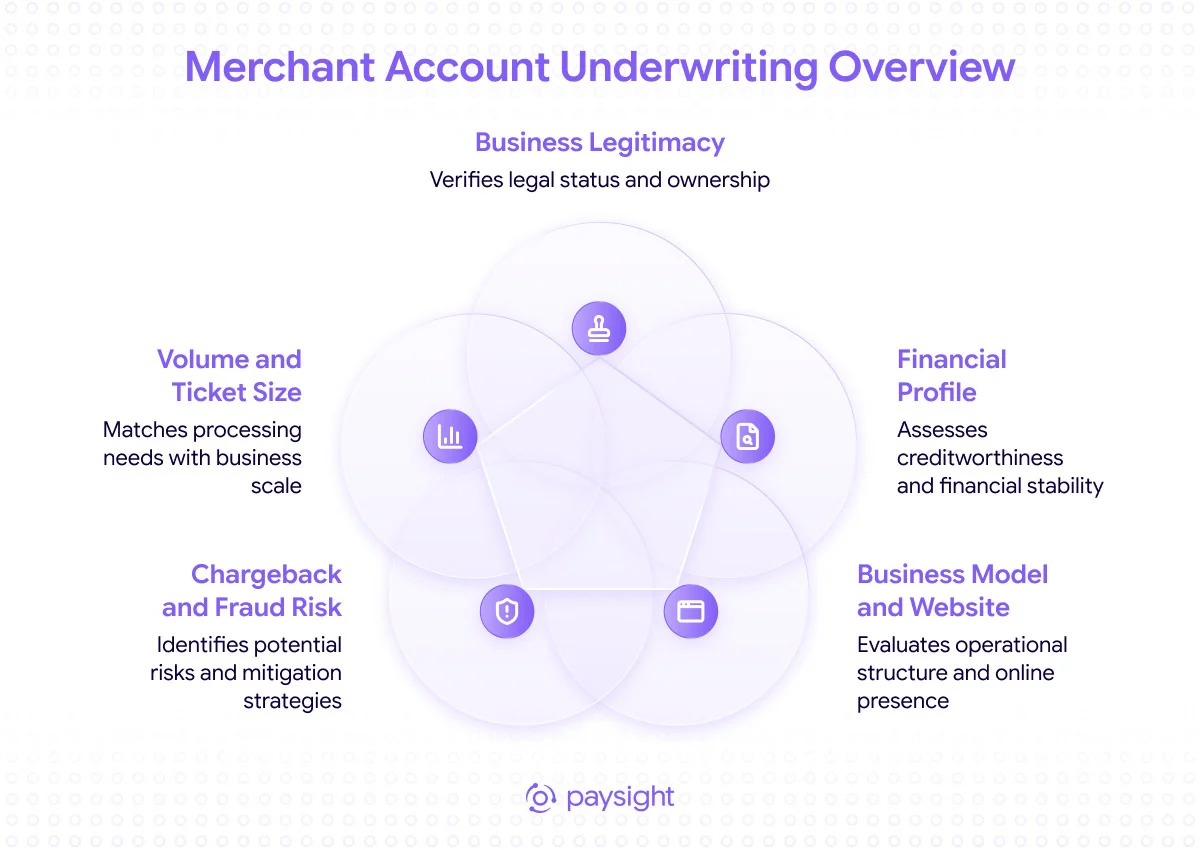
Business legitimacy
Underwriters check registration documents, licenses, and ownership records to confirm the business exists as described and that ownership is transparent. The most common failure is inconsistency: addresses that differ between incorporation documents and bank accounts, name variations, or ownership structures that do not clearly show who controls the entity. Every document you submit should tell the same story. An underwriter who has to reconcile inconsistencies either delays or declines.
Financial profile
Acquirers review personal credit history for the business owners and business credit history where it exists, along with three to six months of bank statements. They are looking for financial stability: does the business have enough consistent cash flow to absorb a reserve requirement and to cover potential chargebacks without the acquirer bearing all the risk?
If you have existing processing history with another acquirer, include the last three to six months of statements. Clean processing history with low chargeback rates is one of the strongest signals you can provide. If your history is not clean, the absence of statements raises the same questions the statements would have answered. If you have no processing history at all, compensate with stronger financials: higher bank balances, longer operating history, and detailed revenue projections with supporting documentation.
Business model and website
For card-not-present merchants, the website functions as an underwriting document. Underwriters check whether your pricing is clearly visible, whether a refund and return policy exists and is accessible, whether terms of service are present, and whether contact information is real and findable. These are card network requirements, and acquirers check compliance before approval.
Beyond compliance, underwriters are assessing whether the business model makes sense. A site that describes one product but lists a different MCC (Merchant Category Code), or a product description vague enough to obscure what is actually being sold, creates uncertainty that increases the perceived risk of the application.
Chargeback and fraud risk
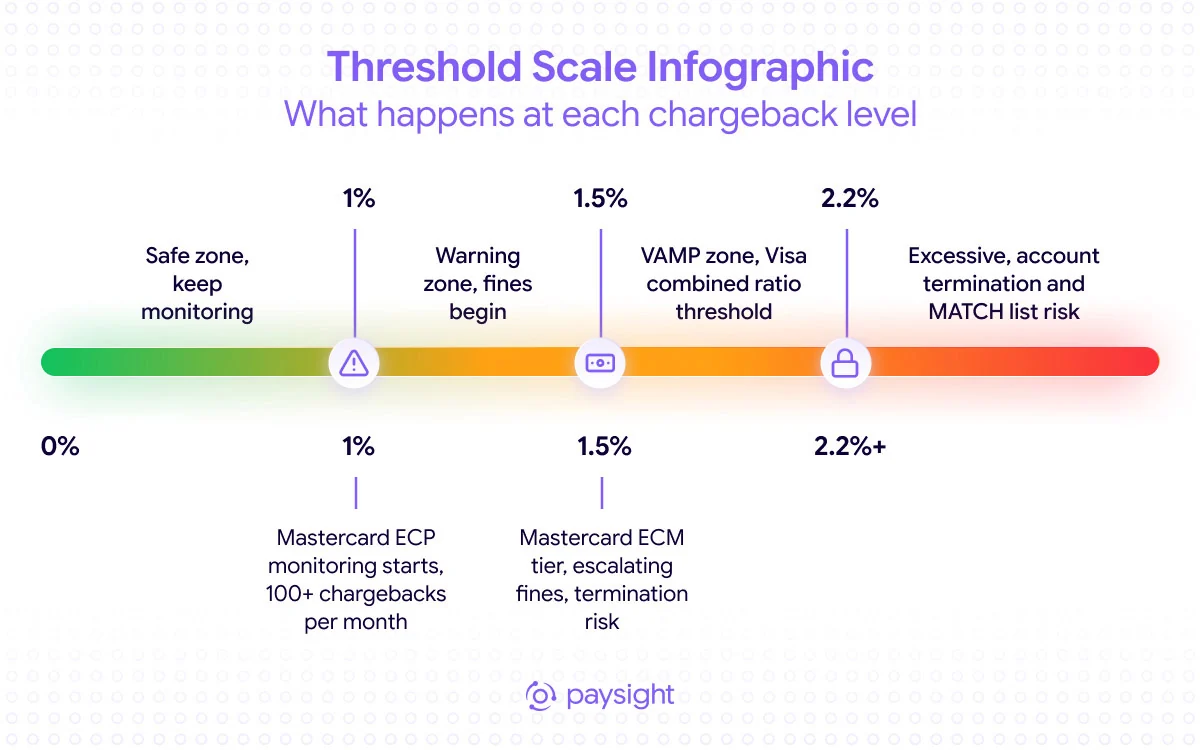
Chargeback rate is one of the most scrutinized inputs in underwriting. Acquirers compare your historical rate against card network thresholds. Mastercard's Excessive Chargeback Program flags merchants at a 1.0% chargeback ratio with 100 or more chargebacks per month, with the Excessive Chargeback Merchant tier beginning at 1.5%. Visa consolidated its dispute and fraud monitoring into VAMP in April 2025, replacing earlier separate thresholds with a combined fraud and dispute ratio. The practical benchmark most underwriters apply is staying below 1% across both networks. They also compare your rate against the typical rate for your industry. A 1.2% rate means something different for a subscription nutraceutical brand than for a single-ticket luxury goods retailer.
If you have chargeback history, do not submit it without context. An explanation letter that describes what caused the elevated rate, what you have done operationally to address it, and what your current rate is carries weight. Acquirers understand that chargebacks happen. An applicant who cannot explain their history signals that they do not understand their own risk profile.
The presence of fraud prevention mechanisms matters: 3D Secure, AVS matching, CVV requirements, velocity limits. These signal that you have thought about risk management, which is exactly what an underwriter wants to see.
Volume and ticket size
State your expected monthly processing volume and average transaction value accurately. Acquirers build their risk models around these numbers. A business that states $50,000 monthly volume and then processes $300,000 in the first month creates a risk signal that triggers enhanced scrutiny or an immediate review.
If your projections are uncertain, give a range and explain the basis for it. Projections that are too high relative to your business size and financials will raise questions you do not want asked during underwriting.
MCC: The Code That Sets Your Risk Profile Before Underwriting Starts
The Merchant Category Code assigned to your account determines your chargeback thresholds, interchange rates, and the level of scrutiny your application receives before an underwriter reads a single document.
Most applicants accept whatever MCC the processor suggests. That is a mistake. MCC selection is a decision with real consequences.
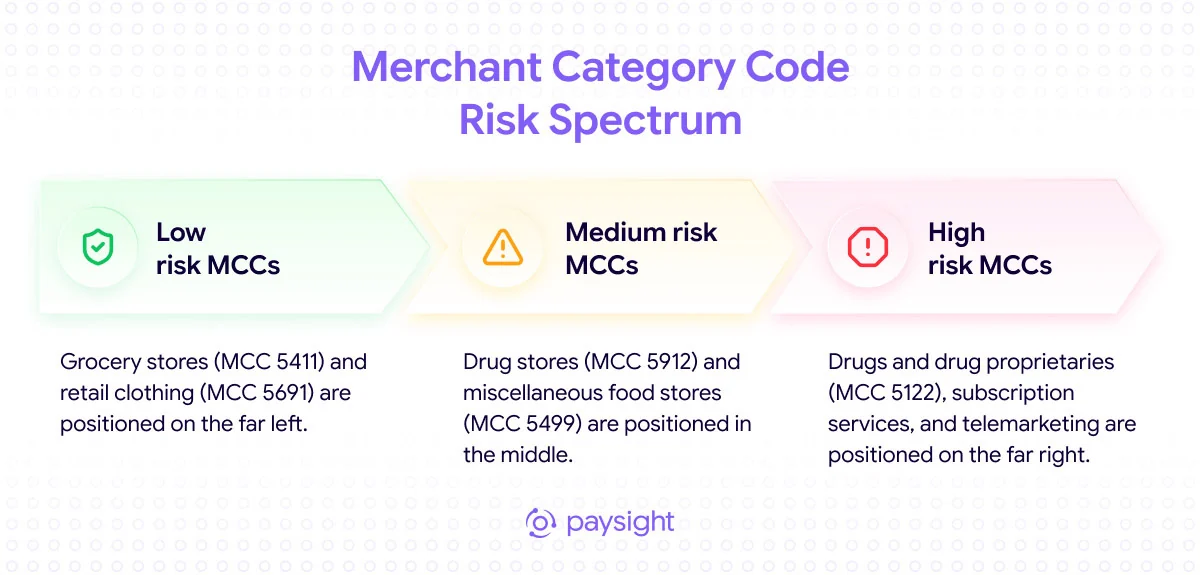
A supplement brand, for example, can fall under several codes. MCC 5122 (drugs, drug proprietaries, and druggist sundries) carries a higher risk classification and stricter underwriting than MCC 5912 (drug stores and pharmacies) or MCC 5499 (miscellaneous food stores). The product may be identical across all three classifications, but the code shapes how the acquirer models the risk before any conversation begins.
Before applying, research which MCCs are accurate for your business model and which carry the most favorable risk profile for your category. A neutral MCC reference is available at classification.codes. If you are already processing under an MCC that does not reflect your actual business, discuss reclassification with your acquirer.
The same logic applies to businesses that have evolved: a company that started selling physical goods and added a subscription tier may now be primarily a subscription business but still processing under an MCC designed for one-time retail. The mismatch creates a risk profile that does not match the actual business, which complicates both approval and limit negotiations.
Why Applications Get Declined
Merchant account approval declines cluster around a consistent set of causes. The first five are fixable before you apply. The sixth, MATCH list inclusion, requires a different approach and is covered separately below.

- Incomplete or inconsistent documentation. Missing bank statements, ownership documents that list different principals than the application, or incorporation papers from a different state than the bank account create questions that result in delays or declines.
- Website non-compliance. A refund policy that is absent, pricing that requires you to contact sales, or a terms of service page that a customer could not find without help are all grounds for decline. Run your own site through the same checklist an underwriter uses before you submit an application.
- Chargeback history without context. An elevated rate with no explanation, no remediation evidence, and no current rate comparison leaves the acquirer to draw their own conclusions. Submit a chargeback explanation letter alongside any history that shows elevated rates.
- Wrong MCC. A code that does not match the business creates a risk classification that triggers underwriting scrutiny a correctly classified application would have avoided.
- Volume projections that do not match business size. An application from a company with six months of operating history projecting $500,000 monthly processing will face skepticism. Projections should be defensible from the financials you are submitting.
The exception: MATCH list inclusion
The MATCH list (Member Alert to Control High-Risk Merchants), maintained by Mastercard, flags businesses whose merchant accounts were terminated for reasons including excessive chargebacks, fraud, and compliance violations. A MATCH listing stays active for five years and causes most standard processor applications to be declined automatically.
A MATCH listing is not always final. Reason codes matter. Code 12 (PCI DSS non-compliance) can be disputed if the business can demonstrate current compliance. The formal dispute process runs through Mastercard directly, and acquirers who placed the listing must remove it if the dispute is resolved in the merchant's favor.
Some acquirers specialize in working with MATCH merchants. Approval is possible but comes with higher rates, larger reserves, and stricter monitoring requirements. If you are on the MATCH list and need to process, applying only to standard acquirers wastes time. Identify specialist acquirers who explicitly work with your situation and apply there first.
How to Prepare a Stronger Application
The goal is to make the underwriter's job easier. An application that answers questions before they are asked moves faster and generates better outcomes.
Documentation checklist
- Government-issued ID for all principals with ownership above 25%
- Business registration documents and EIN confirmation
- Bank statements for the last three to six months
- Voided check or bank letter confirming your settlement account
- Last three to six months of processing statements if applicable
- Business license if required for your industry
- Any relevant regulatory compliance certificates
Website compliance checklist
- Pricing clearly listed and accurate
- Refund and return policy accessible from the checkout flow
- Terms of service present and complete
- Contact information real and findable (physical address, email, phone)
- SSL certificate active
- Business name on the site matches the name on the application
- Product descriptions accurate and complete
If you have chargeback history, write an explanation letter. A strong letter covers four things: what caused the elevated rate (specific trigger, not a general statement), what operational changes you have implemented since (retry logic, billing descriptors, cancellation flows, chargeback alerts), what your current rate is with supporting evidence, and what monitoring you have in place going forward. Include documentation of those changes if you have it.
For subscription businesses, describe your model explicitly in the application. State your retry schedule, your billing descriptor, your cancellation process, and your refund rate alongside your chargeback rate. An underwriter who understands your business model can assess the risk accurately. An underwriter who has to infer it from incomplete information will default to conservative assumptions.
Your Approval Terms and What to Do in the First 30 Days
Merchant account approval comes with terms, and those terms are negotiable more often than most merchants realize.
Rolling reserve
A rolling reserve is a percentage of your processing volume (typically 5-10%) held by the acquirer for a period (typically 90-180 days) as security against chargebacks and fraud losses. It is standard for new merchant accounts, especially in categories with elevated chargeback risk, and it is a negotiating point.
The size of the reserve, the holding period, and the conditions for release can all be discussed. A merchant with strong financials, clean prior processing history, or a track record in the same industry can often negotiate a smaller reserve or a shorter holding period. If you have assets that could serve as alternative collateral, some acquirers will accept them in place of or alongside a reserve.
Once you are processing, the speed at which you can reduce or eliminate the reserve depends on your chargeback ratio and processing volume. A clean first three to six months is the single most effective argument for reserve reduction. The reserve terms in your initial agreement are a starting point.
First 30 days checklist
- Check your billing descriptor immediately. Run a test transaction and confirm what appears on a bank statement. If it does not match the name your customers know, change it before you process live volume. Descriptor confusion is one of the most common causes of friendly fraud chargebacks.
- Run test transactions across card types: Visa, Mastercard, debit, credit. Confirm they settle correctly and that fees match the rate agreement.
- Ramp volume gradually. A sudden spike in processing volume in the first month triggers automated risk flags regardless of transaction quality. Gradual volume increase gives the acquirer's systems time to establish a baseline for your account.
- Set up chargeback monitoring from day one. You need to know your chargeback rate in real time, not at the end of the month when it is reported. A rate that creeps above threshold without early intervention is significantly harder to recover than one caught early.
Building Acquirer Infrastructure That Lasts
Most merchants treat MID approval as a one-time problem to solve and then stop thinking about it. Operators who run payment infrastructure well treat it as an ongoing management task.
Staged underwriting and growing your processing limits
Most acquirers issue new accounts with processing caps. A cap of $50,000 per month on a business with $200,000 in monthly demand is a starting position. Acquirers increase limits when the evidence supports it.
To accelerate a limit increase, you need clean processing history at or near your current cap, a chargeback ratio consistently below 0.5%, and a formal request with documentation. Three months is the minimum window worth requesting at; six months of clean history gives you a significantly stronger case. The documentation should include current processing statements, your chargeback rate, your refund rate, and updated financial statements if your business has grown. Making the request with complete supporting evidence moves it through the process faster.
Acquirer diversity as infrastructure
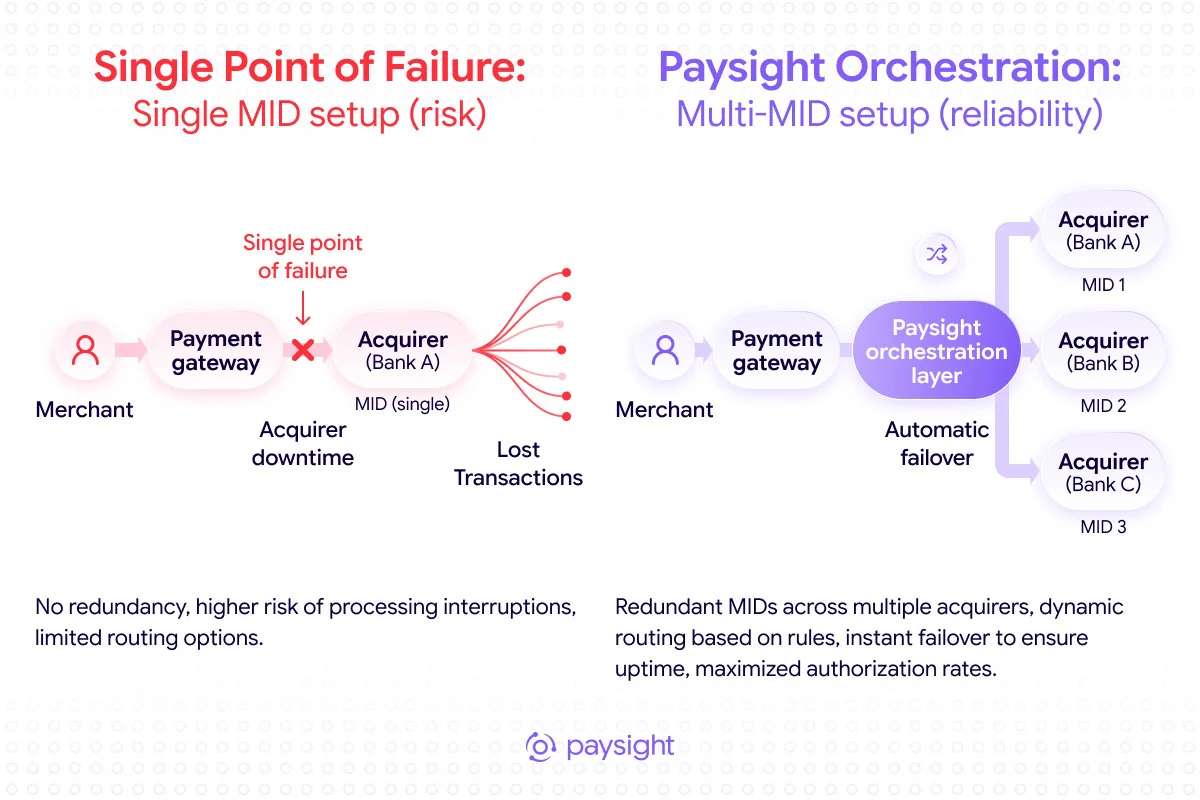
A single MID at one acquirer is a single point of failure. If that acquirer restricts your volume, changes its risk tolerance for your category, or terminates the relationship, your processing stops until you can establish a new account. Establishing a new account under those conditions, often with a termination on record, is significantly harder than building a multi-acquirer setup from the beginning.
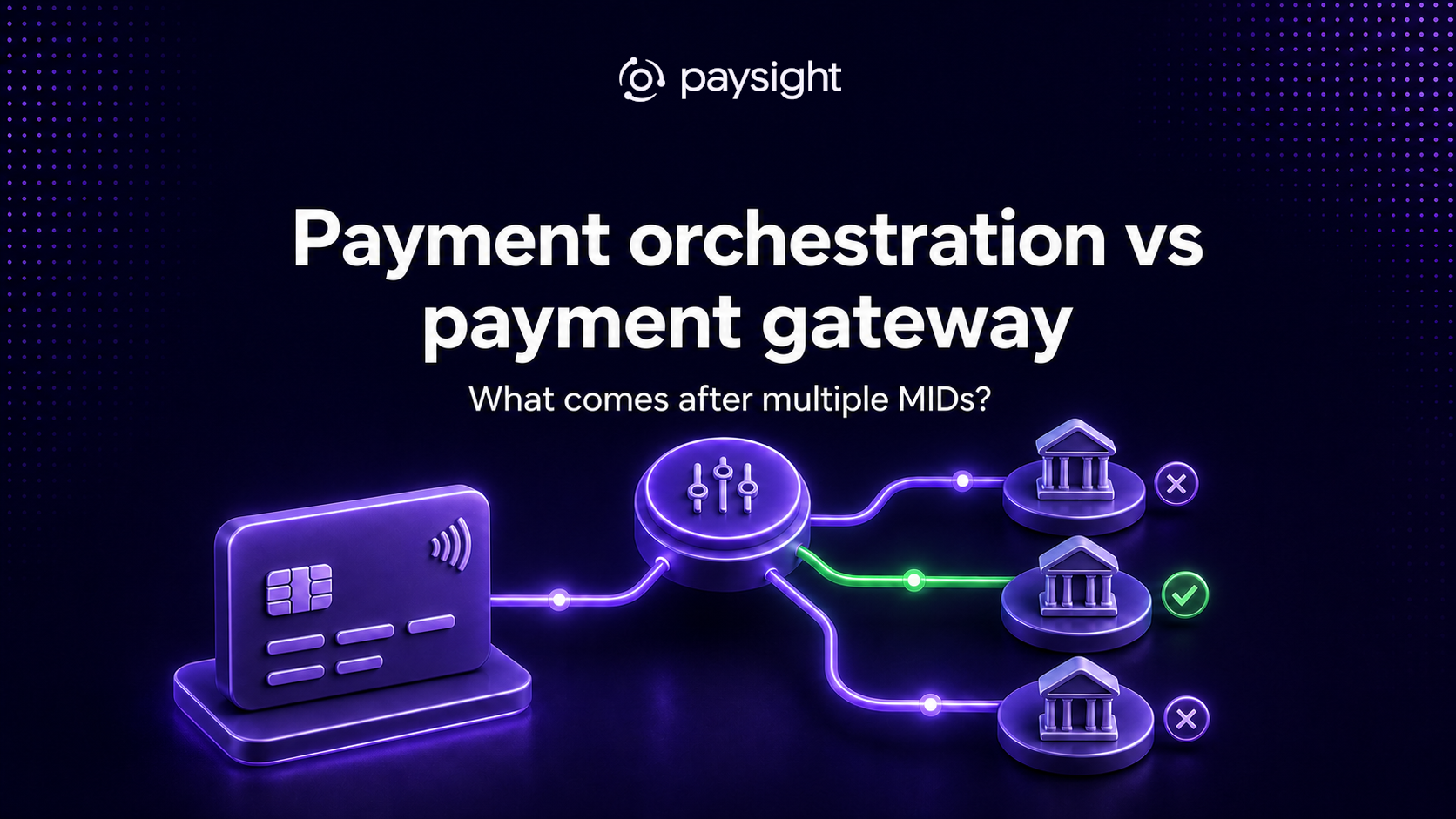
Two to three active MIDs across different acquirers is the right setup for any business processing meaningful volume. Different acquirers have different strengths: some perform better on European-issued cards, others on US domestic transactions, some have higher tolerance for subscription billing models, others are stronger on cross-border transaction approval rates. Distributing volume across acquirers with complementary strengths improves overall approval rates across the portfolio, keeps each MID within healthy processing ranges, and ensures that a change in any single relationship is a routing adjustment rather than a revenue event.
How Paysight Fits Into This
Paysight is a payment orchestration platform. It connects merchants to multiple acquiring relationships and manages how traffic flows between them.
If your payment infrastructure is built around a single merchant account, every acquirer decision is a potential revenue event. Talk to Paysight.
Standard applications for low-risk categories take two to five business days. Applications in categories that require additional scrutiny, including subscription businesses and nutraceuticals, can take one to two weeks. Incomplete applications extend timelines significantly because underwriters pause review while waiting for missing documents.
There is no universal minimum, but personal credit history is reviewed for all principals with significant ownership. A score below 600 creates friction. More important than the score is the absence of recent bankruptcies, judgments, or patterns that suggest inability to manage financial obligations.
Specialist acquirers underwrite categories that standard acquirers decline. The application process is the same, but documentation requirements are typically more detailed and approval timelines are longer. The key is matching your application to an acquirer who has experience in your specific category.
Yes, but the application needs to address the rate directly. An explanation letter describing what caused the elevated rate, what operational changes you have made, and what your current rate is will be required. Some acquirers will approve with conditions: a larger reserve, a lower processing cap, or enhanced monitoring.
The MATCH list is maintained by Mastercard and flags businesses whose merchant accounts were terminated for specific reasons including excessive chargebacks, fraud, and compliance violations. A listing stays active for five years and causes most standard processor applications to be declined automatically. Reason code 12 (PCI non-compliance) can be disputed through Mastercard's formal process if you can demonstrate current compliance.
A rolling reserve is a percentage of processing volume (typically 5-10%) held by the acquirer for 90-180 days as security against chargebacks. It is standard for new accounts and negotiable. Merchants with strong financials, clean prior processing history, or collateral to offer can negotiate a smaller reserve, a shorter holding period, or faster release conditions.
Request a limit increase after three to six months of clean processing at or near your current cap. Submit the request with current processing statements, your chargeback rate, your refund rate, and updated financial statements. Complete documentation moves through the process faster than an informal request without supporting evidence.
A single MID means a single point of failure. If your acquirer restricts your volume or terminates the relationship, your processing stops. Multiple active MIDs across different acquirers means that a change in any single relationship is a routing adjustment rather than a revenue event. Different acquirers also have different strengths by card type, geography, and business model, which improves overall approval rates across your transaction portfolio.
Your MCC determines chargeback thresholds, interchange rates, and the level of scrutiny your application receives before underwriting begins. Research which codes are accurate for your business model and which carry the most favorable risk classification for your category. If you are already processing under a code that does not reflect your actual business, discuss reclassification with your acquirer.
Paysight is a payment orchestration platform that connects merchants to multiple acquiring relationships and manages traffic between them. It keeps chargeback ratios clean through real-time chargeback alerts and subscription management, maintains healthy metrics across multiple MIDs through intelligent routing, and enables token portability so that adding or changing acquirers does not disrupt existing subscriber billing relationships.


.svg)


.png)


%25201.jpeg)


%25201.jpeg)


Company Reg. No. 760371
VAT No. IE4280069RH


