


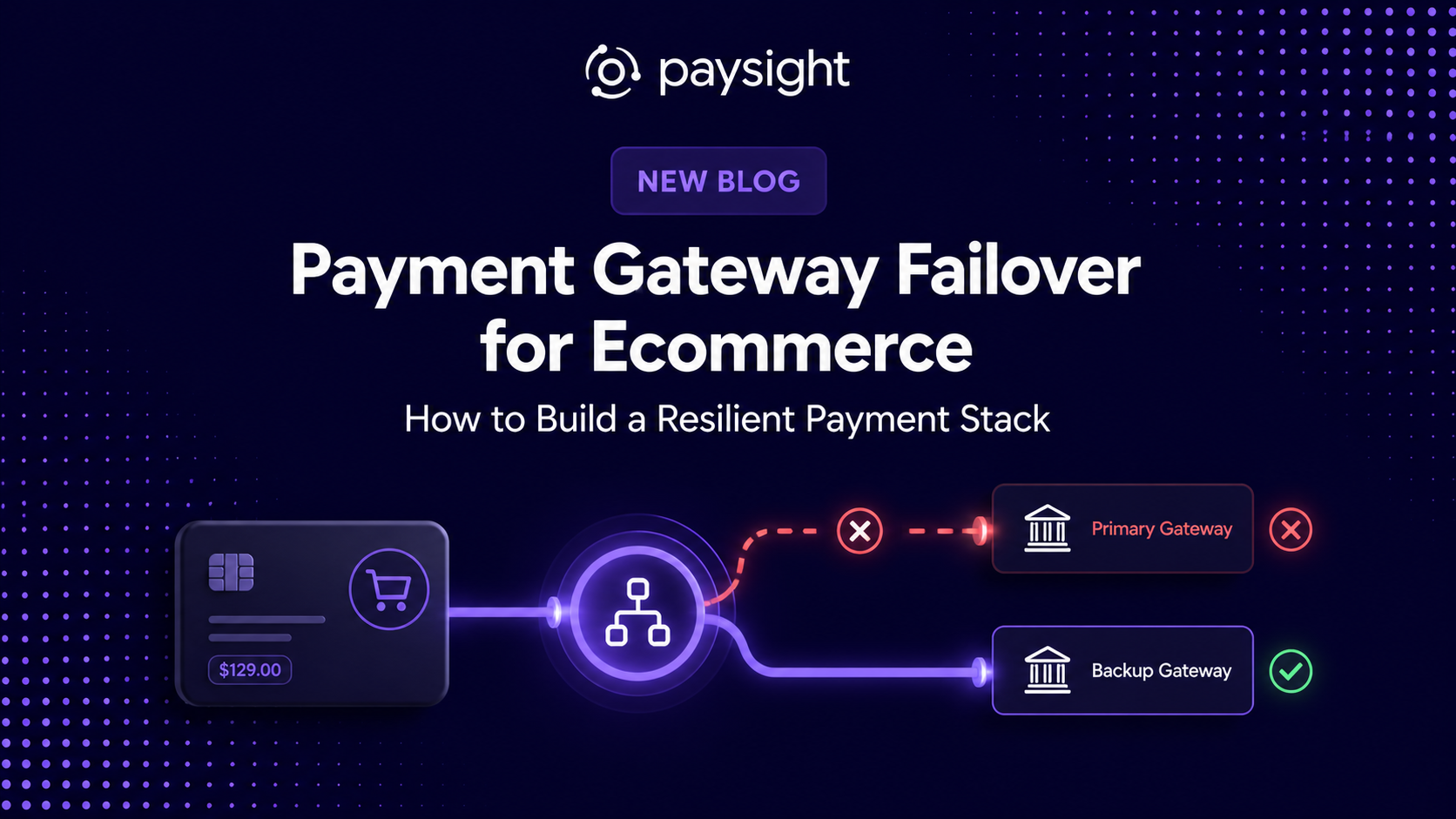
A payment gateway outage does not have to be a total blackout to damage revenue. A route can remain technically online while timing out, returning elevated errors, failing in one region, or degrading for a specific card type. If every payment depends on that route, a local provider problem becomes a checkout-wide problem.
Payment gateway failover gives eligible transactions another path when the primary route is unavailable or unhealthy. The important word is eligible. Safe failover is not a rule that retries every unsuccessful payment through every provider. It is a controlled system that distinguishes technical failures from valid payment decisions, confirms uncertain outcomes, and moves only the right transactions to a compatible backup.
This guide explains how payment gateway failover works, which events should trigger it, what can go wrong, and how ecommerce teams can design, test, and measure a resilient payment stack.
Key takeaways
Fail over on infrastructure failures, not every decline: timeouts, connection failures, and confirmed gateway incidents may justify another route; an expired card, fraud block, or issuer instruction normally requires a different response.
Protect every reroute against duplicate charges: preserve one order identity, use idempotency controls, check the original transaction status after ambiguous responses, and never assume that a timeout means the payment failed.
Verify route compatibility before an incident: the backup must support the same market, currency, card type, transaction model, authentication flow, and stored-credential requirements as the primary route.
Treat failover as an operating system, not a switch: health monitoring, routing rules, alerts, reconciliation, testing, and ownership matter as much as the second gateway connection.
What is payment gateway failover?
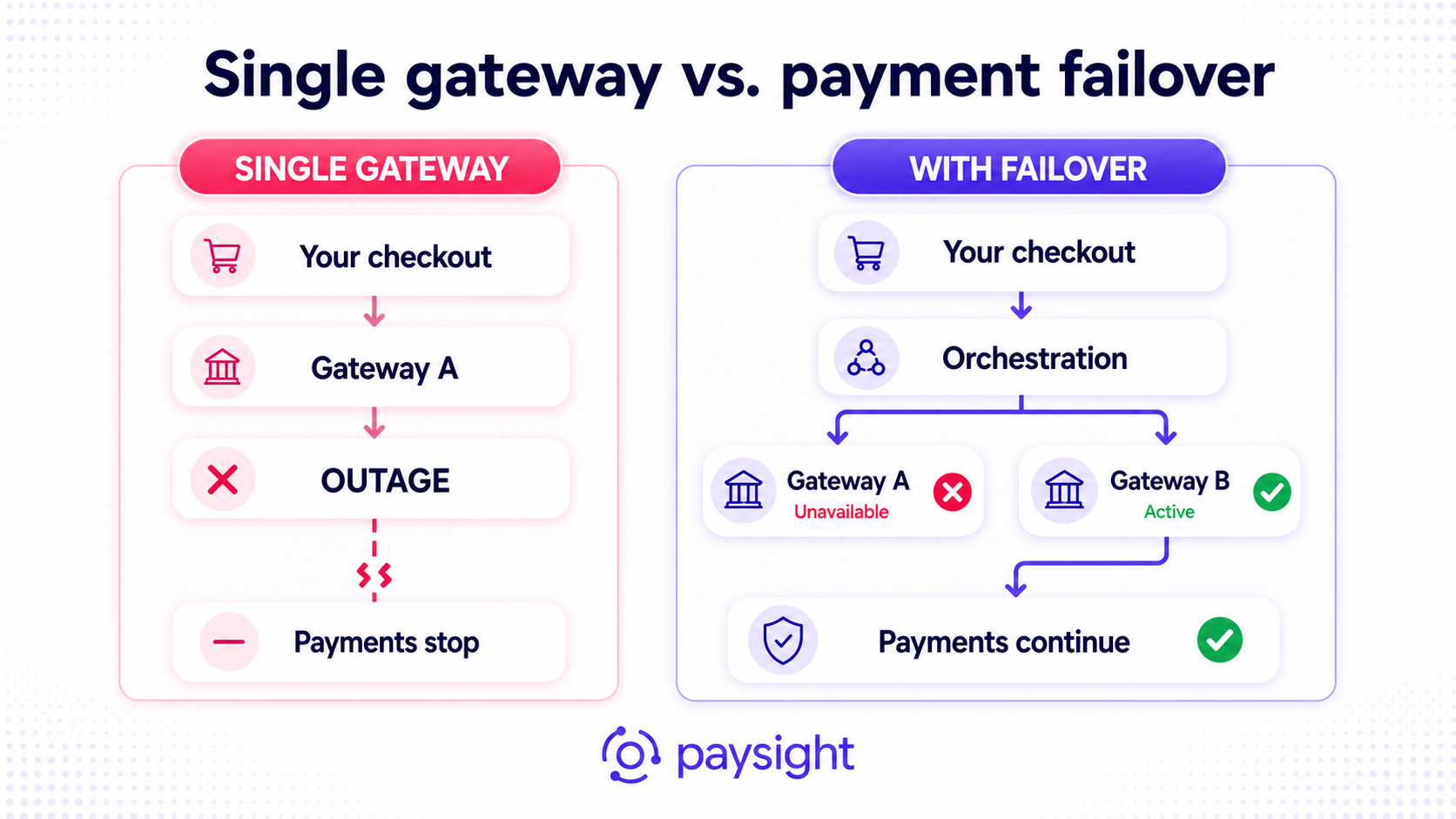
Payment gateway failover is the automatic or operator-controlled movement of eligible payment traffic from a primary route to a backup route when the primary becomes unavailable or degraded. The objective is payment continuity during a technical incident.
In the simplest active-passive model, Gateway A receives normal traffic and Gateway B remains ready. Monitoring watches error rates, latency, and provider health. When a threshold is crossed, new eligible requests move to Gateway B until Gateway A is healthy again.
Recurly's gateway failover documentation describes this model as routing transactions to a backup when communication errors indicate downtime. It also exposes several limitations that operators should take seriously: both routes need compatible currencies and card types, captures may need to stay with the original authorization gateway, and some transactions can be pinned to a specific route.
That is the difference between having a second provider contract and having working redundancy. A backup only reduces risk when it is connected, credentialed, compatible, monitored, and proven under real failure conditions.
Failover, cascading, smart routing, and orchestration are not the same
These terms are related, but they describe different decisions.
Gateway failover
Failover responds to a route that is unavailable or unhealthy. It is primarily a resilience control: if the selected path cannot reliably process the request, move eligible traffic to a tested backup.
Payment cascading
Cascading sends a failed transaction to another route under defined rules. The trigger may be a technical failure, but it may also be a recoverable decline for which another processor or MID is permitted. Cascading therefore needs tighter decline classification and retry governance than outage-only failover.
Smart payment routing
Smart routing chooses a route before the first attempt based on rules or signals such as geography, currency, BIN, payment method, transaction type, provider performance, cost, or MID capacity. Its job is to select an appropriate path during normal operation.
Payment orchestration
Payment orchestration is the control layer above the routes. It connects processors and acquirers, applies routing and cascading logic, manages shared services, and centralizes transaction data. Failover can be one policy inside that broader system.
The distinction matters because the safest response depends on what actually failed. An outage calls for continuity. A recoverable issuer response may call for a controlled retry. A hard decline may require customer action. A routing rule should not flatten those cases into the same behavior.
Why single-gateway setups are fragile
A single gateway concentrates several different dependencies behind one connection:
- Gateway API availability and latency
- Processor and acquirer availability
- Merchant account or MID status
- Regional endpoints and network connectivity
- Token vault access
- Fraud and authentication integrations
- Currency, card-brand, and payment-method support
- Credentials, certificates, and configuration
Any one of those can interrupt payment acceptance. A provider can also degrade partially. European cards may fail while domestic cards continue to work. One MID may reach a capacity or risk limit. A certificate change can break only a specific integration. Blended reporting can hide the issue while conversion drops in a narrow but valuable segment.
For subscription merchants, the failure is not limited to checkout. A gateway incident during a renewal run can create involuntary churn, dunning work, customer messages, and delayed cash flow. If stored credentials are locked to one processor, a backup connection may exist but still be unable to bill the subscriber.
Redundancy therefore needs to be designed around payment capabilities and transaction state, not just provider count.
How payment gateway failover works
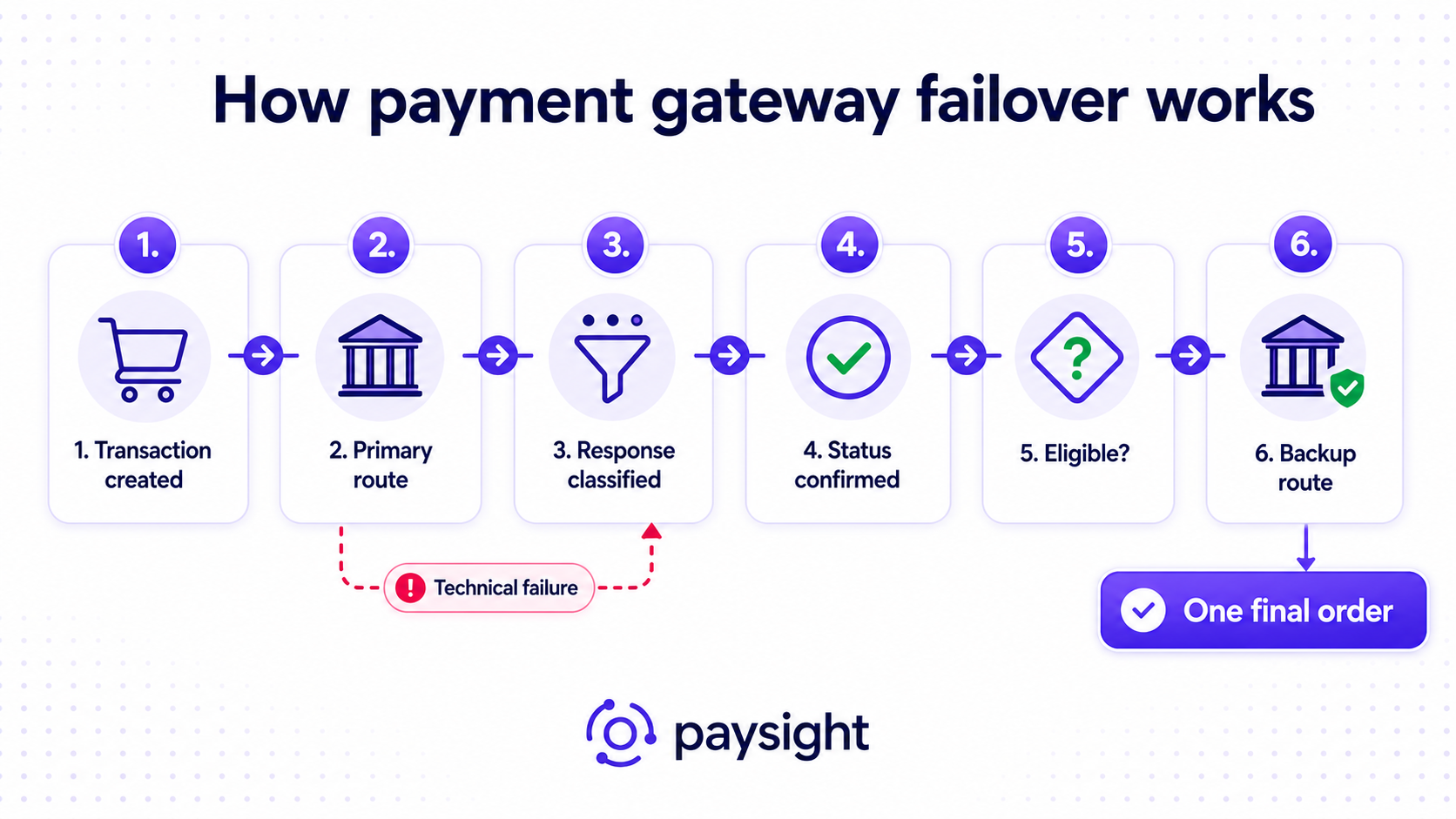
A mature failover flow performs six decisions around one payment attempt.
- Create one transaction identity. Assign an order reference and idempotency key before the first authorization request. Every status check, retry, and reroute must map back to that same commercial order.
- Select the primary route. Apply normal routing rules for the market, currency, payment method, transaction type, risk profile, and available MID capacity.
- Classify the result. Separate approvals, valid issuer declines, fraud or authentication blocks, invalid requests, confirmed technical failures, and ambiguous outcomes such as timeouts.
- Resolve uncertainty. If the connection ended without a definitive result, query transaction status or wait for the provider webhook before attempting another authorization. A missing response is not proof that no charge occurred.
- Apply the failover policy. If the error is eligible and the backup supports the transaction, send the request through the next healthy route while preserving order identity and duplicate protection.
- Record the final state. Store the route, response, latency, rule, gateway reference, MID, and final order outcome. Downstream fulfillment, receipts, refunds, and finance workflows should see one canonical result.
Stripe's documentation on cross-processor retries illustrates why eligibility matters: transactions can be excluded when the backup processor does not support a feature used on the first attempt, and unsuccessful 3D Secure authentication is not treated like a normal retry candidate.
Which payment failures should trigger failover?
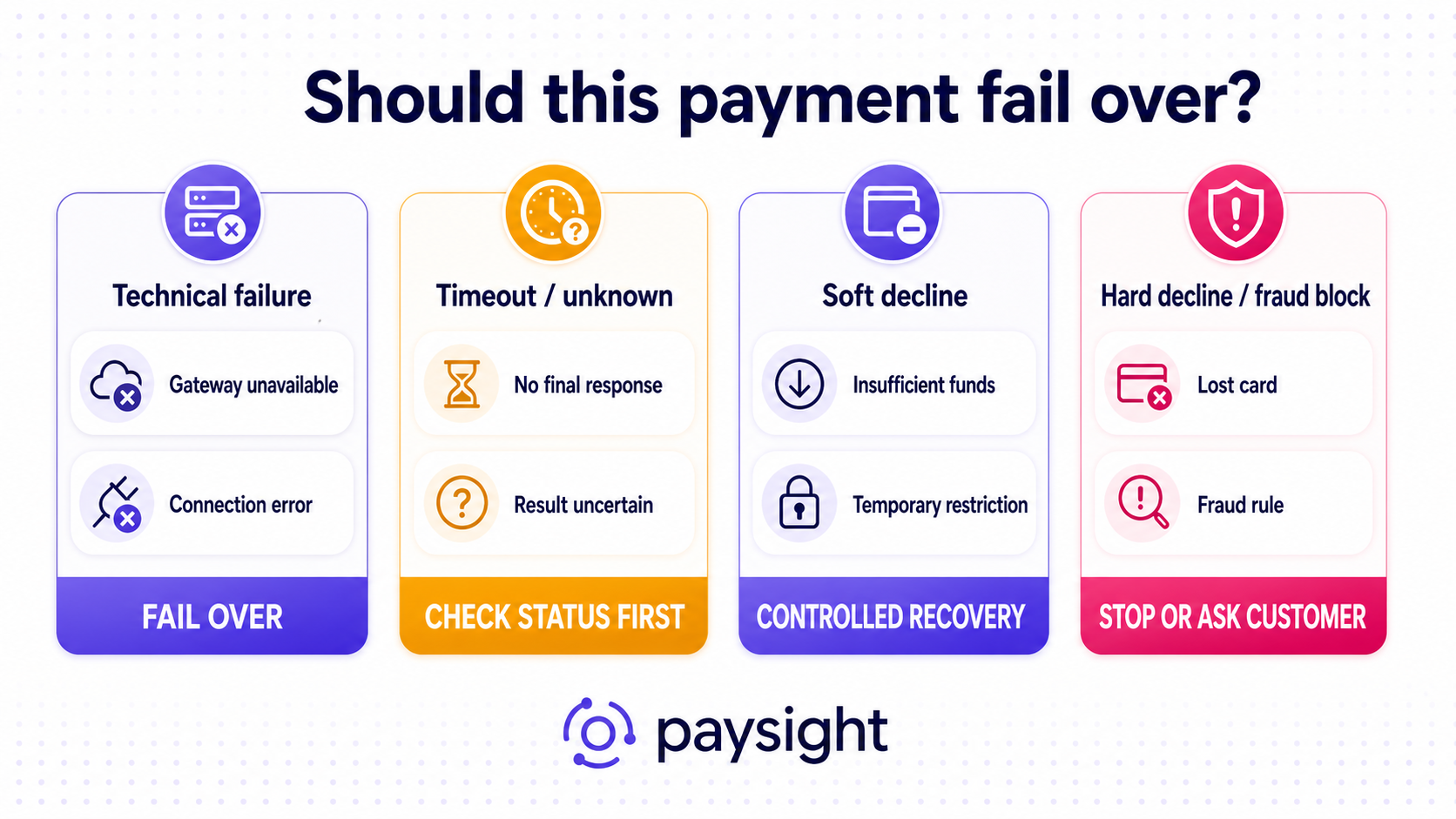
Good failover logic begins with an error taxonomy. The provider's exact codes differ, but the decision should map into a small number of operational classes.
Confirmed technical failure: usually eligible
Examples include connection refusal, DNS or TLS failure, confirmed provider outage, unavailable host, and explicit gateway or processor system error. These are the clearest failover candidates because the payment path failed before returning a normal authorization decision.
Timeout or unknown result: investigate before rerouting
A timeout is dangerous because the request may have reached the processor even though the response did not return. First perform a status check, wait for an authoritative webhook when appropriate, or safely repeat the same idempotent request. Only create a new routed attempt after the original state is known or the system can prove duplicate protection across routes.
Adyen's idempotency guidance explains that a timed-out request can be retried with the same key without performing the action twice. Stripe likewise recommends idempotency keys for POST requests so a connection failure can be retried without accidentally creating a second operation.
Soft issuer decline: sometimes eligible for controlled recovery
Insufficient funds, issuer unavailability, and some temporary restrictions may recover later or through an approved alternative route. These are not outage failover by default. They belong to a broader retry or cascading policy that respects network guidance, retry limits, and merchant risk rules.
Hard decline: usually not eligible
Lost or stolen card, closed account, invalid credentials, revoked authorization, and explicit do-not-retry advice should stop automated routing. The customer may need to provide a different payment method or contact the issuer.
Fraud or authentication block: do not bypass blindly
A fraud decision or failed 3D Secure step is not a gateway outage. Sending the same transaction around the original control can weaken risk governance and create inconsistent customer treatment. Route only when the full risk and authentication policy explicitly permits it.
Stripe's decline documentation separates issuer declines, fraud blocks, and invalid API calls because each category requires a different response. A failover engine should preserve that distinction.
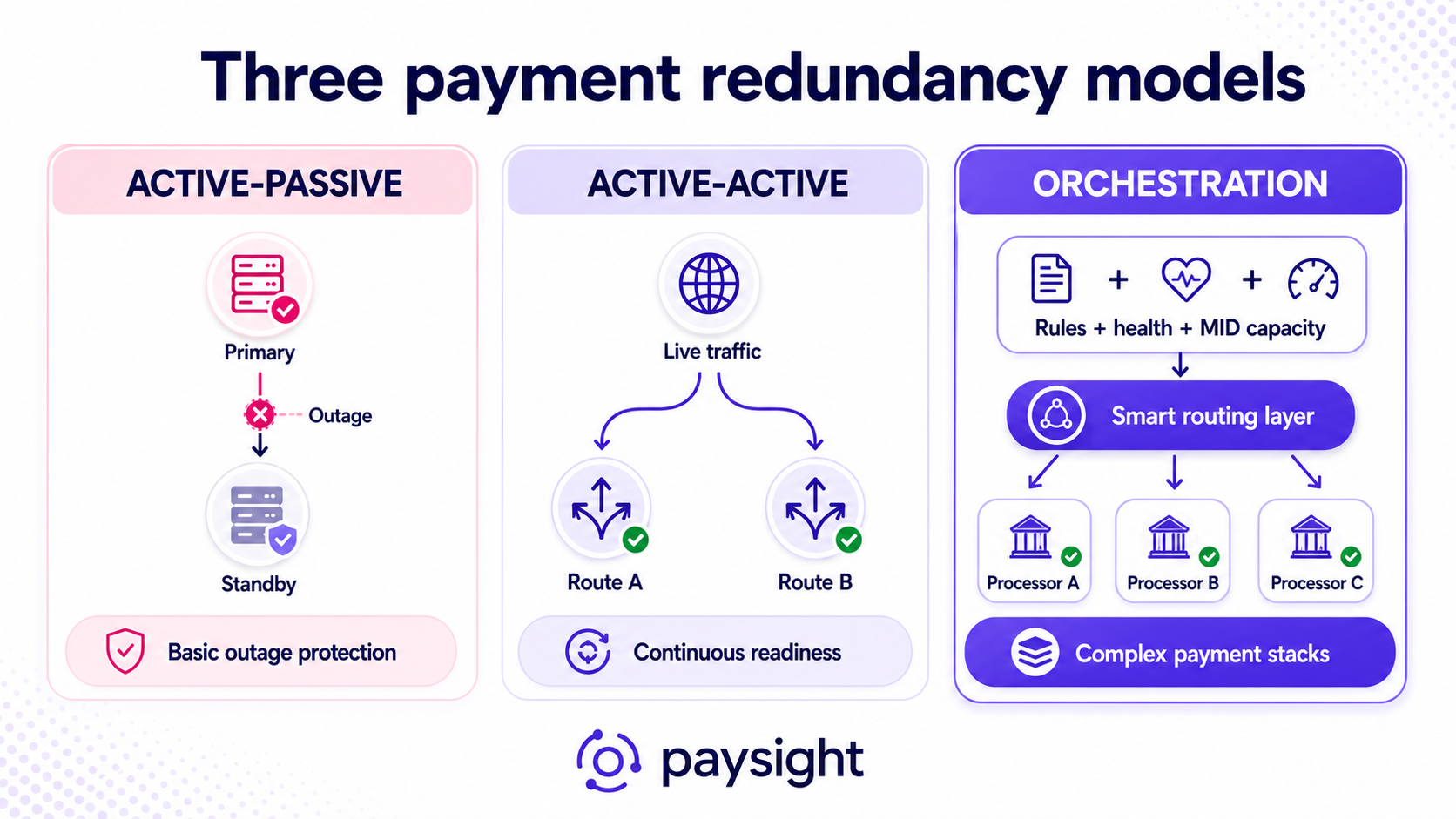
Three payment redundancy models
Active-passive failover
One primary route handles normal traffic while one or more backups wait for a health trigger. This model is straightforward to understand and can protect against a total outage. Its weakness is readiness: a route that receives no routine traffic can fail silently because of expired credentials, configuration drift, or an untested downstream dependency.
Active-active routing
Two or more routes receive production traffic during normal operation. Continuous volume proves that credentials, tokens, fraud controls, reporting, and settlement paths work. If one route degrades, its traffic can be redistributed. Active-active setups offer stronger operational evidence but require more careful reconciliation and performance analysis.
Rules-based orchestration
An orchestration layer selects among routes using transaction rules, live conditions, MID capacity, and failure classification. It can combine normal smart routing with failover and controlled cascading. This model is more flexible, but poor rules can create loops, excessive retries, inconsistent risk decisions, or traffic oscillation between unhealthy routes.
The right model depends on volume, markets, processor relationships, subscription exposure, and operational maturity. The goal is not the highest gateway count. It is the smallest set of genuinely independent, compatible routes that can be monitored and operated well.
How to build payment gateway failover safely
1. Build a route coverage matrix
List every market, legal entity, currency, card brand, payment method, transaction type, and sales channel. Assign a primary and compatible backup to each combination. Mark unsupported combinations explicitly; an incomplete backup is not redundancy.
2. Confirm commercial and technical independence
Two gateway logos can still depend on the same processor, acquirer, bank sponsor, regional endpoint, or merchant account. Map the dependencies behind each route. The more shared infrastructure the routes have, the more likely one incident affects both.
3. Design token portability
Determine where card credentials and network tokens live and whether the backup can use them. Confirm PCI scope, vault migration options, token aliases, account updater behavior, and how new customers are stored during an incident. For recurring billing, test stored-credential indicators and merchant-initiated transaction requirements on every route.
4. Preserve transaction state
Use a canonical order ID, provider references, idempotency keys, and an attempt ledger. The system should know whether a payment is new, pending, authorized, captured, voided, refunded, or disputed. Never let a second route create a second commercial order for the same shopper action.
5. Keep authorization and post-authorization flows together
Captures, voids, refunds, and disputes often need to return through the route that handled the original authorization or charge. Store that route affinity. Recurly's documentation notes that authorization and capture may not be compatible with failover because the capture must stay on the original gateway.
6. Align fraud, 3DS, and checkout behavior
Send consistent customer, device, product, address, and risk data to every route. Confirm which provider owns 3DS authentication and whether the authentication result can be used by the backup. Keep the amount, currency, tax, discount, descriptor, and fulfillment decision consistent after rerouting.
7. Add circuit breakers and recovery rules
Define error and latency thresholds, minimum sample sizes, cooldown periods, and route re-entry rules. Avoid switching traffic back after one healthy response. Use a stable recovery window so traffic does not bounce between providers during a partial incident.
8. Centralize monitoring and alerts
Monitor success rate, technical-error rate, latency, ambiguous outcomes, failover volume, recovered payments, and duplicate incidents by route, market, currency, card type, and transaction model. Alert with enough context for an operator to know what changed and which customers are affected.
9. Reconcile every route
Match the canonical order ledger against gateway transactions, captures, settlements, fees, refunds, chargebacks, and payouts. During an incident, reconciliation is part of the failover control. A payment is not operationally complete until the order and the money agree.
Special considerations for subscription payments
Subscription billing needs a different failover plan from live checkout.
The customer is not present to re-enter details or complete a new authentication challenge. The backup must support merchant-initiated transactions, stored credentials, the correct card-on-file indicators, and the merchant's retry policy. Tokens may be processor-specific, and account updater results may not be available in every vault.
There is also a timing choice. For a brief outage, pausing renewals may be safer than immediately rerouting them, especially when the original result is ambiguous. Recurly, for example, documents a model in which recurring transactions are paused during a failover event and released after the primary recovers, while first-time signup transactions can use the backup route.
For each subscription route, test:
- Initial signup and first payment
- Scheduled renewal
- Soft-decline retry
- Card updater result
- Plan change and proration
- Cancellation and reactivation
- Full and partial refund
- Chargeback and dispute evidence
- Customer email and access state
How to test a gateway failover plan
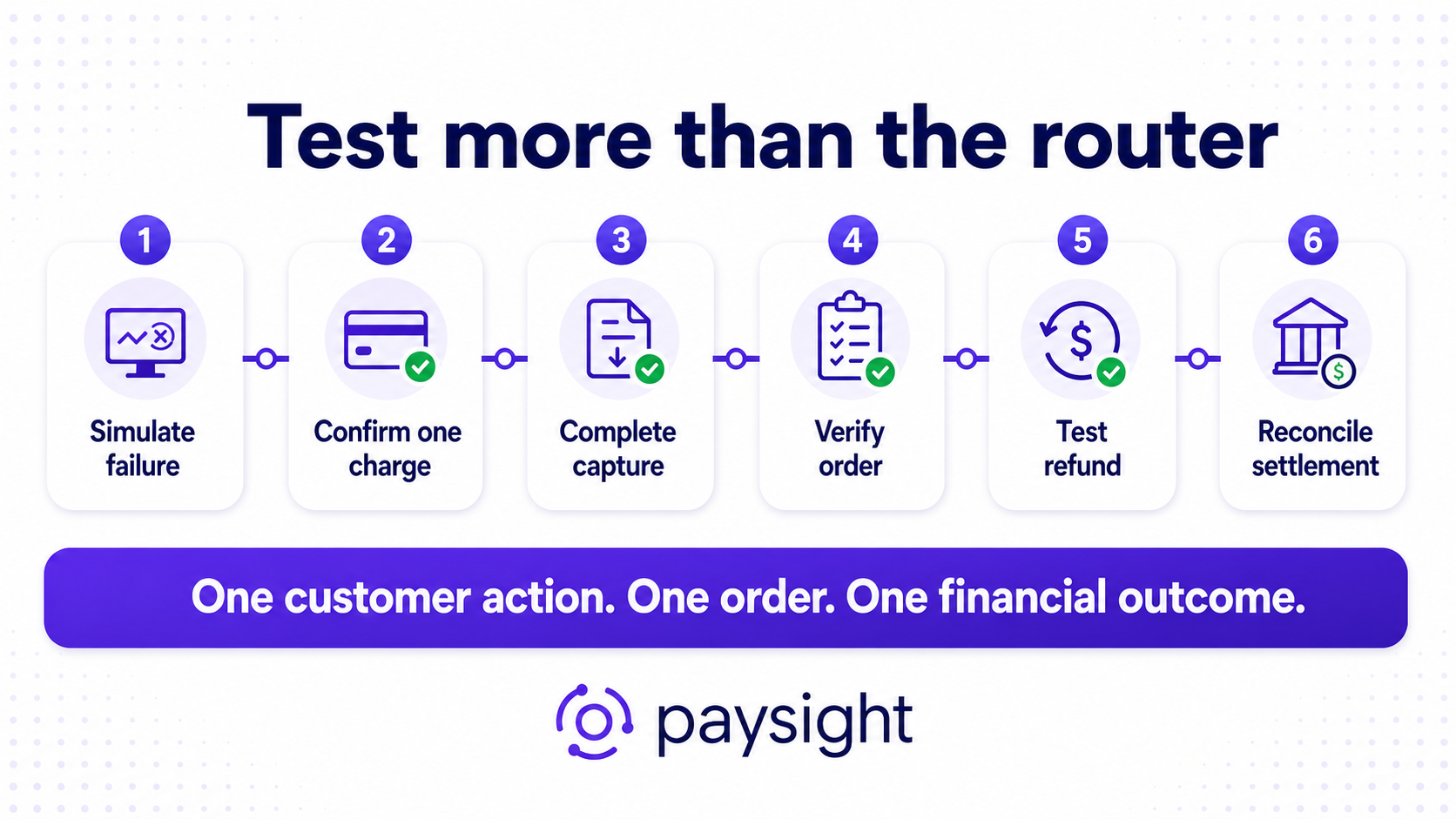
Test the full order lifecycle, not just the router.
Start with sandbox and controlled failure injection. Simulate a connection failure, a timeout with an unknown outcome, a provider 5xx error, a hard decline, a fraud block, a failed 3DS challenge, an unavailable token, and recovery of the primary route. Confirm that each condition produces the intended action.
Then test small live transactions under team control where provider rules permit it. Verify authorization, capture, receipt, order creation, inventory, fulfillment, refund, settlement, and reporting. Run separate tests by currency, card type, region, and subscription model.
The most important test is the ambiguous timeout. Confirm that the system checks status and uses idempotency before creating another attempt. A failover plan that preserves checkout but creates duplicate charges is not resilient.
Run drills before major campaigns, after provider or checkout changes, and on a regular schedule. Record the trigger, recovery time, affected routes, customer impact, duplicate risk, manual work, and reconciliation result. Update thresholds and runbooks after every real or simulated incident.
Metrics that show whether failover works
Track failover as a separate operating control rather than hiding it inside the blended approval rate.
- Gateway availability and latency by route
- Technical-error and timeout rate
- Failover trigger rate
- Eligible transactions rerouted
- Failover recovery rate
- End-to-end checkout completion
- Ambiguous outcomes awaiting confirmation
- Duplicate authorization or charge incidents
- Time to detect and time to recover
- Authorization, capture, refund, and settlement mismatches
- Subscription renewals delayed, rerouted, and recovered
Measure unique orders as well as attempts. One order can generate more than one technical attempt, so attempt-level approval rate alone can become misleading. The final metric is whether one customer action produced one correct order and one correct financial outcome.
Common payment failover mistakes
- Retrying every decline through every gateway
- Assuming a timeout means the charge failed
- Using a backup that cannot process the same currencies or card types
- Discovering during an outage that tokens are locked to the primary processor
- Moving authorization to one route while capture or refund logic still points elsewhere
- Applying different fraud and 3DS policies across routes
- Keeping a backup completely idle until the day it is needed
- Switching traffic based on one error without a stable threshold
- Failing over checkout but not subscriptions, refunds, reporting, or fulfillment
- Measuring reroutes without reconciling final orders and settlements
How Paysight supports resilient payment routing
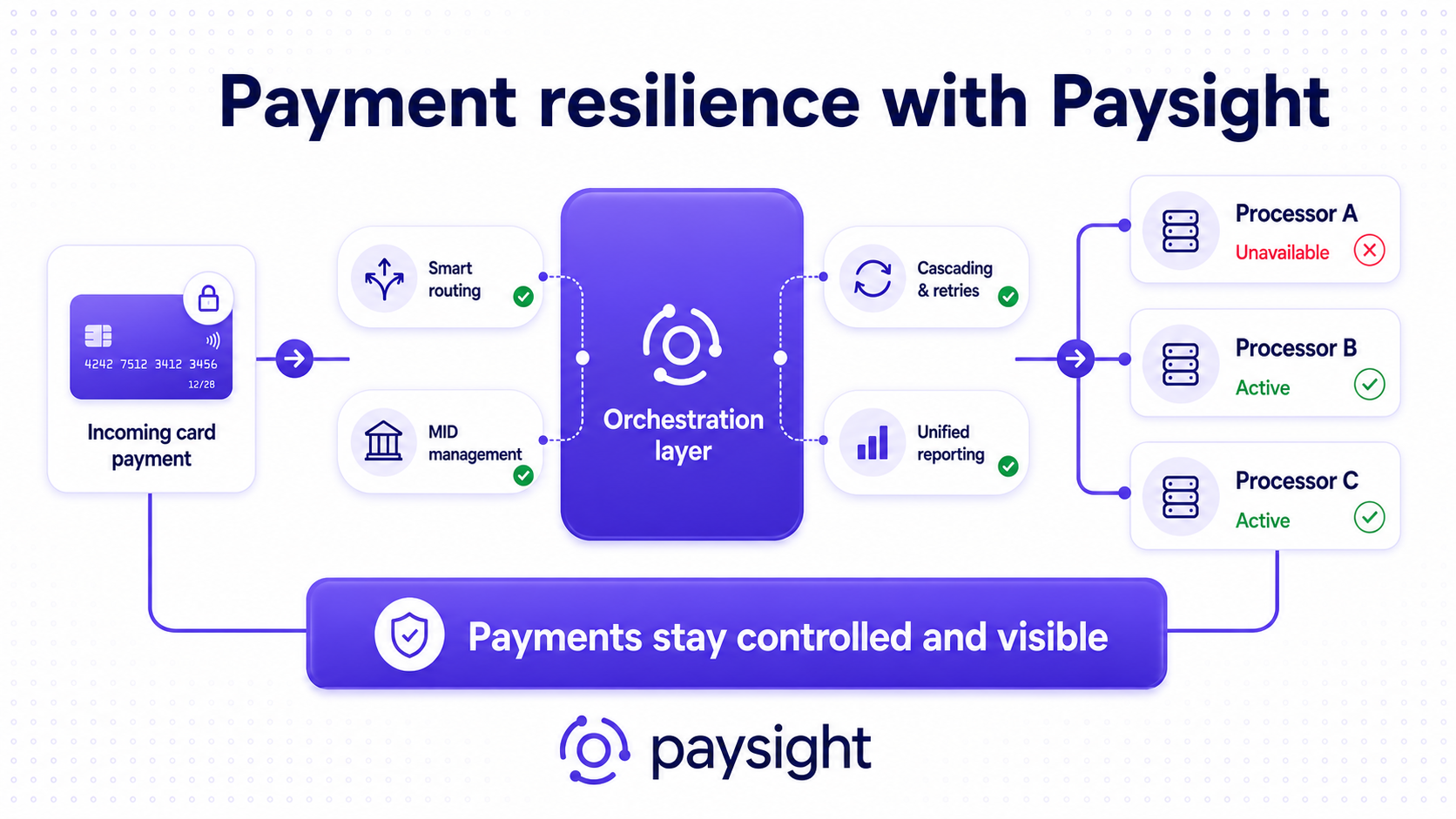
Paysight provides a payment orchestration layer for ecommerce merchants operating across multiple MIDs and processors. The platform combines smart routing, MID management, cascading and retry strategies, provider connectivity, and unified transaction reporting.
That structure lets teams define how payments should move during normal operation and how eligible failures should recover. Routes can be selected using rules and real-time conditions, traffic can be distributed across MIDs, and failed one-time or recurring transactions can follow controlled recovery logic.
Most importantly, payment events remain visible from a common operating layer. Teams can investigate declines, compare route performance, and manage payment flows without treating each processor dashboard as a separate source of truth.
Explore Paysight's payment orchestration platform or talk to the team about the routes, markets, and failure scenarios your current setup needs to support.
Payment gateway failover is the movement of eligible payment traffic from a primary gateway to a compatible backup when the primary route is unavailable or degraded. It protects continuity during technical incidents but should not automatically reroute every decline.
The system monitors gateway health and transaction responses, classifies the failure, confirms uncertain outcomes, and applies routing rules. If the problem is eligible and the backup supports the transaction, the payment is sent through the backup while preserving order identity and duplicate protection.
Failover responds to an unhealthy or unavailable route. Smart routing selects a suitable route during normal operation using factors such as geography, currency, card BIN, provider performance, cost, or MID capacity. Both can be managed inside a payment orchestration layer.
No. Technical failures may qualify, while timeouts require a status check because the original request may have succeeded. Hard declines, fraud blocks, invalid payment details, and failed authentication usually require customer action or a different recovery policy.
Use one canonical order reference, idempotency keys, transaction-status checks, webhooks, and an attempt ledger. Do not create a new authorization through the backup until the original attempt is confirmed failed or duplicate protection can guarantee one final charge.
Yes, but the backup must support stored credentials, merchant-initiated transactions, the correct currencies and card types, and the merchant's token and retry setup. In some incidents it can be safer to queue renewals until the original route recovers rather than reroute an uncertain result immediately.
Paysight connects multiple processors and MIDs through one orchestration layer. Merchants can apply smart routing, traffic-distribution, cascading, retry, and recovery rules while monitoring transaction outcomes and route performance from a unified system.


.svg)

.png)




Company Reg. No. 760371
VAT No. IE4280069RH


