


An ecommerce CRM tells you who the customer is, what they bought, how often they return, and which interactions shaped the relationship. Payment orchestration tells you how a payment should move across processors, merchant accounts, payment methods, and recovery services.
Connected properly, these systems turn payment events into useful customer context and customer context into better payment decisions. A failed renewal can trigger the right recovery journey. A high-value returning customer can be routed through a suitable processor without weakening fraud controls. Support can see whether an order failed, succeeded after a controlled retry, or is waiting for authentication instead of asking the customer to try again blindly.
The goal is not to make the CRM process payments or to fill it with raw gateway logs. The goal is to create a reliable operating loop between customer data, transaction decisions, and the teams responsible for revenue.
This guide explains what an ecommerce CRM with payment orchestration is, how the two layers work together, which use cases matter, what data should move between them, and how to evaluate an integrated or connected setup.
Key takeaways
An ecommerce CRM and a payment orchestration platform solve different problems. The CRM manages customer context and engagement; orchestration manages payment-path decisions and transaction execution.
The connection is most valuable when payment events become actionable customer signals. Decline reason, retry outcome, processor route, authentication status, and subscription state can drive service, retention, and recovery workflows.
A single customer view does not require one all-in-one database. It requires clear systems of record, durable identifiers, normalized events, and agreed ownership for every workflow.
Payment data should be useful without exposing sensitive card data. Store tokens and payment credentials in an appropriate vault, and send only the minimum operational context into the CRM.
Measure the final customer and revenue outcome, not only payment attempts. One successful order, one correct charge, and one reconcilable settlement matter more than a superficially high retry count.
What is an ecommerce CRM with payment orchestration?
Salesforce defines CRM as technology for managing a company’s relationships and interactions with customers and prospects. In ecommerce, that record commonly includes identity, consent, orders, returns, support cases, marketing engagement, customer value, subscription status, and lifecycle segments.
Payment orchestration is the control layer that connects a checkout or billing system to multiple payment processors, acquirers, merchant accounts, payment methods, fraud tools, token services, and other payment infrastructure. It can apply routing rules, coordinate eligible retries, normalize transaction responses, and provide shared operational visibility.
An ecommerce CRM with payment orchestration is therefore not simply a CRM with a payment button. It is a connected operating model in which customer and order context can inform payment execution, while payment outcomes update the customer record and trigger the next appropriate action.
The distinction matters. If the CRM tries to become the payment ledger, transaction state becomes unreliable. If the payment layer tries to become the CRM, customer communication and lifecycle context become shallow. Strong architecture gives each layer a clear job and connects them through events and identifiers.
Why a standard ecommerce CRM is not enough
A standard ecommerce CRM can tell a team that a customer has purchased three times, opened a support case, or belongs to a high-value segment. It usually cannot decide whether a card transaction should go to processor A or processor B, whether another route supports the required authentication, or whether a retry would create duplicate-charge risk.
Payment behavior is also more complex than a simple “paid” or “failed” field. A transaction may be awaiting 3D Secure, authorized but not captured, timed out with an unknown processor result, declined for a hard reason, recovered on a secondary route, partially refunded, disputed, or settled with a fee that differs from the original estimate.
Reducing all of that to one CRM status removes the detail needed by payments and finance teams. Copying every raw processor response into the CRM creates the opposite problem: noise, security exposure, and conflicting records.
The practical answer is a normalized event layer. The payment system remains responsible for transaction truth. It sends the CRM the customer-safe facts needed for segmentation, service, and automation.
Why payment orchestration needs customer context
Orchestration can route and monitor payments without becoming a CRM, but customer and order context can make its decisions more useful.
A first-time international order, a renewal from a long-tenured subscriber, and a high-value purchase from a known customer may all require different routing, authentication, or recovery policies. The payment layer does not need the customer’s entire marketing history. It needs a controlled set of attributes that are relevant to the payment decision.
Useful context may include:
- Customer type: new, returning, subscriber, wholesale, or marketplace seller
- Order characteristics: amount, currency, products, risk category, and fulfillment model
- Commercial context: one-time purchase, initial subscription, renewal, upgrade, or recovery attempt
- Geography and entity: customer country, merchant entity, market, and local acquiring eligibility
- Prior operational state: previous successful route, payment-method age, or an unresolved transaction
- Consent and communication state: whether the business may send a recovery message and through which channel
These signals should never become a reason to bypass issuer decisions, authentication requirements, fraud controls, or card-network rules. Customer context helps select a suitable eligible route; it does not make an ineligible transaction valid.
How CRM and payment orchestration work together
The workflow begins with one commercial identity. The ecommerce platform creates an order or subscription event with a stable customer ID and order ID. The CRM, commerce platform, and payment layer retain their own records, but they can all refer to the same commercial transaction.
Before authorization, the payment layer receives the minimum context required for routing: amount, currency, market, transaction type, available payment method, merchant entity, and approved customer or order attributes.
The orchestration layer then filters eligible routes and applies the configured policy. Stripe’s public orchestration documentation provides one example of rules based on card country, currency, amount, and other conditions, with processor-level performance monitoring.
After the attempt, the payment layer records the processor, merchant account, response, authentication state, retry history, and final transaction status. It then emits a normalized event to the commerce and CRM systems.
The CRM uses that event to update the customer journey or trigger an owned workflow: a service task, a payment-update message, a subscriber recovery sequence, a suppression rule, or a lifecycle segment change.
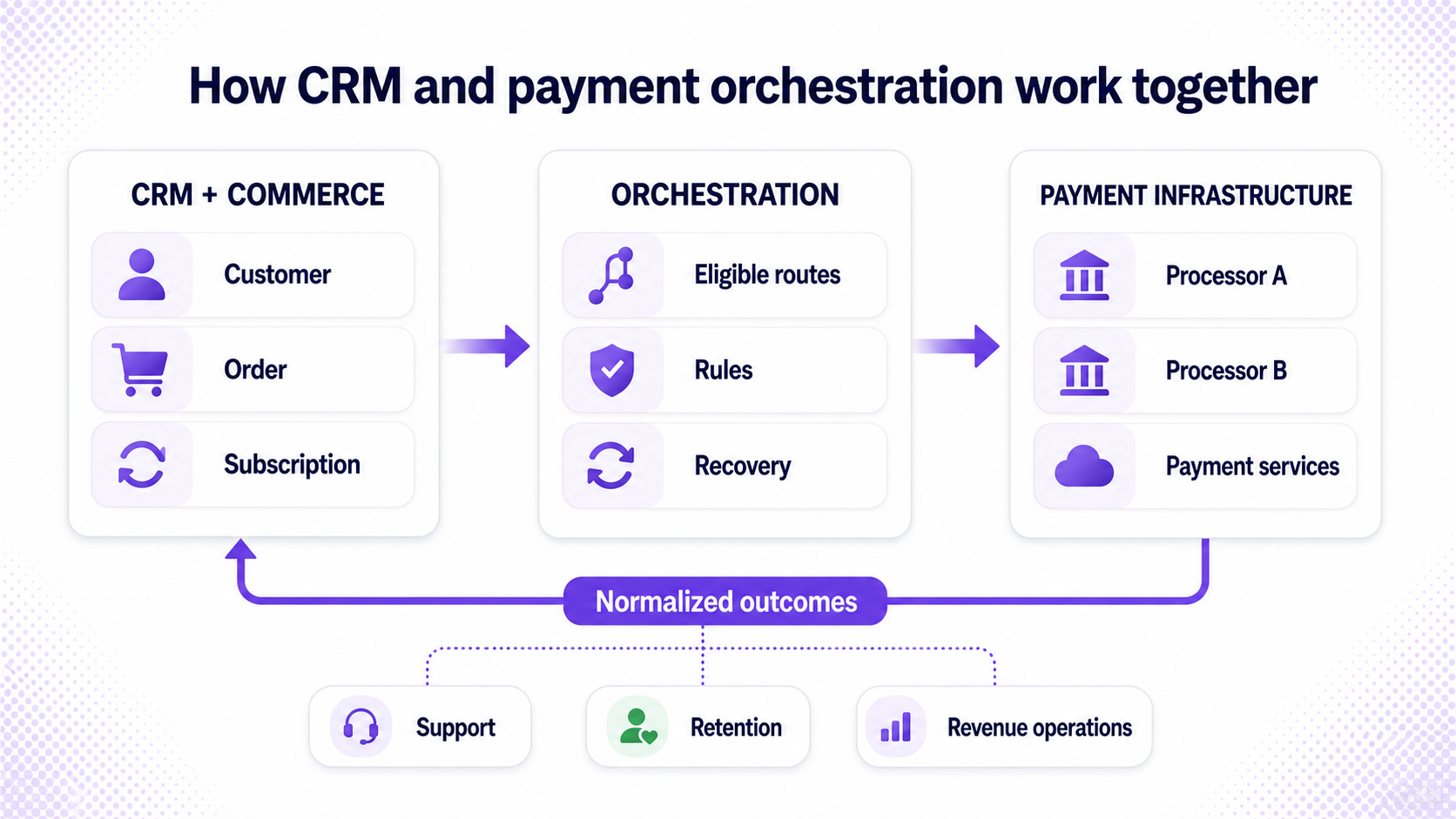
The result should be a closed loop. The CRM informs the payment policy with approved context; orchestration returns a trusted outcome; the appropriate team or automation acts on that outcome; and the final customer state remains consistent across the stack.
The payment events worth sending to your CRM
Not every processor message belongs in a customer profile. Start with events that change what a customer, support agent, retention team, or revenue operator should do next.
This table is intentionally action-oriented. A field is useful in the CRM only when it changes a decision, a segment, a message, or a service workflow.
The payment layer should retain the detailed attempt ledger. The CRM should store a customer-safe summary and a reference back to the source transaction for authorized users who need the full detail.
High-value ecommerce use cases
Recovering failed subscription payments
Recurring payments are where the connection often creates the clearest value. The customer is not present, so a generic decline can otherwise become a cancellation without a coordinated response.
The orchestration layer can classify the failure and determine whether another processor, merchant account, payment method, or later retry is eligible. The CRM or subscription system can then trigger the correct communication: wait, ask for a new payment method, confirm recovery, or open a service task for an important account.
Hard declines, revoked authorizations, and failed authentication should not be retried blindly. Recoverable failures need retry ceilings, timing rules, and one shared attempt history. The CRM message must reflect the actual payment state, not merely the first failure.
Reducing false “payment failed” support tickets
Payment timeouts create ambiguity. The checkout may not receive a response even though the processor completed the authorization. Telling the customer to pay again can create a duplicate.
An orchestration layer can reconcile the ambiguous state through transaction lookup, webhooks, and idempotent operations before the CRM sends a failure message. Support sees “status under verification” or the final confirmed outcome rather than a misleading decline.
Routing by market and merchant entity
International merchants may have several legal entities, processors, currencies, and local acquiring relationships. CRM or commerce data can provide the customer market and business segment; orchestration can use that context to select only routes that are technically and commercially eligible.
The value is operational consistency. Marketing does not choose the processor, and the CRM does not hard-code gateway logic. It supplies trusted context; the payment policy owns the decision.
Protecting high-value customer journeys
A returning customer with a large order may deserve faster human support when a payment fails, but not weaker fraud controls. The payment event can trigger a priority service workflow while the orchestration layer preserves the same risk and authentication requirements.
This distinction prevents a common mistake: using customer value as a reason to force more attempts. The better response is to choose an eligible route, avoid duplicate or inappropriate retries, and give the service team precise context.
Coordinating refunds, disputes, and retention
A refund or dispute changes the customer relationship as well as the financial record. Payment orchestration can normalize the event and preserve the processor reference. The CRM can update the service case, suppress an inappropriate promotion, or assign follow-up.
The payment system remains the source of truth for the financial state. The CRM records how the event affects the customer journey.
CRM signals and payment decisions
The safest design is to make the boundary explicit: which CRM signals can influence routing, what decision the payment layer may make, and which guardrail must still apply.
This model keeps routing explainable. Every decision can be traced to a rule, an eligible route set, and a business objective. It also prevents a marketing attribute from silently overriding security or compliance policy.
Integrated platform versus connected stack
Some vendors package CRM, checkout, billing, and orchestration inside one product. Others connect a commerce platform, a CRM, and a specialized payment layer. Neither model is automatically better.
An integrated platform can reduce setup work and give teams one interface. A connected stack can preserve best-fit tools, limit migration scope, and keep payment specialization outside the CRM. The decision should be based on operating requirements rather than the appeal of having fewer logos on an architecture diagram.
The most important question is not whether the tools share one brand. It is whether customer identity, order state, payment state, communication ownership, and reconciliation remain consistent when something goes wrong.
Data architecture: one customer view without one giant database
“Single source of truth” is often misunderstood as “copy everything into one system.” A stronger model assigns truth by domain.
The CRM owns customer identity, relationship context, communication history, consent, service activity, and business-facing lifecycle fields.
The commerce or order system owns products, prices, carts, orders, fulfillment, returns, and the commercial state of the purchase.
The subscription system owns plans, billing schedules, entitlements, pauses, upgrades, cancellations, and renewal state.
The payment layer owns payment attempts, route decisions, processor references, authentication results, authorization and capture state, refunds, and recovery history.
Finance systems own settlement, fees, bank payouts, accounting entries, and reconciliation sign-off.
These systems can present a unified view without duplicating all of their internal records. Use stable IDs, versioned events, timestamps, and links to the authoritative record. Define how late or repeated events are handled and how conflicts are resolved.
Security, privacy, and token strategy
Payment context is valuable, but raw card data does not belong in a general-purpose CRM.
Use a PCI-appropriate payment form and vault. Send the CRM a payment-method reference and safe descriptors such as brand, last four digits, expiry month and year when appropriate, token status, and updater result. Do not send the primary account number, security code, or sensitive authentication data.
The PCI Security Standards Council’s tokenization guidance explains that tokenization replaces the primary account number with a surrogate value and may reduce the amount of cardholder data in merchant systems, although it does not eliminate PCI DSS responsibilities.
Also ask whether the token is portable. A processor-specific vault token may work for the current route but prevent recovery through another processor. Token ownership therefore affects both security and payment resilience.
Apply data minimization to customer context as well. The orchestration layer should receive only the fields required by an approved routing or risk rule. Sensitive profile attributes should not be copied into transaction metadata simply because the integration makes it possible.
Metrics that show whether the integration works
Avoid measuring the project by the number of synchronized fields or automated messages. Measure whether it improves payment outcomes and customer operations.
- Unique-order authorization rate
- Checkout completion rate
- Subscription renewal and recovered-revenue rate
- Recovery rate by decline class and attempt number
- Duplicate authorization or charge incidents
- Time between a payment event and the correct customer action
- Payment-related support contacts and average resolution time
- Percentage of support cases with complete payment context
- Customer-update completion after an unrecoverable decline
- Approval rate by route, market, transaction type, and customer cohort
- Refund and dispute workflow accuracy
- Settlement and CRM/order-state mismatches
Attempt-level approval rate can be misleading when one order generates several attempts. The end state should be one correct order, one correct charge, an accurate customer record, and a payment the finance team can reconcile.
Implementation plan
1. Define the commercial use cases
Choose two or three workflows with measurable value, such as subscription recovery, payment-status support, or market-based routing. Do not begin by synchronizing every available field.
2. Assign systems of record
Document which system owns customer, order, subscription, payment, and settlement state. Name the identifiers that connect them.
3. Create a payment event vocabulary
Normalize events such as payment authorized, authentication required, recoverable failure, unrecoverable failure, recovery scheduled, payment recovered, refund completed, and dispute opened.
4. Map each event to one owner and action
Decide whether the next step belongs to orchestration, CRM automation, subscription billing, support, risk, or finance. Prevent two systems from sending conflicting messages or scheduling independent retries.
5. Establish token and data boundaries
Confirm where credentials live, which references may enter the CRM, how access is controlled, and whether a second processor can use the stored payment method when required.
6. Test exceptions before happy paths
Test timeouts, duplicate webhooks, late responses, hard declines, authentication failure, processor outages, token failure, partial refunds, and out-of-order events. Verify both transaction state and customer communication.
7. Reconcile and monitor
Create dashboards that connect customer outcomes to route and processor performance. Set alerts for missing events, mismatched states, unusual retry volume, and processor degradation.
How to choose an ecommerce CRM with payment orchestration
Ask vendors or your internal team to demonstrate the complete lifecycle, not only a successful checkout.
- Can the platform connect the processors, acquirers, MIDs, and payment methods you actually use?
- Can routing use approved customer and order context without copying sensitive profile data?
- Which payment events can be sent to the CRM, and are they normalized across processors?
- How are timeouts, duplicate events, and idempotency handled?
- Can stored credentials support subscription recovery across routes?
- Who owns customer communication after each failure class?
- Can support see a safe payment summary and link to the full transaction?
- Are refunds, disputes, authentication, and settlement states represented correctly?
- Can rules be tested before live traffic is moved?
- Does reporting connect final order outcomes to processors, routes, cohorts, and customer actions?
- Can data and tokens be migrated if the architecture changes?
- What operational work remains with the merchant, CRM team, payment team, and finance team?
The best answer may be an all-in-one platform, a connected stack, or a hybrid. The correct choice is the smallest architecture that can execute the required workflows safely and explain every important state.
How Paysight connects payments to the customer journey
Paysight provides the payment orchestration and operations layer beneath an ecommerce checkout or billing flow. Merchants can connect multiple processors, acquirers, merchant accounts, and supporting payment services while keeping their existing commerce and customer systems.
The orchestration layer applies routing and traffic-distribution rules, coordinates eligible recovery flows, and centralizes transaction visibility. Normalized payment outcomes can then inform CRM, support, subscription, and revenue workflows without turning the CRM into a payment processor.
This separation gives each team the information it needs. Payments teams can manage routes and performance. Support can understand the customer-safe status of a transaction. Retention teams can trigger the right recovery journey. Finance retains the processor and settlement detail required for reconciliation.
Explore Paysight’s payment orchestration platform or talk to the team about the CRM, commerce, subscription, and processor systems you want to connect.
An ecommerce CRM is a system for managing customer identity, orders, interactions, service history, consent, lifecycle segments, and relationship context for an online business. It gives marketing, sales, support, and retention teams a shared customer view.
Payment orchestration is a control layer that connects a checkout or billing system to multiple processors, acquirers, merchant accounts, payment methods, and supporting payment services. It can apply routing rules, coordinate eligible retries, normalize responses, and centralize payment visibility.
No. A CRM may store payment status or provide a payment link without controlling multiple processors or routes. Payment orchestration manages how eligible transactions move through the payment infrastructure and how outcomes are normalized across providers.
Store only the customer-safe context needed for service and automation, such as payment status, transaction reference, processor-independent decline class, authentication status, payment-method descriptor, retry state, and links to the authoritative transaction. Raw card numbers and security codes should not be stored in the CRM.
It can classify renewal failures, apply controlled retry rules, use eligible alternative routes, connect token and account-updater services, and return a normalized outcome to the subscription and CRM systems. This helps prevent recoverable payment failures from becoming involuntary churn.
Yes, when a limited set of approved customer and order attributes helps identify eligible routes or operational policies. Customer context should not override authentication, issuer decisions, fraud controls, card-network rules, or processor restrictions.
No. Paysight sits beneath the commerce and customer stack as a payment orchestration and operations layer. It connects processors, acquirers, MIDs, and payment services, then returns normalized outcomes that CRM, support, subscription, and finance workflows can use.


.svg)

.png)




Company Reg. No. 760371
VAT No. IE4280069RH


