


Understanding GMV in Ecommerce: What It Measures, What It Misses, and What Actually Drives It


Gross merchandise value explained: the ecommerce metric investors watch and founders misread, and what actually drives it.
GMV is the metric everyone tracks and almost nobody reads correctly. It shows up in investor decks, platform dashboards, and quarterly reviews, and in every one of those contexts, it overstates how well the business is actually doing.
This article explains what gross merchandise value actually measures, how it relates to MRR, LTV, approval rates, and net revenue, and why payment infrastructure is the most overlooked lever for growing it.
What Is GMV in Ecommerce?
Gross merchandise value (GMV) is the total monetary value of all merchandise sold through a platform or store over a given period, before any deductions. It counts the full sale price of every transaction, regardless of returns, fees, chargebacks, or whether the revenue was ultimately retained.
Formula: GMV = Sale price × Number of units sold
Example: An e-commerce store sells 1,000 products at an average price of $80 in Q3. GMV = $80,000.
GMV is a volume metric. It measures how much was sold, not how much was kept.
GMV vs. Net Revenue: What's the Difference?
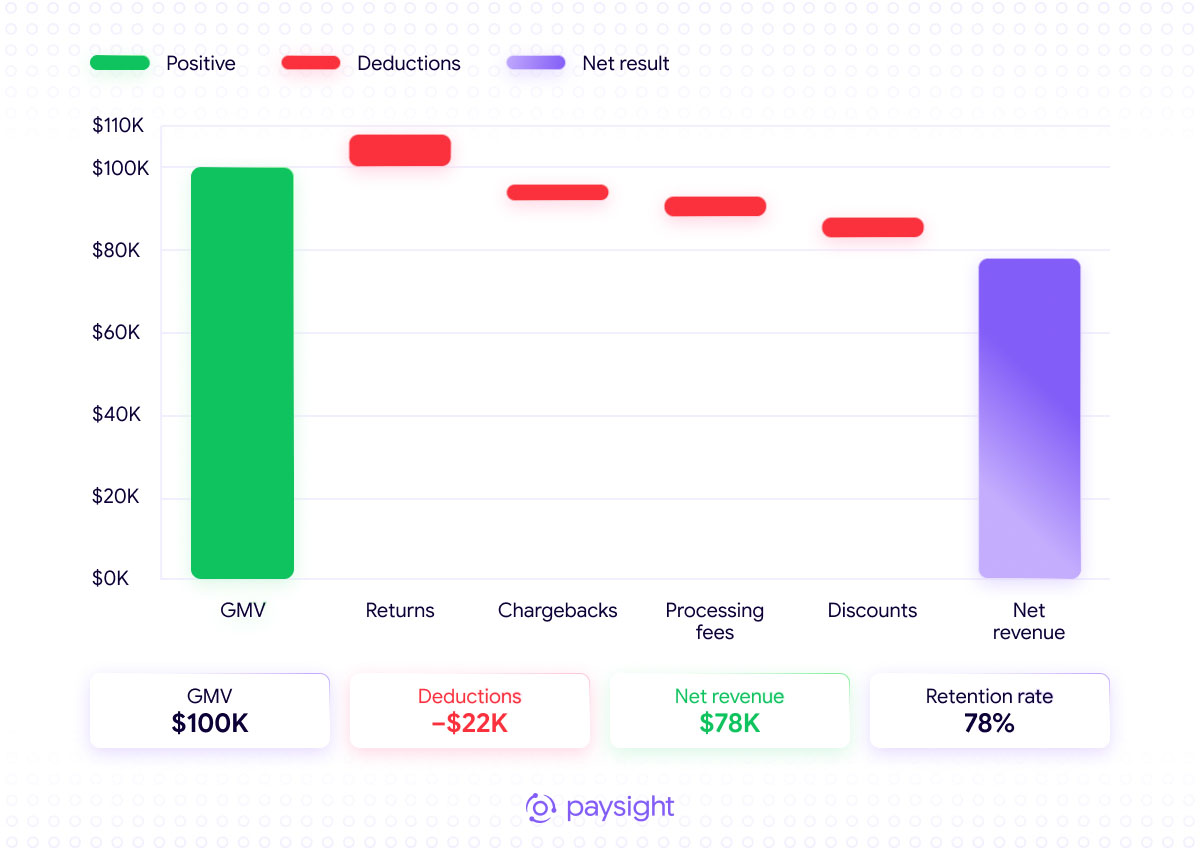
GMV and net revenue measure fundamentally different things. Confusing them is one of the most common mistakes in e-commerce reporting.
GMV counts the total value of transactions initiated. It does not account for:
- Returns and refunds
- Chargebacks
- Platform or processing fees
- Discounts and promotions
- Seller payouts (on marketplace models)
Net revenue is what remains after all of those deductions. For most e-commerce businesses, net revenue is significantly lower than GMV, sometimes by 20–40% depending on the category, return rate, and payment processing costs.
A business can grow GMV quarter-over-quarter while net revenue stays flat or declines if return rates increase, chargebacks rise, or processing costs grow faster than volume.
Why it matters: reporting GMV growth without context can create a misleading picture of business health. GMV tells you how much your customers intended to buy. Net revenue tells you how much you actually earned.
How to Calculate GMV
The basic GMV formula is straightforward:
GMV = Average order value (AOV) × Number of transactions
For subscription businesses, the calculation extends across billing cycles:
- Monthly GMV = Monthly recurring revenue (MRR) × Number of active subscribers
- Annual GMV = Annual recurring revenue (ARR) × Number of active subscribers
In practice, most e-commerce platforms, such as Shopify, WooCommerce, and BigCommerce, automatically report GMV in their dashboards. The number requires context to be useful.
GMV Benchmarks: What's Normal?
GMV benchmarks vary significantly by business model, category, and stage. Some reference points:
- GMV growth rate: High-growth ecommerce businesses typically target 30–50% year-over-year GMV growth in early stages. Mature businesses in competitive categories may grow GMV at 10–20% annually. Growth below 10% in a growing market category warrants attention.
- GMV-to-net-revenue ratio: For direct-to-consumer ecommerce, net revenue is typically 70–85% of GMV after returns, discounts, and fees. Businesses with high return rates (fashion, footwear) or high chargeback rates may see this ratio fall below 70%. Subscription businesses with low return rates and high renewal rates tend to have tighter GMV-to-net-revenue gaps.
- Approval rate impact on GMV: A 5-percentage-point improvement in authorization approval rate on $1M monthly GMV translates to approximately $50,000 in additional realized revenue per month — $600,000 annually — without any change to traffic, conversion, or pricing.
GMV vs. Other Key Ecommerce Metrics
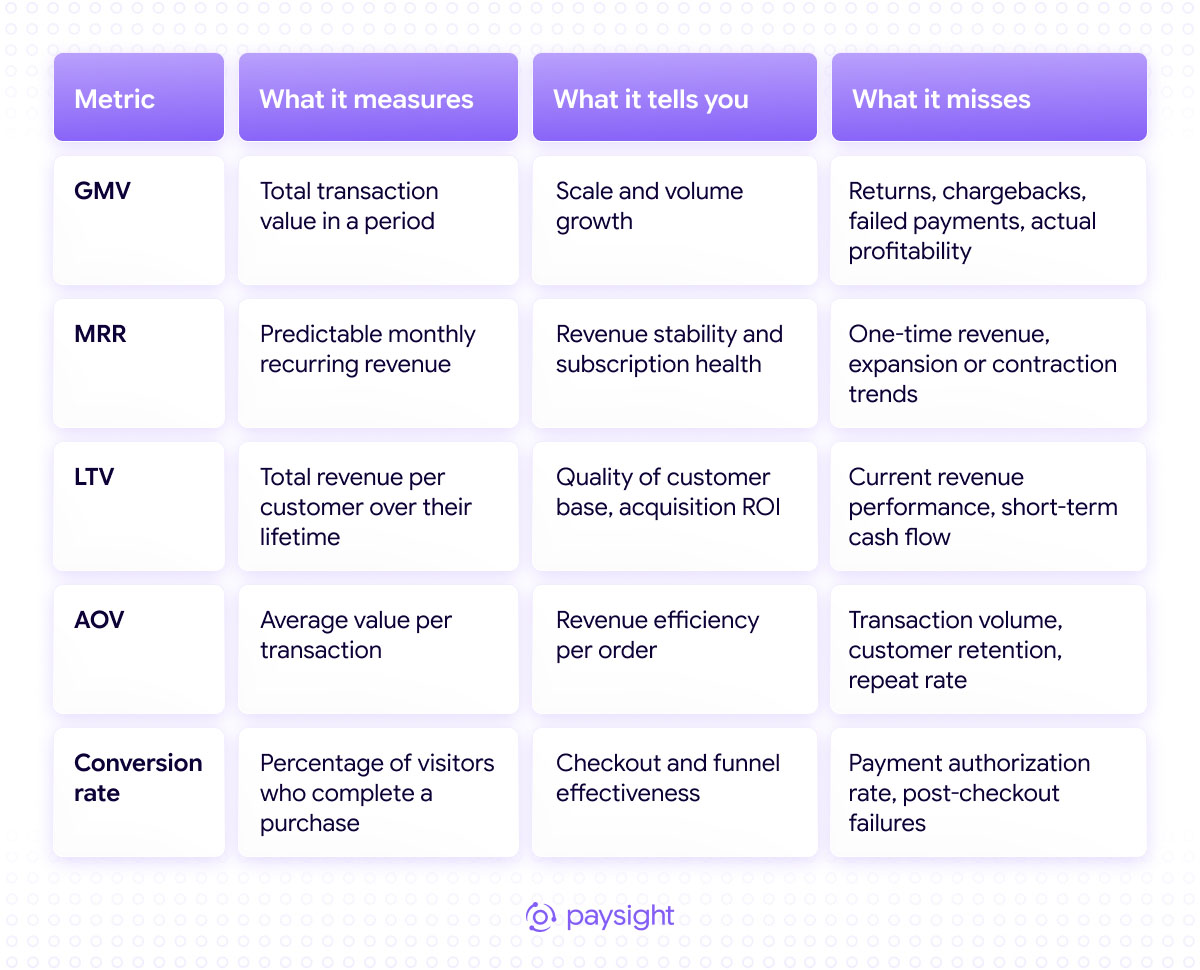
GMV doesn't exist in isolation. Here's how it relates to the metrics that give it meaning:
What GMV Doesn't Show You
GMV is a useful benchmark. It becomes misleading when treated as a success metric in isolation.
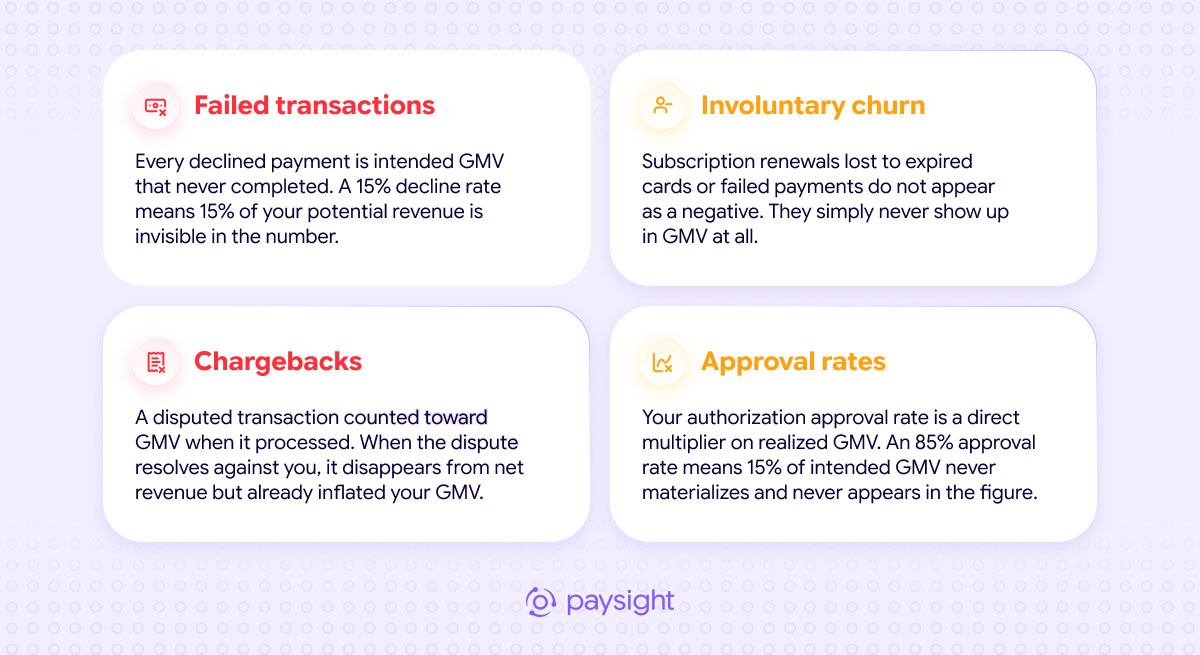
Understanding GMV means understanding what's suppressing it, and much of what suppresses ecommerce GMV happens in the payment infrastructure layer, not in the storefront.
How Payment Infrastructure Directly Affects GMV
This is where most GMV discussions stop too early. The factors that determine whether intended GMV becomes realized GMV are almost entirely payment-side.
Authorization approval rates
Every checkout that ends in a payment decline is a transaction that never enters your GMV. Approval rates vary significantly by acquirer, card type, geography, and transaction type. Routing transactions to the acquirer best positioned to approve them, based on card BIN, issuing country, or transaction profile, directly increases the volume of transactions that complete and count toward GMV.
For merchants running on a single processor, approval rates are fixed by that processor's relationships and risk model. Payment orchestration across multiple acquirers, with intelligent routing logic, consistently improves approval rates, which means more completed transactions and higher realized GMV from the same traffic.
Retry recovery and cascading
When a transaction is declined, cascading logic retries the transaction on the next best-positioned acquirer rather than presenting a failure to the customer. For subscription businesses, smart retry logic applied to failed renewals recovers a meaningful portion of the recurring GMV that would otherwise lapse into involuntary churn.
Chargeback ratio and GMV quality
A high chargeback ratio degrades GMV quality — inflating the gross figure while eroding net revenue. Managing chargebacks proactively, through alert-driven intervention before disputes become formal chargebacks, keeps the relationship between GMV and net revenue healthy. It also protects the processing relationships that enable GMV to continue growing.
Subscription renewal success rate
For subscription businesses, monthly GMV is a direct function of how many renewals succeed. Card account updaters keep stored card data current, reducing failed renewals from expired or reissued cards. Dunning flows recover failed charges before customers churn. The renewal success rate is effectively a GMV retention rate for recurring revenue businesses.
How Paysight Connects to GMV Growth
Paysight is a payment orchestration platform. It connects e-commerce businesses to multiple acquiring relationships and manages how traffic flows between them. Each of the four payment infrastructure levers above maps directly to a Paysight capability.
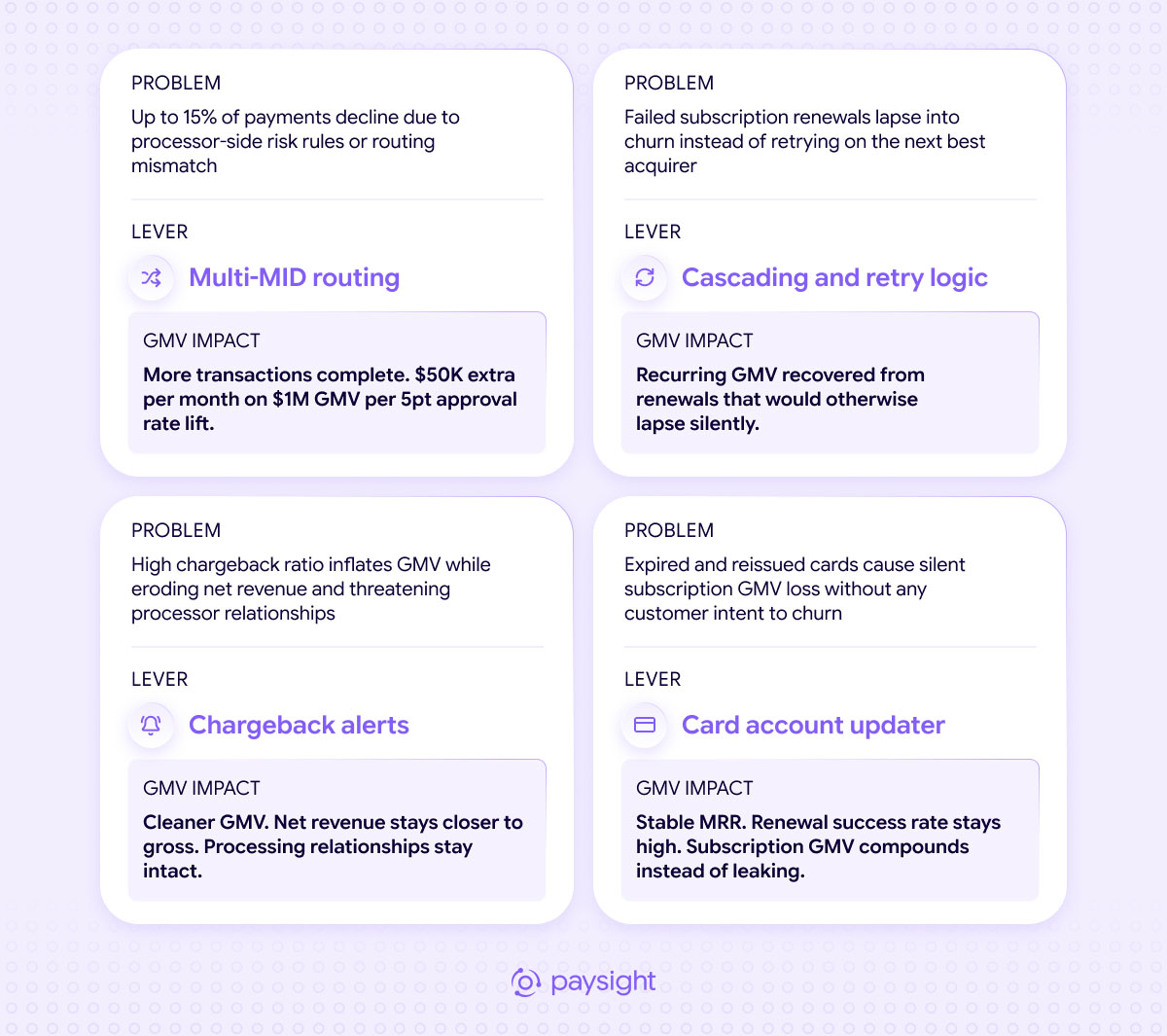
The point isn't that payment infrastructure is the only GMV driver, because it isn't. Acquisition, product, pricing, and conversion all matter. The point is that payment infrastructure is often the most overlooked GMV lever, and the one with the most direct, measurable impact on the gap between gross and net.
GMV in Subscription Ecommerce: A Different Calculation
For subscription businesses, GMV has a compounding dimension that one-time purchase businesses don't have. Each new subscriber contributes not just to this month's GMV but to GMV in every future month until they churn.
This makes the subscription GMV calculation more complex and more consequential:
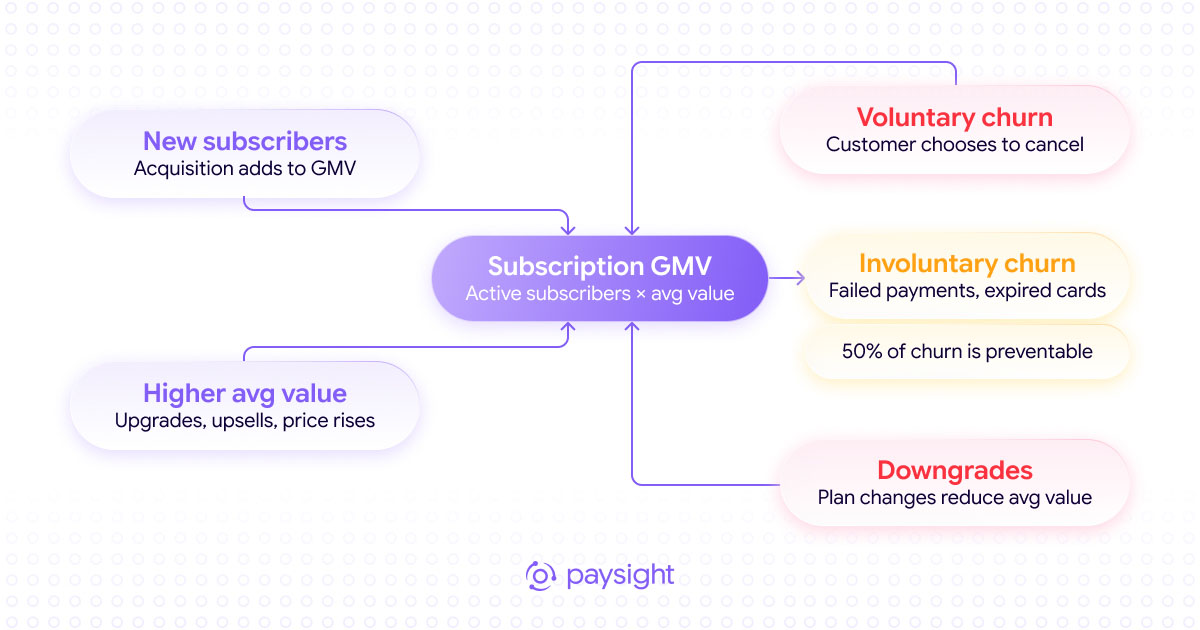
Monthly subscription GMV = Active subscribers × Average subscription value
For subscription businesses, GMV is just one of several subscription revenue metrics worth tracking alongside MRR, renewal success rate, and involuntary churn rate, which together give a more complete picture than GMV alone.
The variables that determine whether this grows or shrinks:
Ready to Protect Your Subscription GMV?
Involuntary churn is almost entirely preventable. A 2023 PYMNTS and FlexPay study found that failed payments account for 50% of all subscriber churn. Half of your GMV erosion may have nothing to do with customers choosing to leave.
Card account updaters, retry logic, and dunning flows are typically the highest-ROI fix available. Talk to Paysight to see what that looks like for your operation.
GMV stands for gross merchandise value. It represents the total monetary value of all goods sold through a store or platform over a given period, before any deductions for returns, fees, or chargebacks.
No. GMV measures the total value of transactions initiated. Revenue, specifically net revenue, is what remains after deducting returns, refunds, chargebacks, discounts, and fees. For most e-commerce businesses, net revenue is 70–85% of GMV.
GMV = Average order value × Number of transactions. For subscription businesses: GMV = Active subscribers × Average subscription value, calculated monthly or annually.
GMV is used as a top-line growth indicator, particularly for marketplace and platform businesses where the company takes a percentage of GMV as revenue. It is a measure of scale and transaction volume. However, sophisticated investors look at GMV alongside net revenue margin, LTV, and churn to assess actual business health.
High-growth e-commerce businesses typically target 30–50% year-over-year GMV growth in early stages. Mature businesses in competitive categories grow at 10–20% annually. The right benchmark depends on category, stage, and market conditions.
Failed payments reduce realized GMV without appearing as a visible negative in the metric. Every declined transaction is intended GMV that was never completed. For subscription businesses, failed renewals reduce recurring GMV each billing cycle. Improving payment authorization rates and retry recovery directly increases realized GMV.
GMV is a total transaction volume measure across all revenue types. MRR, or monthly recurring revenue, measures only predictable recurring revenue from subscriptions or repeat billing. For subscription businesses, MRR is a more operationally useful metric because it reflects revenue stability and renewal health, not just transaction volume.
Chargebacks inflate GMV when the transaction is processed but erode net revenue when the dispute is resolved against the merchant. A high chargeback rate signals that GMV is overstated relative to retained revenue. It also threatens the processing relationships that enable GMV to keep growing.
.png)


.svg)





%25201.jpeg)



Company Reg. No. 760371
VAT No. IE4280069RH


