


Can You Sell Vapes on Shopify in 2026? The Ban, Migration Options, and Payment Risk


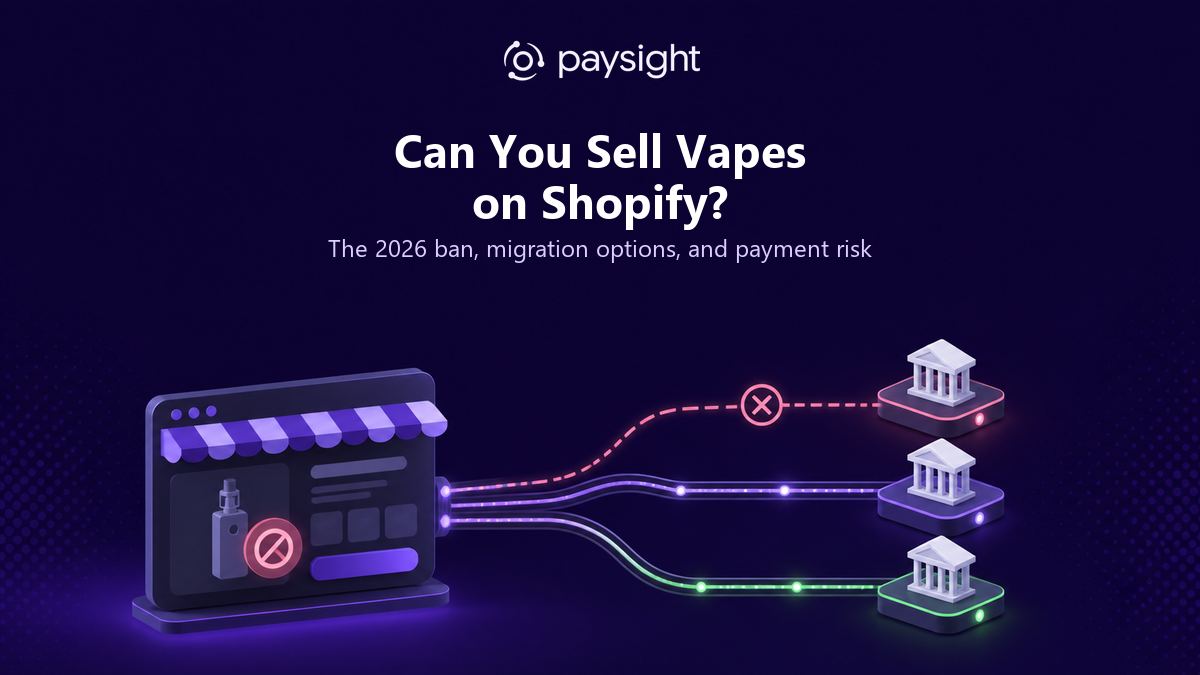
Shopify no longer supports the sale of vape products. In June 2026, the platform told affected merchants to remove e-cigarette products by July 8 or risk product suspension or store termination. For operators in the category, this is not a routine policy update. It is a forced review of the storefront, compliance stack, payment relationships, and every dependency that can stop revenue.
The immediate question is where to move. The more important question is how to avoid rebuilding the same single-provider risk somewhere else.
This guide explains what changed, what Shopify's decision means for vape merchants, which migration architectures are worth considering, and how a diversified payment setup can make the next platform transition less dangerous.
Key takeaways
- Shopify's 2026 policy applies to vape and electronic nicotine delivery system products, including products authorized by the US Food and Drug Administration.
- Moving to another storefront does not automatically solve payment, acquiring, banking, shipping, age-verification, or regulatory requirements.
- Self-hosted and open-source commerce can give a merchant more control, but it also transfers more compliance, security, and infrastructure responsibility to the merchant.
- A resilient setup separates the storefront from the payment layer, uses properly underwritten processor and merchant-account relationships, and avoids depending on a single route.
- Payment orchestration can manage eligible processors and MIDs, routing, cascading, recovery, and reporting. It cannot make a prohibited product legal or turn an undisclosed high-risk business into an approved one.
Can you sell vapes on Shopify in 2026?
No. Shopify's June 24, 2026 notice required merchants to remove e-cigarette products by July 8. Reuters reported that stores which did not comply could face product suspension or termination. Shopify also confirmed that the new policy applied to all vape products rather than only products without US authorization.
The ban came after a bipartisan coalition of state attorneys general asked Shopify to stop facilitating illegal e-cigarette sales. The Illinois Attorney General's announcement and Connecticut Attorney General's announcement both described Shopify's action as a platform-wide ban on vaping products.
That does not mean every neighbouring product category or accessory is automatically covered in exactly the same way. Merchants should obtain written confirmation from Shopify and qualified counsel for their specific catalogue rather than treating an article or support conversation as legal advice.
How the Shopify vape ban developed
This timeline matters because the policy did not appear in isolation. Regulators were looking at the full chain that makes an online sale possible: the commerce platform, payment companies, age verification, shipping, product authorization, and tax compliance.
The California Attorney General's April 2026 letter asked nine major payment and financial companies to strengthen controls against unlawful online tobacco and nicotine sales. The same announcement highlighted PACT Act obligations such as age verification, labelling, tax compliance, and other applicable state and federal requirements.
The lesson is broader than Shopify: regulated merchants are exposed to policy decisions at several independent layers. A storefront migration removes one dependency. It does not remove the others.
Why Shopify changed its policy
The public record points to three connected pressures.
1. Product authorization
The FDA maintains a list of authorized e-cigarettes and other ENDS products. As of August 2026, the agency listed 45 authorized products. Products outside the authorized list may not lawfully be marketed in the United States, even when they are widely available online.
2. Age verification and delivery controls
Online tobacco transactions have obligations that extend beyond a date-of-birth checkbox. Merchants may need compliant age verification, adult-signature delivery, shipping-provider approval, tax registration, record keeping, and jurisdiction-specific product controls.
A 2026 BMC Public Health study examined 58 online e-cigarette stores and found that 51 appeared to violate at least one PACT Act-related restriction assessed by the researchers. Twenty sites lacked an adult-signature statement, 42 did not require ID before the purchasing page, and 45 listed a restricted shipping carrier. The study did not complete purchases and was not a representative census of the industry, so its results should be read as evidence of recurring compliance gaps rather than a failure rate for all merchants.
3. Platform and payment-provider risk
Platforms and payment providers can impose requirements that are stricter than the minimum legal standard. For example, Stripe classifies tobacco products, including e-cigarettes and e-liquid, as a restricted business. Restricted does not always mean categorically impossible, but it does mean additional review and no guarantee of approval or continued support.
That distinction matters. A merchant can believe its products are legal and still lose a platform, gateway, processor, acquirer, bank, host, or shipping relationship because the provider's policy or risk appetite changes.
Migration solves the platform problem, not the payment problem
The urgent response to a platform ban is often: move the catalogue and reconnect a gateway. That is necessary, but incomplete.
A commerce stack has several independent points of failure:
If the replacement store still depends on one gateway, one processor, one merchant account, and provider-controlled tokens, the merchant has changed the storefront without changing the operating risk.
The better migration question is: which parts of the stack should be portable, which providers have explicitly underwritten the business, and how quickly can traffic move to another eligible route if one relationship changes?
Shopify alternatives for vape merchants
No platform choice is a blanket approval to sell vape products. Before committing to a migration, get written answers from the platform, hosting provider, payment providers, acquiring banks, fraud tools, shipping carriers, and any subscription or tax services you plan to use.
WooCommerce
WooCommerce describes its core product as open-source software and publishes specific guidance for highly regulated products. Its documentation says the self-hosted plugin can be used for regulated products subject to law, while some direct Automattic services may remain unavailable. The same guidance tells merchants to verify payment-gateway, merchant-account, hosting, and shipping policies separately.
That makes WooCommerce a credible architecture to evaluate, not an automatic compliance pass. The merchant owns more of the decisions and more of the operational burden.
Medusa or another headless commerce framework
Medusa's documentation describes a customizable commerce framework with modules for products, carts, payments, orders, inventory, and custom workflows. A headless approach can reduce dependence on a hosted storefront's product policy, but it requires a capable technical team and deliberate choices for hosting, checkout, age verification, payments, tax, and fulfilment.
Adobe Commerce or Magento Open Source
Adobe documents on-premises commerce deployment as an environment where the merchant controls and maintains its own infrastructure. That control can suit complex regulated operations, but the merchant is responsible for security, performance, upgrades, monitoring, data, and disaster recovery.
Another hosted platform
A different hosted SaaS platform may be the fastest way to restore a storefront. It also preserves the same structural exposure: the provider can change its acceptable-use policy, its payment integrations, or its risk appetite. Treat a hosted alternative as one contract in the stack, not as permanent infrastructure.
What a resilient vape payment setup looks like
The goal is not to hide the nature of the business or rotate accounts after a provider says no. The goal is to build a transparent, properly underwritten system with more than one legitimate path for eligible payments.
Specialist acquiring relationships
Start with processors and acquiring banks that understand the product, geography, fulfilment model, chargeback exposure, subscription behaviour, and regulatory controls. Disclose the catalogue and business model accurately. A low advertised rate is irrelevant if the relationship was never underwritten for the traffic.
Multiple independent MIDs and processors
One processor and several MIDs under the same risk umbrella may not provide meaningful diversification. A stronger setup uses approved relationships that do not all depend on the same processor, acquirer, gateway, or sponsor-bank decision.
This does not mean sending the same transaction to every provider. Each route needs a defined purpose, eligibility rules, transaction controls, volume plan, and accurate reporting.
Orchestration above the payment routes
A payment-orchestration layer can connect the storefront to multiple eligible processors and merchant accounts. It can route transactions by geography, currency, card type, product or risk constraints, route health, and agreed volume strategy.
If a route has a technical failure or another eligible route is a better fit, controlled cascading can move the transaction without rebuilding the checkout. Hard declines, fraud responses, stop instructions, and ambiguous transaction states still need strict stop rules.
Portable credentials and recurring-payment continuity
Subscription businesses should understand who controls stored credentials and whether tokens can be migrated. If the only usable token exists inside a provider that ends the relationship, moving the storefront may not preserve recurring revenue.
Plan token portability, stored-credential indicators, card-account updating, retry rules, and customer payment-method updates before the migration rather than after the first renewal failure.
Unified monitoring, disputes, and reconciliation
Multiple routes add resilience only when operators can see what is happening. Monitor approval rates, decline reasons, route health, chargebacks, refunds, settlements, and payout differences by processor and MID. A single operational view prevents diversification from becoming blind fragmentation.
A practical migration checklist
- Confirm the legal and product position. Identify every SKU, destination market, age requirement, tax obligation, shipping rule, licence, and FDA authorization question that applies. Use qualified counsel where necessary.
- Map every provider dependency. Document the platform, host, domain, age-verification tool, fraud stack, gateway, processors, acquiring banks, MIDs, token vault, tax tools, carriers, subscriptions, analytics, and customer communications.
- Secure written provider approval before rebuilding. Do not finish a new storefront and only then discover that the gateway or acquirer will not support the catalogue.
- Choose the migration architecture. Compare a self-hosted plugin, headless framework, on-premises platform, and hosted SaaS based on policy control, technical capacity, time, and total operating cost.
- Export and reconcile business data. Preserve products, customers, consent records, orders, subscriptions, refunds, disputes, tax records, and fulfilment history. Validate counts and totals before cutover.
- Design the payment topology. Define the primary and backup eligible routes, transaction types, volume allocation, currencies, descriptor strategy, fraud controls, 3DS policy, and stop conditions.
- Plan credential migration. Confirm whether stored payment credentials can be exported or transferred through an approved process. Prepare a customer-update campaign where they cannot.
- Test the complete money movement. Run successful and declined payments, authentication, refunds, partial refunds, subscriptions, retries, route failover, webhooks, reconciliation, and payout reporting.
- Cut over with observability. Monitor checkout errors, authorizations, orders, stock, tax, shipping, disputes, and settlements closely. Keep a rollback or controlled traffic plan.
- Review concentration quarterly. A resilient setup can drift back toward a single processor, MID, or provider. Revisit route concentration and contract dependencies before the next policy change forces the issue.
Where Paysight fits
Paysight sits below the storefront as the control layer for eligible payment routes. A merchant can change the commerce front end without rebuilding every processor connection, then manage approved MIDs, routing, cascading, recovery, and payment visibility from one place.
For a regulated merchant, that can mean:
- routing eligible transactions to the right underwritten processor or MID;
- using controlled failover when a route has a technical or availability problem;
- separating recurring-payment recovery from live-checkout logic;
- monitoring route-level approval, decline, refund, settlement, and dispute performance;
- reducing the operational dependence on a single gateway or processor integration.
Paysight does not provide legal approval to sell a product, replace underwriting, or guarantee that a processor will support a category. It gives compliant merchants the infrastructure to operate approved payment relationships as a coordinated system rather than a collection of disconnected integrations.
If Shopify's vape ban has forced a storefront migration, use the moment to redesign the dependency that matters most: how revenue reaches you after the customer clicks pay. Talk to Paysight about building a multi-processor payment setup around your next commerce platform.
Sources
- Reuters: Shopify tells users to remove vapes from online stores
- Illinois Attorney General: Shopify bans all e-cigarette sales
- Connecticut Attorney General: Shopify ban on e-cigarette sales
- California Attorney General: payment companies urged to address illegal online tobacco sales
- FDA: authorized e-cigarette and ENDS products
- BMC Public Health: third-party ecommerce technology and illegal online e-cigarette sales
- WooCommerce: highly regulated products
No. Shopify required merchants to remove e-cigarette products by July 8, 2026 and said non-compliant stores could face product suspension or termination.
Yes. Public reporting and state attorney-general announcements described the policy as applying to all vape products, including the limited set authorized by the FDA.
Shopify no longer supports vape sales on the platform, so changing the payment gateway does not solve the platform restriction. Any replacement platform and payment provider must approve the business and product catalogue in writing.
Potential architectures include self-hosted WooCommerce, Medusa or another headless framework, Adobe Commerce or Magento Open Source, a custom storefront, or another hosted platform that explicitly approves the catalogue. Each option still requires separate checks for hosting, payments, acquiring, age verification, shipping, tax, and local law.
There is no universal provider. Vape merchants should work with processors and acquiring banks that explicitly underwrite their product, jurisdictions, fulfilment model, and risk profile. Approval can change, so written terms and accurate disclosure matter.
Properly approved independent routes reduce concentration risk and let operators match eligible transactions to suitable processors. Multiple routes should be governed by underwriting scope, volume plans, compliance controls, and clear stop rules rather than used to evade a provider decision.
No. Orchestration cannot prevent a processor or acquirer from ending a relationship. It can reduce operational dependence on one route and make it easier to continue through another already approved route when the transaction and business remain eligible.
Start with compliance and provider approval, then map data and payment dependencies. Secure the new platform, hosting, acquiring, gateway, age-verification, shipping, and tax arrangements before moving live traffic or attempting to transfer stored credentials.


.svg)


.png)

%25201.jpeg)



Company Reg. No. 760371
VAT No. IE4280069RH


