


Most subscription brands meet automatic renewal law the hard way: a demand letter about a missing checkbox, a state attorney general asking how cancellation works, or a processor flagging complaints that all say "I never agreed to this." The rules aren't new. What changed over the last 18 months is how many of them there are and how specific they've become.
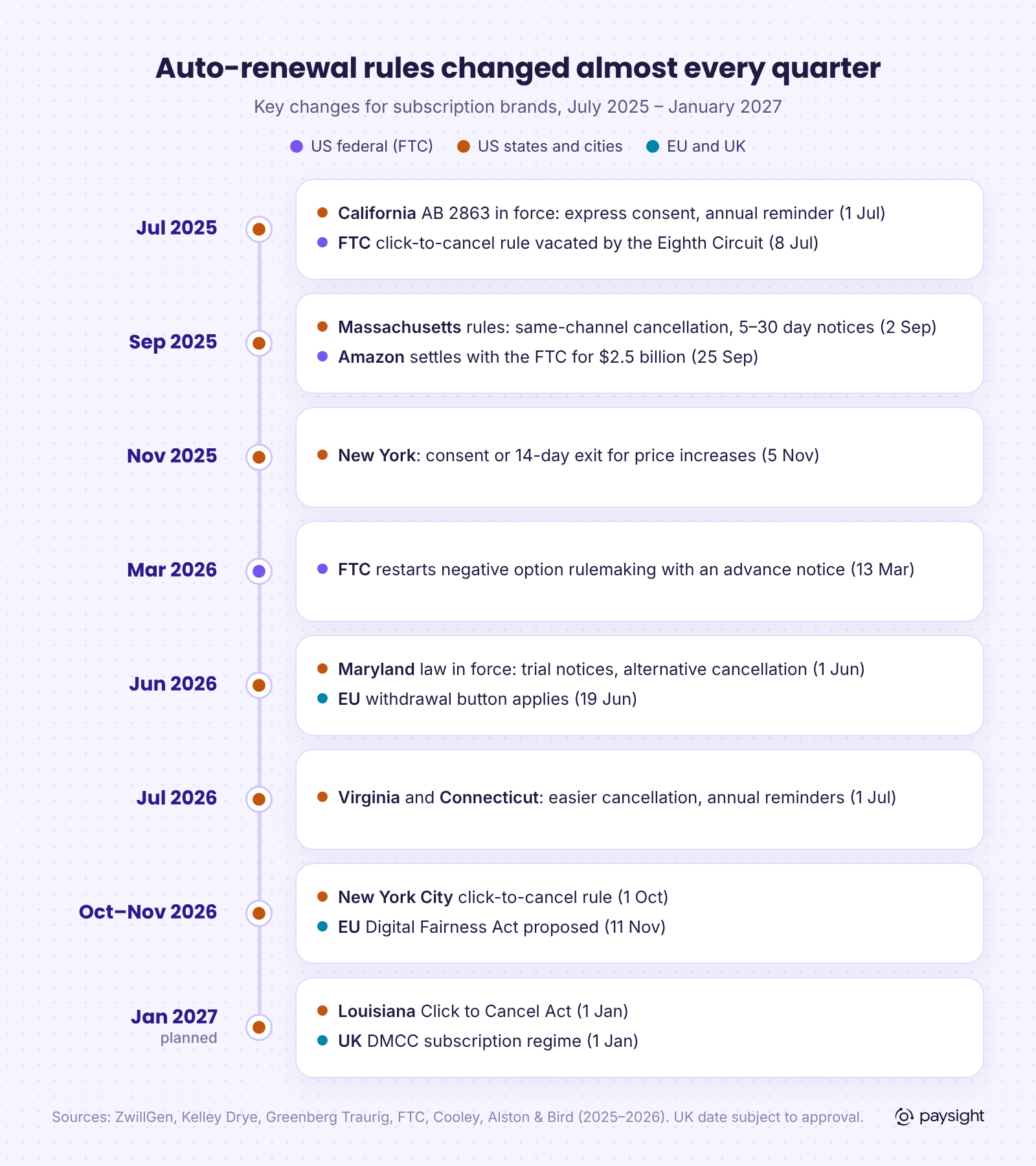
In 2025 and 2026, California tightened its law, Massachusetts, Virginia, Maryland and Connecticut added detailed cancellation and reminder duties, New York City wrote its own rule, and Louisiana's law starts on 1 January 2027. The FTC's federal "click-to-cancel" rule was struck down, but the FTC is still bringing cases, and the EU and UK are adding cancellation buttons and renewal reminders of their own.
This guide turns that patchwork into one checklist for the moments that matter: signup, consent, the reminder before a charge, cancellation and what happens after it. It's written for operators, not lawyers, and it isn't legal advice. Use it to find the gaps, then confirm the fixes with counsel.
Key takeaways
- The FTC's 2024 click-to-cancel rule is not in force (vacated on 8 July 2025), but ROSCA still requires clear terms, express consent and a simple way to cancel for every online subscription sold in the US.
- State laws now set the detail: separate consent for the renewal terms, reminders inside fixed day windows, cancellation in the same channel as signup, and limits on save offers.
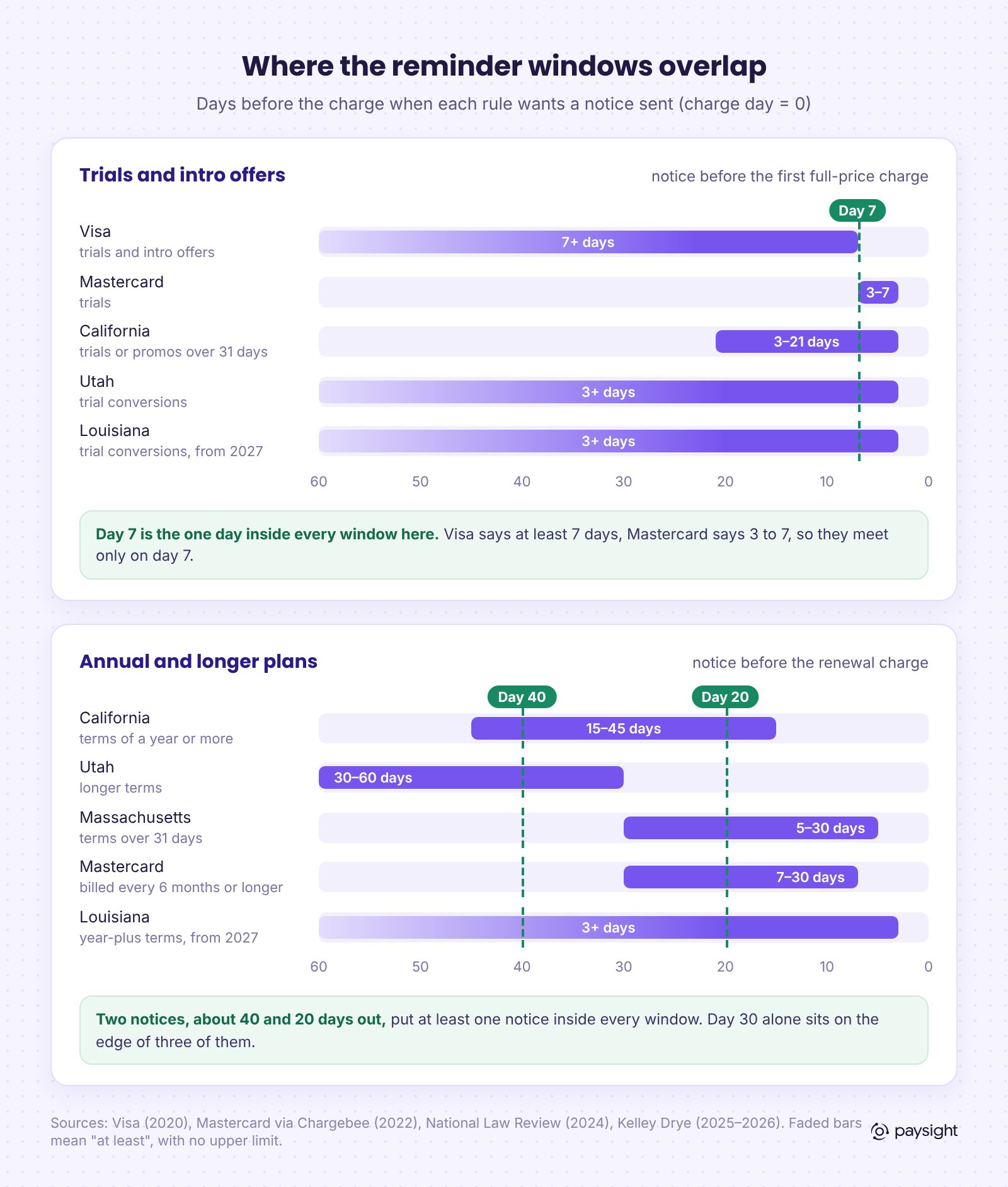
- Reminder windows overlap. A notice 7 days before a trial converts fits every window we list below; for annual plans, two notices about 40 and 20 days out cover them all.
- Keep proof. California requires consent records for at least three years; Louisiana will require one year from 2027.
- The EU withdrawal button applies from 19 June 2026, the UK's subscription regime is planned for 1 January 2027, and the EU's proposed Digital Fairness Act adds a "terminate the contract here" button.
The rules that apply in late 2026
Four layers stack on top of each other: federal US law, state law, card network rules and, if you sell abroad, EU and UK consumer law. A brand selling online to customers in all 50 states effectively has to meet the strictest version of each requirement.
Federal: ROSCA still applies, the FTC rule doesn't (yet)
The Restore Online Shoppers' Confidence Act (ROSCA, 2010) covers every negative option sold online. Before taking billing details you must clearly disclose all material terms, you need the customer's express informed consent before charging, and you must provide a "simple mechanism" to stop recurring charges. ROSCA doesn't define "material terms" or "simple mechanism", which is why state laws and FTC settlements fill in the detail.
The FTC's amended Negative Option Rule, the 2024 "click-to-cancel" rule, was due to take effect on 14 July 2025. The Eighth Circuit vacated it on 8 July 2025 on procedural grounds. The FTC started again with an advance notice of proposed rulemaking published on 13 March 2026; comments closed on 13 April 2026. As of mid-November 2026 there is no proposed rule text, so nothing new is binding at federal level.
Enforcement didn't pause. Amazon agreed on 25 September 2025 to pay $2.5 billion ($1 billion civil penalty, $1.5 billion in refunds) over Prime enrolment and cancellation, and must offer a clear way to decline Prime and a simpler way to cancel. The FTC sued Uber in April 2025 over subscription billing and cancellation, and Care.com settled for $8.5 million in 2024. All three cases rest on ROSCA and Section 5 of the FTC Act, not on the vacated rule.
States: a patchwork that keeps growing
Most states with auto-renewal laws share a core: clear disclosure, consent and a way to cancel. The recent changes add specific mechanics. These are the ones that changed most between 2025 and early 2027.
Sources: ZwillGen's auto-renewal update (updated April 2026), Kelley Drye's 2025 and summer 2026 round-ups, Greenberg Traurig on Virginia, and Kilpatrick Townsend on California (all linked below). Earlier laws still apply too: Minnesota (annual notice, online cancellation, and save offers only with prior consent, since 1 January 2025) and Utah (renewal notice 30–60 days ahead for longer terms, trial notice at least 3 days before conversion), among others.
Card networks: stricter than some states
Visa and Mastercard add their own rules for trials and intro offers: consent at checkout, a reminder before the first full-price charge, a receipt with cancellation instructions, and online cancellation. Mastercard also requires reminders 7–30 days before charges on plans billed every six months or longer. We cover those rules in detail in the first renewal playbook and our high-risk merchant account guide, so we won't repeat them here. Breaking them can cost you disputes you can't win and, in time, the merchant account.
EU and UK: buttons and reminders
The UK start date has moved before: it was pushed back to spring 2027 earlier in 2026, then brought forward to January 2027 in the draft regulations. Check the final regulations before you build to them.
The checklist: five moments to get right
Each step below lists what to do and which rule makes it necessary. If you meet the strictest version, you are usually covered everywhere else.
1. Signup: put the terms next to the button
- Show, next to the payment button and before you collect card details: that the subscription renews automatically until cancelled, the price and billing frequency, the price after any trial or intro offer, the date the first full charge happens, and how to cancel (ROSCA; California; Massachusetts; New York City's "visual proximity" test).
- Don't hide terms on mobile. If a layout collapses the terms behind a link on small screens, that's the version a regulator will test.
- Send a confirmation email straight after signup that repeats the terms and the cancellation method. Several state laws require an acknowledgment, and Louisiana's does from 2027.
2. Consent: separate, unticked and recorded
- Get consent to the renewal terms on their own, not bundled into general terms and conditions: an unticked checkbox next to the renewal terms works for most states (California's "express affirmative consent"; Maine's law, which appears to require separate consent for agreements from 1 January 2026).
- Record what the customer saw and agreed to: the timestamp, the exact terms text and version, the price, and the channel. California requires these records for at least three years, or one year after the contract ends if that is longer.
- Get fresh consent, or offer the New York-style 14-day exit with a pro rata refund, before raising a subscriber's price.
3. Before the charge: reminders, trials and price changes
Reminder rules are where brands slip most, because each one uses a different window. Here are the windows side by side, in days before the charge.
The practical pattern:
- Trials and intro offers: one notice 7 days before the first full charge. Visa asks for at least 7 days and Mastercard for 3 to 7, so day 7 is the only day that meets both; it also sits inside California's window and meets the 3-day minimums in Utah and Louisiana. Schedule it by calendar date and test it, because a day late or early breaks one of the two network rules.
- Monthly plans: a receipt for every charge with the amount and a cancel link, plus one annual reminder of the terms (California, Minnesota, Connecticut, Massachusetts).
- Annual and semi-annual plans: two notices, about 40 and 20 days before renewal. The 40-day notice covers California and Utah; the 20-day notice covers California, Massachusetts and Mastercard. Day 30 is the only single day inside all of them, but it sits on the edge of three (Massachusetts, Utah and Mastercard), so a scheduling bug or time-zone shift can push it outside.
- Price changes: 7–30 days' notice in California, and consent or a refund window in New York. Put the change in its own email, not in a newsletter footer.
Send reminders in the channel the customer signed up through or regularly uses (California requires this for the annual reminder), and include the price, the charge date and a direct cancel link. A reminder also earns its keep commercially: in Recharge's data the first renewals are where most voluntary churn happens, and a customer who cancels by email is cheaper than one who disputes the charge.
4. Cancellation: as easy as signing up
- If customers can sign up online, let them cancel online, without a call, chat or email exchange (California, Massachusetts, Virginia, Colorado's one-step link, New York City, Minnesota for any business with an account area).
- Offer cancellation in every channel you sell through. If you take phone signups, the line must answer or take messages in business hours, and Connecticut wants voicemail cancellations processed within one business day.
- Save offers are allowed in most places with conditions: a cancel button visible on the same page (California, Colorado), a statement that the customer can cancel at any time before the offer (Connecticut), or the customer's prior consent to receive offers (Minnesota). If the customer says "cancel", cancel.
- Don't make a survey answer a condition of cancelling. You can ask why; the answer has to be optional.
5. After cancellation: confirm, stop billing, keep records
- Confirm the cancellation in writing straight away, with the effective date and whether any charge is still due. The EU withdrawal rules require a confirmation on a durable medium; most US laws expect it in practice.
- Make sure the cancellation reaches billing. A subscription cancelled in a help desk tool but still active in the billing system is the classic way to end up refunding (New York City requires refunds of charges after the first cancellation attempt) or losing a dispute.
- Keep the cancellation request, its timestamp and the confirmation with the consent record, so you can answer an attorney general, a processor or a chargeback with one record.
Renewal disputes cost twice: the refund plus the dispute fee, and every one counts toward your Visa and Mastercard ratios. Brands that still see "forgot to cancel" disputes after fixing the flow use chargeback alerts to refund before a dispute lands; we compare the options in Ethoca vs Verifi CDRN vs RDR.
Where Paysight fits
Paysight doesn't make a subscription compliant; that depends on your offer, your copy and your flows, and on advice from your counsel. It also isn't a payment processor: brands connect their own gateways and merchant accounts, and Paysight runs subscriptions on top of them. What it does give you are the pieces that make the checklist easier to run:
- Online cancellation on your own domain. Care Portals let customers look up a charge, request a refund or cancel their subscription directly with you, on a branded page you control, with your own settings for which actions customers can complete themselves.
- One record per customer. Paysight's Payment CRM keeps subscription, transaction and customer data in one place, so the charge history, the cancellation and the refund sit together when you need to answer a complaint or a dispute.
- Cancellation from any channel. Cancellations taken by phone, email or a support tool can be pushed to Paysight through its unsubscribe API, so the subscription stops renewing straight away rather than waiting in a support queue.
- Disclosure at checkout. Paysight checkouts can be set to show your subscription terms with an unticked checkbox and to block payment until the terms are accepted.
- Disputes from renewals. Resolvo, Paysight's chargeback product, handles Ethoca and Verifi alerts, deflection and representment for the disputes that still come in.
Reminder emails stay with your email or retention tool. Paysight's webhooks send billing and subscription events to the tools you connect, which can use them to trigger those notices.
Sources
- Jones Day: FTC revives click-to-cancel rule (May 2026): ROSCA requirements, ANPRM comment deadline 13 April 2026, Care.com and Amazon cases
- FTC: Public comment on the negative option ANPRM (11 March 2026)
- ZwillGen: Automatic renewal mid-year update (July 2025, updated April 2026): vacatur on 8 July 2025, FTC v. Uber, California, Arkansas, Colorado, Massachusetts, New York, Maine, Maryland, Connecticut
- Keller and Heckman: Amazon pays record $2.5 billion (September 2025): settlement terms
- Kelley Drye: Auto-renewal laws 2025 round up (March 2025): Minnesota, Utah, Massachusetts reminder windows
- Kelley Drye: Summer 2026 autorenewal roundup (July 2026): New York City rule, Louisiana Click to Cancel Act
- Greenberg Traurig: Virginia enacts automatic renewal consumer protection law (May 2026)
- Kilpatrick Townsend: California's automatic renewal law amendments take effect in July 2025 (October 2024): consent, records, annual reminder, price changes, save offers
- National Law Review: California expands automatic renewal legislation (October 2024): existing reminder windows
- Visa: Trial subscription updates (effective 18 April 2020)
- Chargebee: Mastercard rules for subscriptions (effective 22 September 2022)
- Greenberg Traurig: EU withdrawal button requirements (May 2026)
- Cooley: What could the EU's Digital Fairness Act mean for your business? (13 November 2026)
- Alston & Bird: UK subscription rules under the DMCCA (October 2026): 1 January 2027 start, reminders, cooling-off, penalties
- Legal 500: The DMCCA subscription contracts timeline just got shorter (September 2026)
- Recharge: Subscription churn is front-loaded (July 2026, updated August 2026)
No. The FTC's 2024 amendments to the Negative Option Rule were vacated by the Eighth Circuit on 8 July 2025, days before they were due to take effect. The FTC published an advance notice of proposed rulemaking on 13 March 2026 (comments closed 13 April 2026), but as of November 2026 there is no proposed rule text.
The Restore Online Shoppers' Confidence Act (ROSCA) still applies to every online subscription: clear disclosure of material terms before billing, express informed consent, and a simple way to cancel. The FTC keeps enforcing it, including Amazon's $2.5 billion settlement in September 2025.
Most large US states have one. Recent changes include California (1 July 2025), Arkansas and Colorado (August 2025), Massachusetts regulations (2 September 2025), New York's price-increase rule (5 November 2025), Maryland (1 June 2026), Virginia and Connecticut (1 July 2026) and a New York City rule (1 October 2026). Louisiana's Click to Cancel Act starts on 1 January 2027.
Because a brand selling online reaches customers in every state, the practical approach is to meet the strictest version of each requirement. Confirm the details with counsel; this is not legal advice.
It depends on the rule and the plan. For trials and intro offers, Visa asks for at least 7 days' notice and Mastercard for 3 to 7 days, so a notice 7 days before the first full charge is the one day that meets both, and it also fits California, Utah and Louisiana.
For annual plans, windows range from 5–30 days (Massachusetts) to 30–60 days (Utah), with California at 15–45 days. Two notices about 40 and 20 days before renewal cover them all. For monthly plans, send a receipt with every charge and an annual reminder of the terms.
If they signed up online, in most cases yes. California, Massachusetts, Virginia, Colorado (a one-step online link), New York City and Minnesota (for businesses with an online account area) all require cancellation through the same channel as signup or online, without a forced call or chat.
ROSCA also requires a simple mechanism to stop recurring charges, and Visa and Mastercard require online cancellation for trial subscriptions.
Usually yes, with conditions. California and Colorado allow a save offer only if a cancel button stays visible on the same page. Connecticut requires you to tell callers they can cancel at any time before making an offer, and Minnesota requires the customer's prior consent to receive retention offers.
If the customer still says they want to cancel, process it immediately, and never make a survey answer a condition of cancelling.
They apply to businesses selling to consumers in those markets. The EU withdrawal button (Directive 2023/2673) has applied since 19 June 2026 for online contracts with a withdrawal right. The UK's DMCC Act subscription regime is planned for 1 January 2027, subject to Parliament approving the regulations, with reminders, cooling-off periods, easy cancellation and fines of up to 10% of global turnover.
The EU's proposed Digital Fairness Act (11 November 2026) would add a "terminate the contract here" button and stop free trials converting without a reminder or express agreement; it is not expected to apply before 2028.
No. Compliance depends on your offer, copy and flows, and on advice from your counsel. Paysight is not a payment processor either; brands connect their own gateways and merchant accounts.
Paysight gives you tools that make the checklist easier to run: Care Portals for online cancellation, refunds and charge lookup on your own domain, the Payment CRM for subscription, transaction and customer data in one place, an unsubscribe API for cancellations taken in other channels, checkout terms with an unticked checkbox, and Resolvo for chargeback alerts and disputes.










Company Reg. No. 760371
VAT No. IE4280069RH


