


Most "best subscription billing software" lists are written for SaaS companies. They compare invoicing, usage metering, and revenue recognition, which is great if you sell seats, and not very useful if you ship coffee, supplements, or skincare every 30 days.
Ecommerce subscriptions have different problems. Renewals are card-not-present charges on cards that expire, get reissued, and run out of funds. Customers want to skip, swap, and pause, not downgrade a plan. And the subscription app usually sits on top of a storefront and a payment processor that it does not control.
This guide compares eight subscription platforms through an ecommerce lens: what each one is built for, what it costs at real volumes, which payment gateways you can connect, and the question most comparisons skip entirely, which is what happens to your recurring revenue when the gateway underneath it has a bad day.
Disclosure: Paysight is our product and appears on this list. We have tried to describe every platform, including ours, on what it is actually good at.
Key takeaways
- Ecommerce subscription tools fall into three groups: Shopify subscription apps (Recharge, Skio, Loop, Stay Ai), DTC subscription platforms that connect to the merchant's own gateways (Paysight, PlatformPay), and enterprise or processor-tied billing (Ordergroove, Stripe Billing).
- Published pricing for the Shopify apps ranges from about 1% to 2.2% of subscription revenue at $100,000 a month, before payment processing fees.
- Apart from Stripe Billing, none of these tools is a payment processor. Whether a renewal actually gets paid depends on the gateways and merchant accounts you connect, plus the retry logic and card updating the tool gives you on top of them.
- Before you pick a tool, ask which payment gateways it supports and who holds the stored card tokens. That decides how hard it is to move later.
What subscription billing software actually does
A subscription billing platform stores the agreement (what the customer gets, how often, at what price), schedules renewals, charges the saved payment method, and handles what happens when a charge fails. In ecommerce, it also powers the customer portal where subscribers skip, swap, and cancel, and increasingly the retention flows that try to stop them from cancelling.
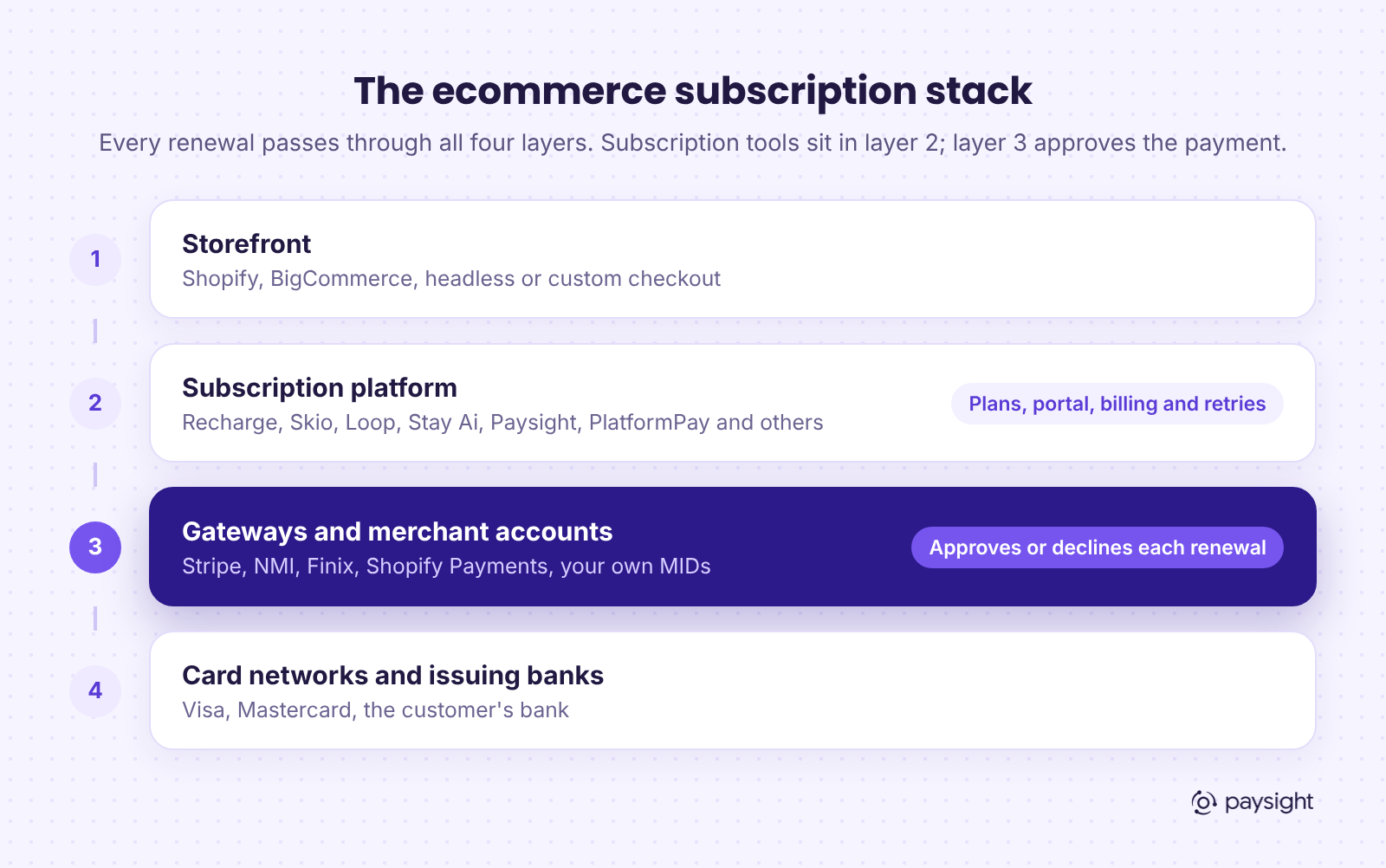
What it does not do on its own is approve payments. Every renewal still goes through a payment gateway and processor, and from there to the card networks and the customer's bank. That layer decides approval rates, fees, payout timing, and whether your account can be frozen. It is also the layer most subscription comparisons leave out.
The 8 platforms at a glance
Pricing is taken from each vendor's public pricing page as of October 2026. Transaction fees for Shopify apps apply to subscription orders and sit on top of your payment processing costs.
Shopify subscription apps
If your store runs on Shopify, these four will be on your shortlist. They plug into Shopify's subscription APIs and checkout, which keeps setup simple. It also means they inherit Shopify's rules about which gateways can store cards for recurring charges. In practice that is a short list led by Shopify Payments, with a few third-party gateways such as Authorize.net and PayPal Express.
Recharge
Recharge is the longest-running and most widely used subscription app on Shopify. It covers the full lifecycle: subscription setup, customer portal, retention flows, SMS ordering on the Plus plan, and a large partner ecosystem.
- Pricing: Starter at $99 a month plus 1.49% + 19¢ per transaction; Plus at $499 a month plus 1.34% + 19¢; custom pricing for high volume. Recharge pricing.
- Strengths: maturity, integrations, and a large pool of agencies who know it well.
- Watch out for: it has the highest published cost of the tools we priced at our example volumes, and add-ons such as SMS are billed separately.
Skio
Skio built its reputation on migrations from older apps and on a simple pricing promise: every feature in one plan. It includes analytics, payment recovery campaigns, lifecycle automations, SMS, and a passwordless customer portal.
- Pricing: Scale at $499 a month billed annually ($599 monthly) plus 1% + 20¢ per order involving a subscription. Skio pricing.
- Strengths: no feature gating, strong migration support.
- Watch out for: the $499 minimum makes it expensive for small programs.
Loop Subscriptions
Loop is the value pick for Shopify brands. Its paid plans charge a percentage of volume with no per-order fee, and there is a free plan for up to 50 active subscriptions.
- Pricing: Starter at $99 a month plus 1%; Pro at $399 a month plus 0.75%; Enterprise negotiable. Loop pricing.
- Strengths: the lowest published cost of the Shopify apps at both of our example volumes, no setup or migration fees.
- Watch out for: as with every Shopify app, payment options are limited to what Shopify supports for subscriptions.
Stay Ai
Stay Ai focuses on retention: A/B testing, AI-driven cancellation and win-back flows, and loyalty mechanics such as digital punch cards. Every plan includes a dedicated account manager.
- Pricing: Pro at $499 a month plus 1% + 19¢ per transaction; Enterprise custom. Stay Ai pricing.
- Strengths: churn prevention tooling and hands-on support.
- Watch out for: best suited to brands with enough subscribers for retention experiments to matter.
DTC subscription platforms that connect to your gateways
This group is built for direct-to-consumer brands that sell through their own funnels and checkouts as well as, or instead of, a standard Shopify setup. Neither tool here is a payment processor. You bring your own gateways and merchant accounts (MIDs), and the platform launches, bills and manages the subscriptions on top of them. That makes setup a little more involved than installing a Shopify app, and it gives you far more say over where renewals are charged.
Paysight
Paysight is a subscription and payment management platform for DTC and ecommerce brands. You use it to launch and run subscription programs, and you connect the gateways and MIDs you already have, such as Stripe, NMI or Finix. Paysight then decides which connected gateway each payment goes through, based on rules like card BIN, region or route performance.
- Pricing: quoted by sales.
- Strengths: subscription, transaction and customer data in one dashboard; routing and retries across several connected gateways; a built-in card account updater; self-service customer care portals for refunds and cancellations; works with Shopify and custom storefronts.
- Watch out for: you need at least one approved gateway or merchant account of your own. Paysight does not underwrite or process payments itself.
PlatformPay
PlatformPay describes itself as a checkout monetization platform. It designs and runs clearly disclosed membership programs that merchants add at checkout, and it offers outsourced billing support around them: customer service, reconciliation, fraud protection, transaction monitoring and compliance audits. Its listed partners include Stripe, Global Payments and NMI.
- Pricing: not published; the site describes a performance-based revenue share model. PlatformPay.
- Strengths: a done-for-you membership program, plus compliance and customer service capacity many smaller teams do not have in-house.
- Watch out for: it is a managed service more than self-serve software, so check exactly how the program is disclosed to customers, who owns the customer relationship, and how revenue is split before you sign.
Enterprise and processor-tied billing
Ordergroove
Ordergroove positions itself as a subscription and relationship commerce platform for larger retailers. It supports Shopify and Shopify Plus, BigCommerce, Salesforce Commerce Cloud, Adobe Commerce, commercetools, and custom carts. Pricing is not published; expect an enterprise sales process. Ordergroove pricing.
Stripe Billing
If you already process on Stripe and run a custom or headless storefront, Stripe Billing is the shortest path to recurring revenue. It is priced at 0.7% of billing volume on pay-as-you-go, with monthly plans for higher volume, plus normal Stripe processing fees. The trade-off is that billing and processing live with the same provider, so every renewal depends on that one account. The subscriber portal, skip and swap logic, and retention flows that ecommerce brands expect also take engineering work. Stripe pricing.
What it costs: two example volumes
Here is what the published pricing works out to for a subscription program, assuming every order is a subscription renewal and a $50 average order value. These numbers cover the subscription software only. Payment processing comes on top.
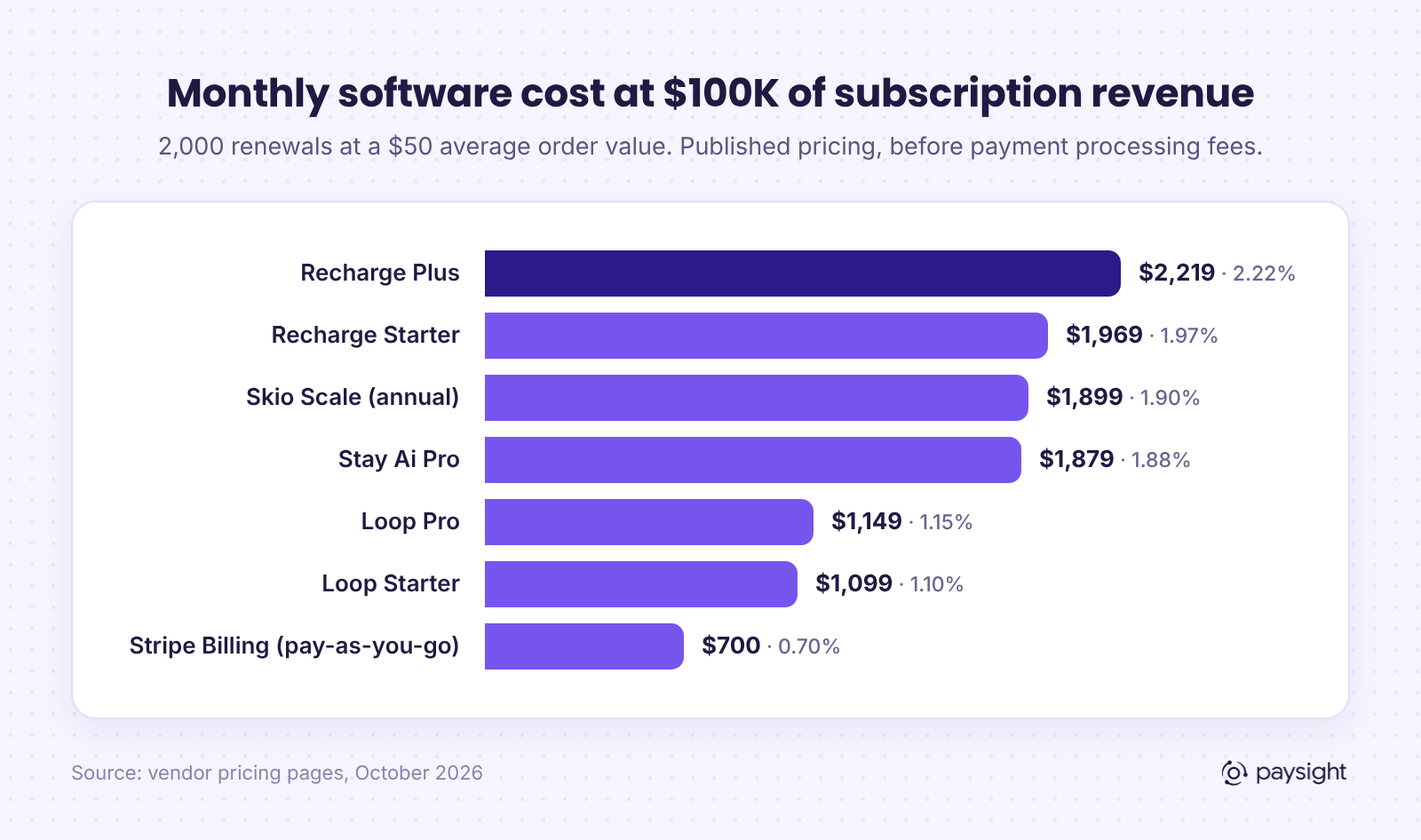
Two things stand out. First, the spread is large: at $100K a month, the gap between the cheapest and most expensive Shopify app is over $1,100 a month. Second, it is small compared with what a single percentage point of renewal approval rate is worth. On $500K of monthly renewals, a one-point improvement in approvals recovers $5,000 a month, more than the entire software bill of most tools here.
That is why we would not pick a subscription tool on price alone.
How to choose: seven questions to ask
- Which storefront are you on, and will you stay? Shopify-only apps are the fastest path on Shopify and a dead end if you plan to move.
- Which payment gateways can you connect for renewals? If the answer is effectively one, every subscriber depends on that single relationship.
- Who holds the stored card tokens, and can you export them? This decides whether migrating later is a data transfer or a re-collection campaign.
- How does it handle failed renewals? Look for retry timing based on decline codes, not a fixed "try again in three days", plus card updater support.
- What can subscribers do in the portal? Skip, swap, pause, change address, and update payment details should all be self-service.
- What reporting do you get? You want renewal approval rate, involuntary churn, and recovered revenue, not just active subscriber counts.
- What does it really cost at your volume? Model your next 12 months, including per-order fees and add-ons, not just today's plan.
The question most comparisons skip
A subscription app can have the best portal and the smartest cancellation flow on the market and still lose revenue if every renewal runs through one processor that starts declining, delays payouts, or closes the account. We have seen it happen to brands with excellent retention metrics.
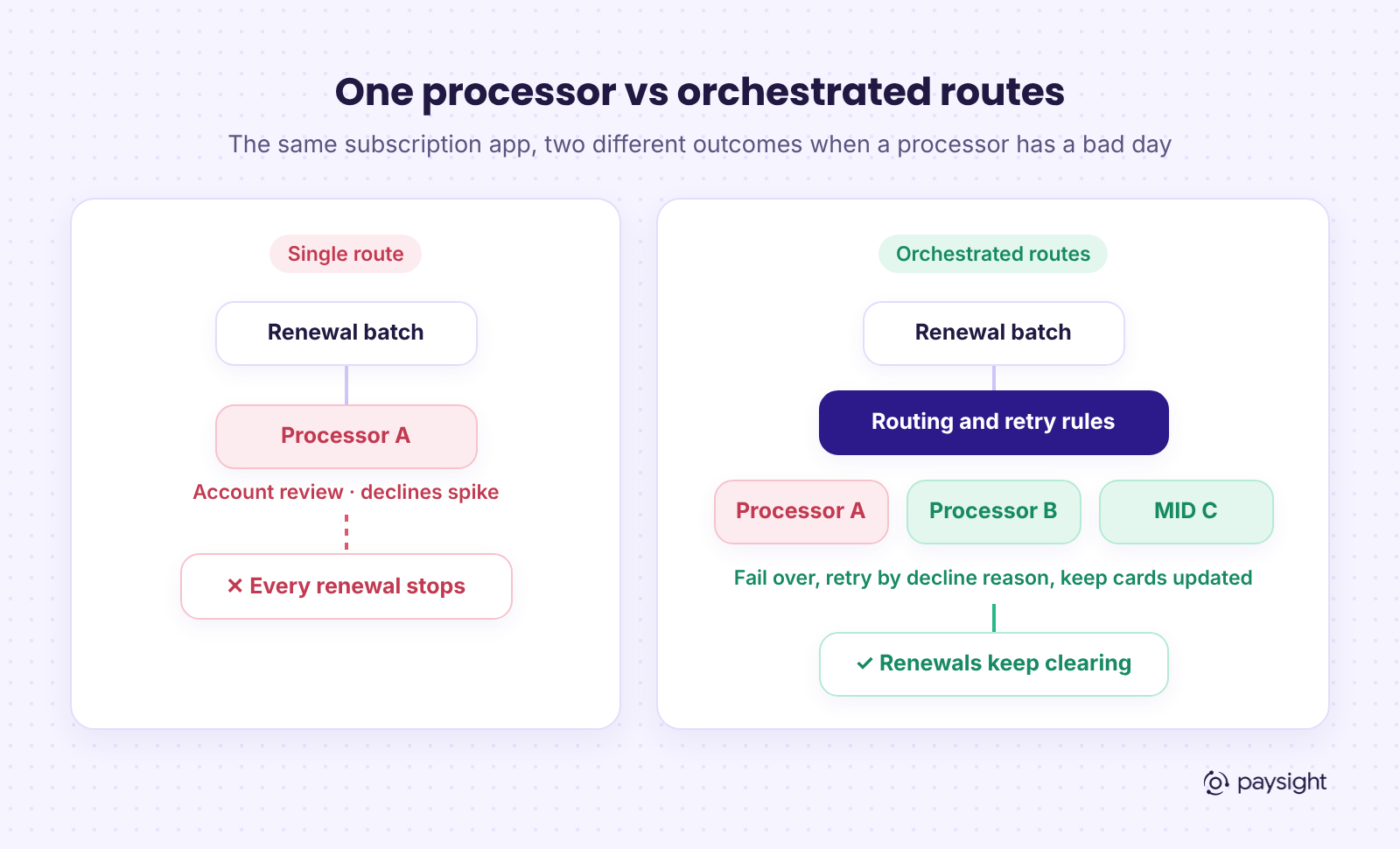
Pick the subscription tool that fits your storefront and your customer experience. Then make sure the gateway setup underneath it is not a single point of failure: more than one approved gateway or merchant account connected, renewals that can move to another route, retries that use the decline reason, and card details that stay current. If you want to go deeper on the payment side, our guide to reducing failed payments in ecommerce is a good next read.
Sources
Subscription billing software stores each subscription agreement, schedules renewals, charges the saved payment method, and handles failed payments. Ecommerce tools also provide a customer portal for skipping, swapping and cancelling, plus retention flows. The actual payment approval still happens in the payment gateway and processor underneath.
It depends on volume and priorities. Recharge is the most established, Skio includes every feature in one plan, Loop has the lowest published cost at most volumes, and Stay Ai focuses on retention tooling. All four work within Shopify's rules about which gateways can store cards for subscriptions.
Using published pricing, Shopify subscription apps cost roughly 1% to 2.2% of subscription revenue at $100,000 a month, depending on the plan, and Stripe Billing costs 0.7% of billing volume on pay-as-you-go. Payment processing fees come on top of these software costs.
Only within the set of gateways Shopify supports for subscription contracts, which is led by Shopify Payments plus a few third-party gateways. Brands that want renewals spread across several gateways or MIDs usually run subscriptions on a platform that lets them connect their own gateways, such as Paysight.
Confirm who holds the stored card tokens and whether they can be exported, which gateways the new platform supports, how failed renewals are retried, what customers can do in the portal, and what the total cost looks like at your volume over the next 12 months.
No. Paysight is a platform for launching and managing subscriptions. You connect your own gateways and merchant accounts, such as Stripe, NMI or Finix, and Paysight bills subscriptions through them, routes and retries payments across the gateways you connect, keeps cards up to date with a card account updater, and gives customers self-service care portals.


.svg)

.png)



Company Reg. No. 760371
VAT No. IE4280069RH


