


The two subscription categories every ecommerce operator needs to understand, physical and digital, and how to choose and run the right model for your business
Subscription models are not interchangeable. The billing logic, churn drivers, payment failure modes, and infrastructure requirements differ significantly depending on what you sell and how you sell it. Most guides list subscription business types without explaining which operational challenges come with each. This one does.
The subscription examples below cover both categories. Understanding which one your model falls into and which subtype within that category is the first step toward building a subscription operation that actually works at scale.
The most useful way to think about subscription models is not by industry or product category but by the two fundamental types: physical and digital. They look similar on a pricing page, a recurring charge in exchange for ongoing value, but they fail differently, scale differently, and require different operational infrastructure.
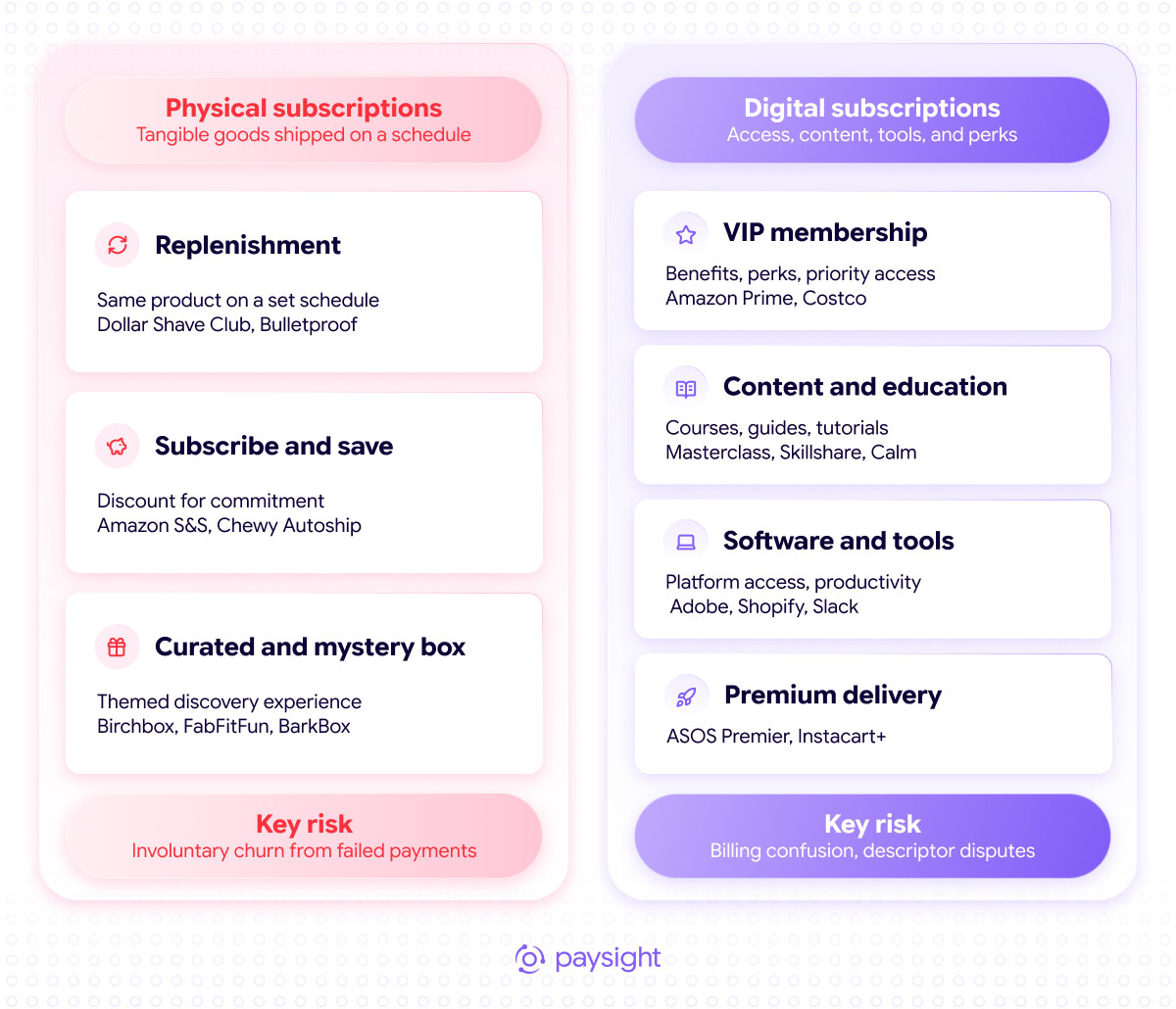
Seven e-commerce subscription types mapped into two categories: physical and digital, with brand examples and key risks
Physical Subscriptions: Models Built Around Tangible Goods
Physical subscription models involve shipping a product to the subscriber on a recurring basis. The operational complexity is higher than digital, as logistics, inventory, fulfillment, and returns all add friction, but the relationship between product quality and retention is more direct. When the product is good and the timing is right, physical subscription models can generate very high LTV.
Replenishment subscriptions
Replenishment subscriptions deliver consumable products on a schedule calibrated to how quickly a customer uses them. The value proposition is simple: never run out, never think about it, and often pay less than buying on demand.
A customer sets a delivery frequency, weekly, monthly, or quarterly, and the product arrives automatically. Billing runs on the same schedule. The customer does not need to take any action for the subscription to continue.
Real examples: Dollar Shave Club, Bulletproof Coffee, most pet food subscription brands.
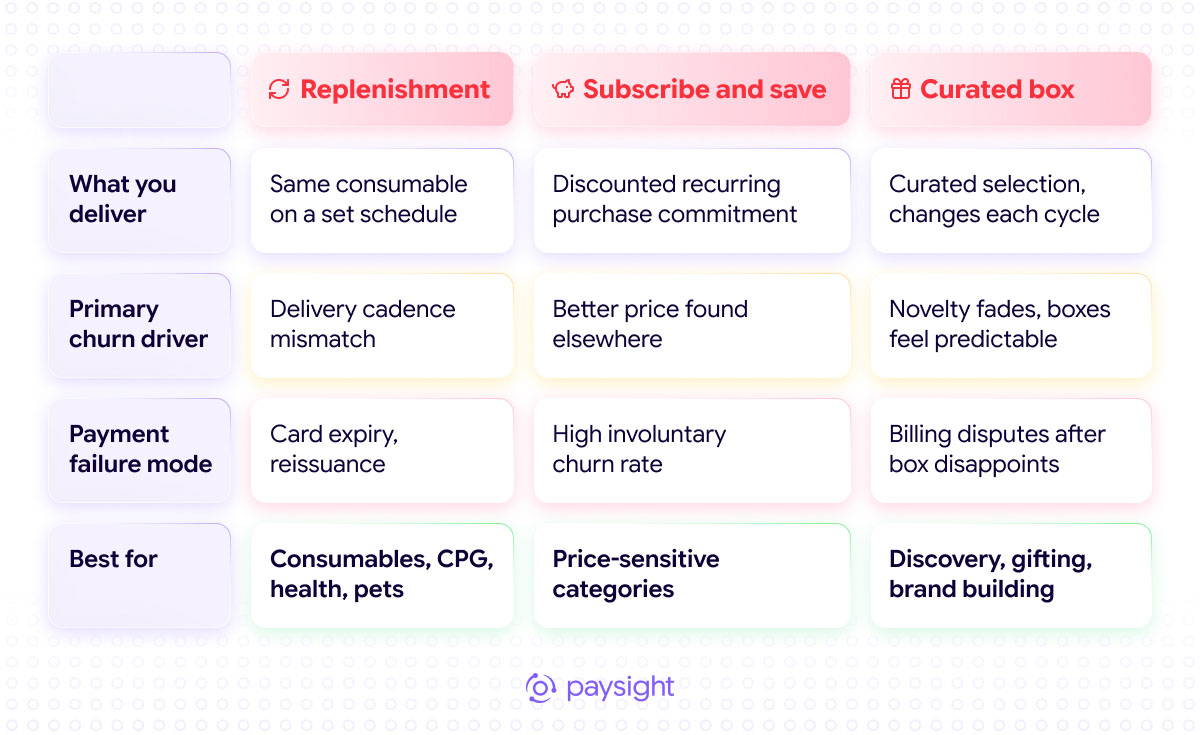
What makes it work: the replenishment model has the highest natural retention of any physical subscription type because the product is genuinely consumed and needs to be replaced. When the delivery cadence matches the consumption rate, cancellation feels like a deliberate inconvenience rather than a neutral choice.
Operator notes: the biggest risk is timing mismatch. Delivering too frequently leads to inventory buildup, and customers cancel not because they dislike the product but because they have too much of it. Strong retry logic and card account updaters are essential because this model typically has a high proportion of long-tenured subscribers whose cards will expire or be reissued over the subscription lifetime.
Subscribe and save
Subscribe and save is a variation on replenishment where the primary value proposition is the discount rather than convenience. The customer commits to a recurring purchase in exchange for a lower per-unit price, typically 5-15% off the standard price.
Real examples: Amazon Subscribe and Save, Chewy Autoship, most major CPG brands' direct-to-consumer channels.
What makes it work: the discount creates a rational commitment. Customers who have done the mental math to realize they save money by subscribing are more deliberate subscribers than those who signed up for a trial. Cancellation requires consciously deciding to pay more.
Operator notes: this model attracts price-sensitive subscribers who will actively compare alternatives. Involuntary churn from failed payments is disproportionately high because the subscriber base often includes customers with variable income or spending patterns. Smart retry logic that sequences attempts across multiple time windows and acquirers recovers a significant portion of renewals that would otherwise lapse.
Curated and mystery box subscriptions
Curated and mystery box subscriptions deliver a selection of products chosen by the brand, often themed, often a surprise, always positioned as a discovery experience rather than a replenishment service.
Real examples: Birchbox (beauty), FabFitFun (lifestyle), Loot Crate (gaming and pop culture), BarkBox (pets).
What makes it work: the curated box model has unusually high acquisition appeal because the discovery element creates genuine anticipation. The model also has a built-in gifting use case — curated and mystery boxes are purchased as gifts at a higher rate than replenishment subscriptions.
Operator notes: the novelty-driven acquisition appeal is also the primary churn driver. Subscribers who joined for the discovery experience will cancel once the boxes start feeling predictable or the perceived value-to-price ratio shifts. Curation quality needs to improve over time, not just be maintained. Chargeback rates tend to be higher than replenishment models because customers dispute charges when a box disappoints.
Replenishment vs subscribe and save vs curated box: churn drivers, payment failure modes, and best use cases compared
Digital Subscriptions: Models Built Around Access and Value
Digital subscription models deliver access rather than physical goods to content, tools, communities, services, or perks. Marginal delivery cost is low or zero, which makes these models highly scalable, but the value perception is less tangible, and the cancellation friction is lower.
VIP membership and access tiers
VIP membership subscriptions charge a recurring fee for access to a set of benefits, discounts, priority service, exclusive products, or a combination. The subscriber is paying not for a specific product but for enhanced status within a commerce relationship.
Real examples: Amazon Prime (free delivery, streaming, exclusive deals), Costco membership (warehouse pricing access), ASOS Premier Delivery.
What makes it work: when the benefits are genuinely used, VIP membership subscriptions generate the highest LTV of any subscription type. A Prime subscriber who uses fast delivery regularly and streams content has a deeply embedded relationship that is expensive and effortful to cancel. Annual billing reduces involuntary churn significantly because there are fewer renewal attempts per year.
Operator notes: the primary churn driver is perceived value decline. When a subscriber stops using the benefits regularly, the subscription fee starts feeling like a waste. Actively surface and remind subscribers of unused benefits — passive retention is not a strategy here. Billing descriptor confusion is common: subscribers who forgot they signed up dispute annual renewals at a high rate. Pre-renewal emails and recognizable descriptors are non-negotiable.
Content and education subscriptions
Content subscriptions deliver ongoing access to educational material, creative content, or skill-building resources like courses, tutorials, guides, use cases, video libraries, and similar formats.
Real examples: Masterclass, Skillshare, Duolingo Plus, Calm.
What makes it work: content subscriptions scale well because the delivery cost is near zero once content is produced. The model also attracts subscribers with high intent — someone who pays for an education subscription has already committed to a goal.
Operator notes: the highest churn risk is content consumption without replacement. A subscriber who completes the content they joined for has no remaining reason to stay unless new content is consistently added. Cancellation rates spike after intensive usage periods. Onboarding flows should pace content consumption rather than encouraging immediate binge behavior — spreading engagement out extends the perceived value window significantly.
Software and tools subscriptions
SaaS subscriptions provide ongoing access to software, platforms, or productivity tools. This is the most mature and analytically well-understood subscription model, with established benchmarks for churn, expansion revenue, and LTV.
Real examples: Adobe Creative Cloud, Shopify, Slack, HubSpot.
What makes it work: SaaS subscriptions generate the most predictable recurring revenue of any subscription type because product usage is integrated into the subscriber's workflow. A business that builds processes around a tool has high switching costs regardless of price.
Operator notes: most involuntary churn comes from billing failures on corporate cards, which have different expiration and replacement patterns than personal cards. Dunning sequences need to accommodate business billing cycles and involve multiple contacts within an organization. Offer annual plans with incentives — they dramatically reduce exposure to both billing failure and voluntary churn simultaneously.
Premium delivery and perks subscriptions
Premium delivery subscriptions charge a recurring fee for enhanced fulfillment benefits, faster delivery, free returns, priority customer service, or early access to new products.
Real examples: ASOS Premier Delivery (unlimited next-day delivery for a flat annual fee), Instacart+ (reduced delivery fees and free delivery above a threshold).
What makes it work: when a customer shops frequently enough that the delivery savings exceed the subscription cost, the model delivers clear rational value.
Operator notes: don't build this as a primary product. It works only as an add-on to a business with an existing high purchase frequency. Without that base, subscribers do the break-even math and cancel. Churn is highly correlated with shopping behavior: when purchase frequency drops, the delivery subscription loses its rationale immediately.
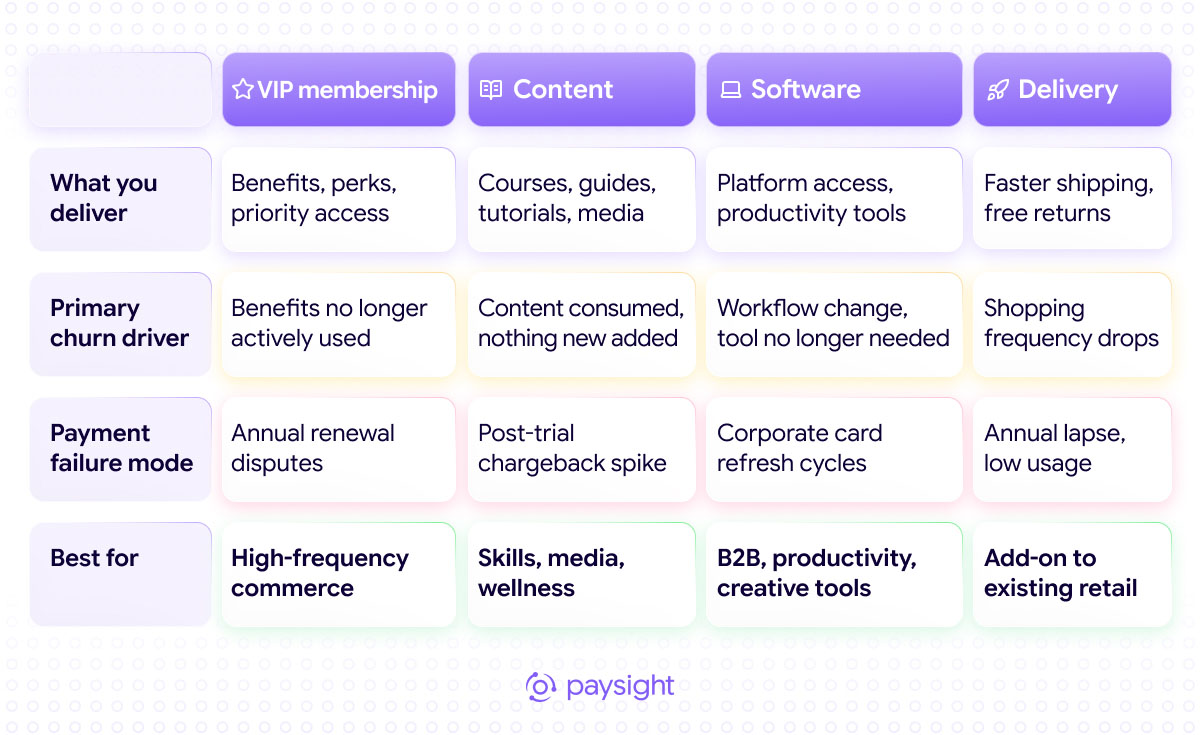
VIP membership, content, software, and delivery perks compared by churn drivers, payment failure modes, and best use cases
Choosing the Right Model: LTV vs. Churn Risk
Not all subscription types are equal in terms of long-term business value. The two dimensions that matter most for operators are LTV potential and churn risk. Where your model sits on this map determines how much infrastructure investment it needs and how hard retention work will be.
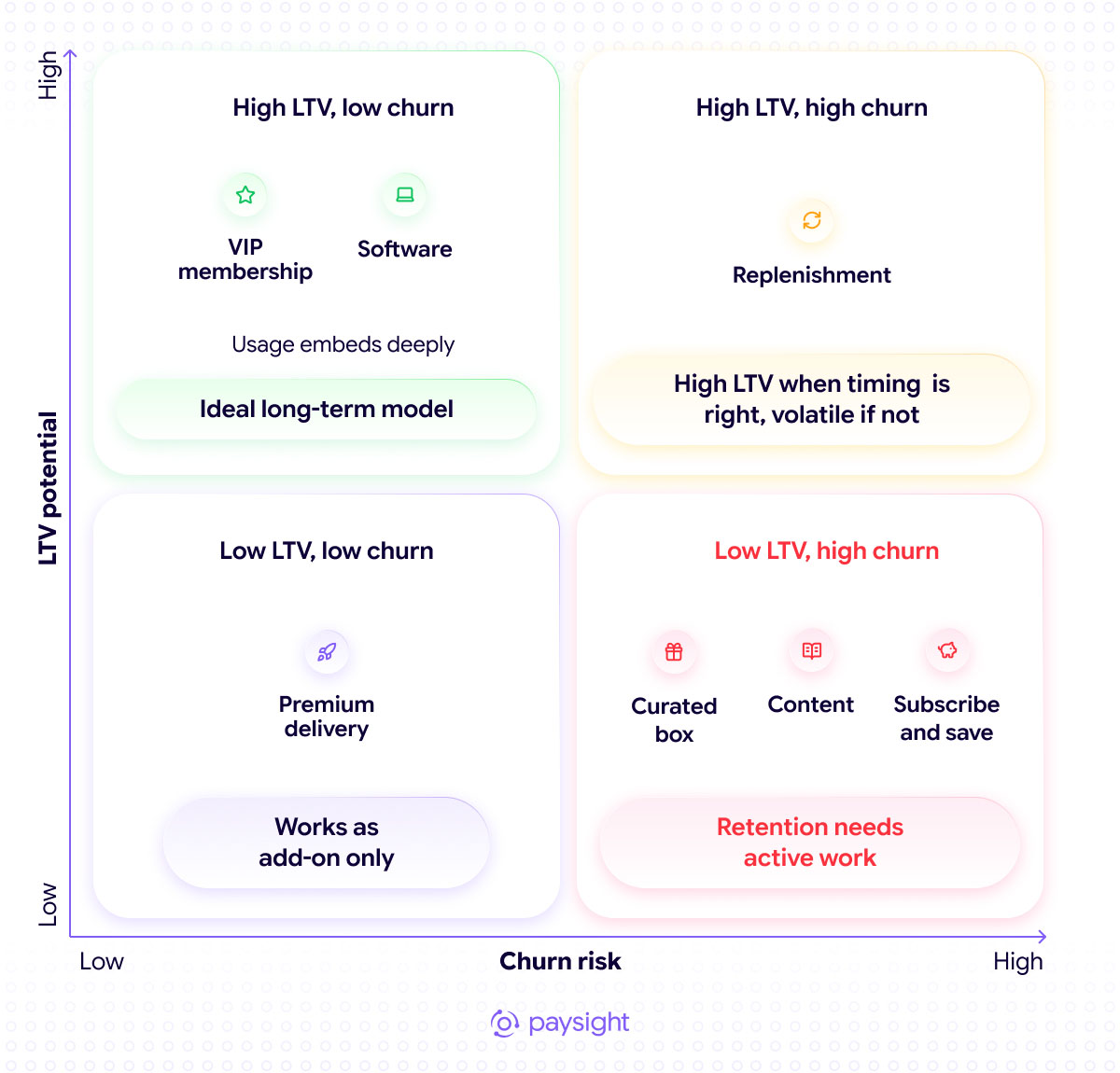
2x2 positioning diagram showing seven subscription types by LTV potential and churn risk: VIP membership and software top left, curated box and content bottom right
VIP membership and software subscriptions sit in the ideal quadrant, high LTV and low churn, because product usage embeds deeply into daily behavior and switching costs are high. Curated and mystery boxes, content, and subscribe and save sit in the hardest quadrant because retention depends on continuously delivering perceived value rather than structural lock-in.
How Subscription Type Shapes Your Payment Infrastructure Needs
Every subscription type generates recurring revenue through repeated billing, but the failure modes, dispute patterns, and operational requirements differ significantly. The infrastructure that protects revenue in a replenishment model is not the same infrastructure that protects it in a digital membership.
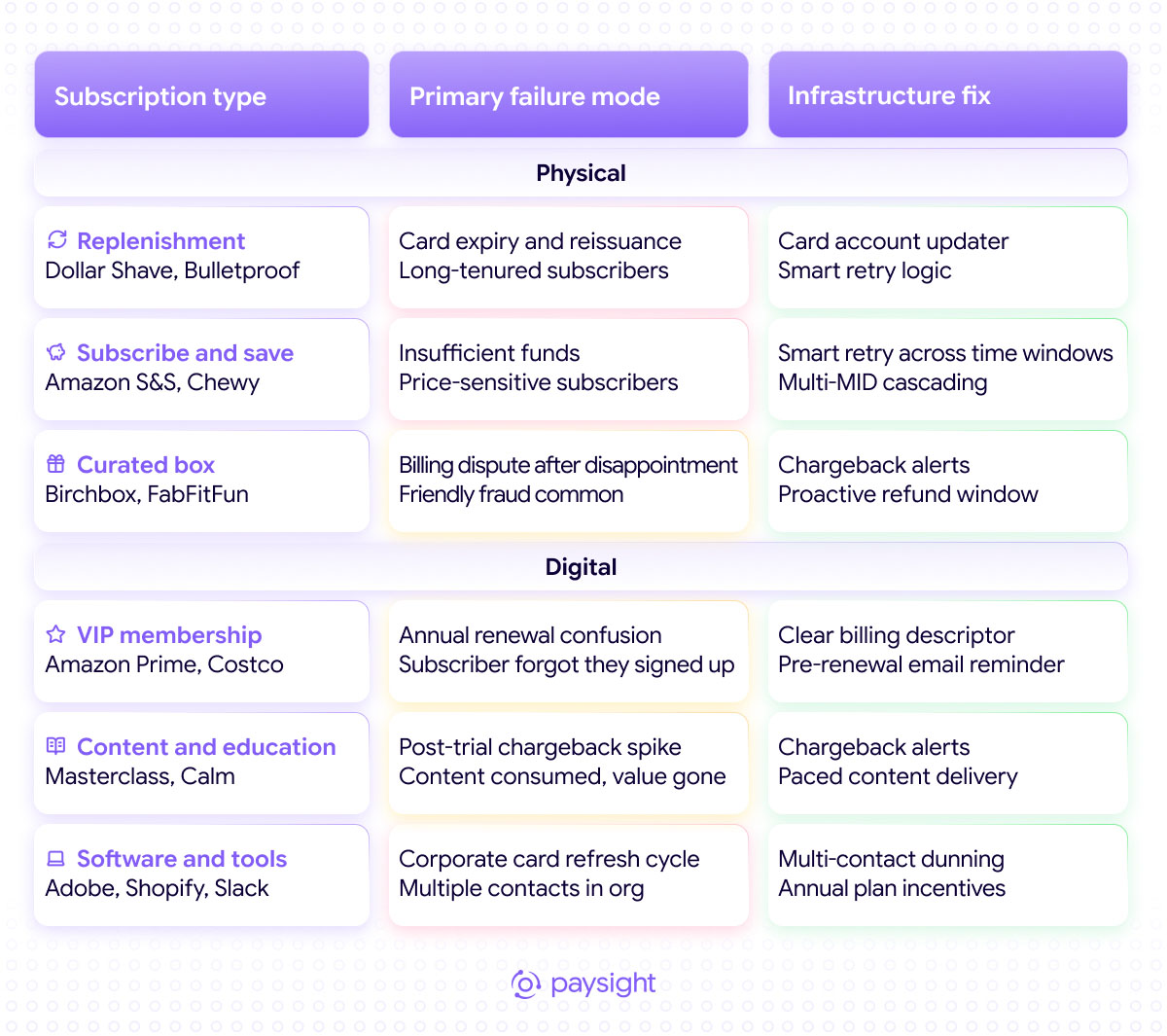
Each subscription type mapped to its payment failure mode and infrastructure fix, from card expiry and retry logic for physical models to billing descriptor fixes for digital models
Physical subscription types have higher involuntary churn exposure because subscriber bases tend to be larger, more price-sensitive, and have longer average tenures. Cards expire, get reissued after fraud incidents, or run low on funds. Smart retry logic, chargeback alerts, and card account updaters are the core infrastructure requirements.
Digital subscription types have different failure patterns. The primary chargeback trigger is billing descriptor confusion — subscribers who do not recognize the charge call their bank before contacting support. Annual renewals for VIP memberships and SaaS products are particularly vulnerable because a year has passed since the subscriber actively thought about the charge. Clear descriptors, pre-renewal email reminders, and easy cancellation flows reduce dispute rates without reducing retention.
Across both categories, multi-MID orchestration matters when subscription volume reaches the point where a single processor relationship becomes a single point of failure. Routing subscription billing across multiple acquirers with automatic failover ensures that no single infrastructure event can take your recurring revenue offline.
How Paysight Supports Every Subscription Model
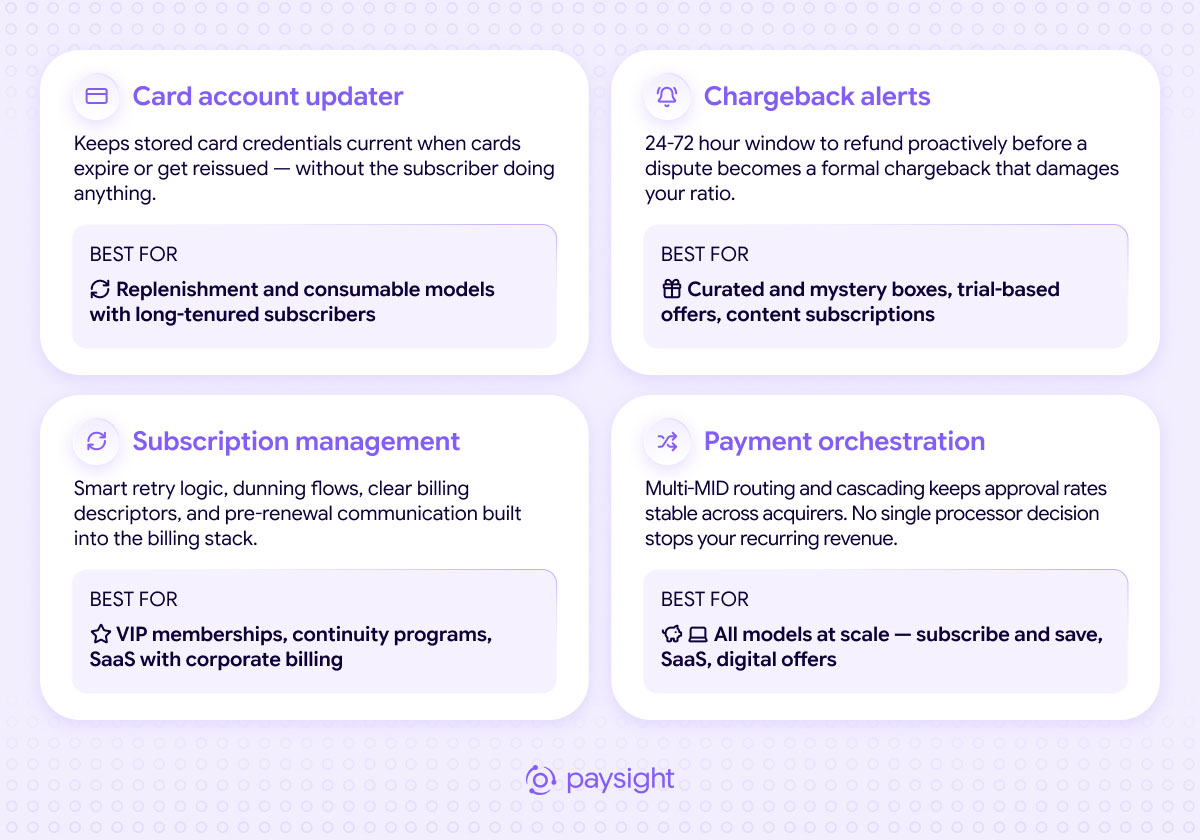
Paysight is a payment orchestration platform that connects subscription businesses to multiple acquiring relationships and manages how traffic flows between them. Subscription management, chargeback alerts, card account updater, and multi-MID routing are all native to the platform, built for the specific failure modes that subscription businesses face, not bolted on afterward.
The infrastructure requirements map directly to each subscription type:
For consumable and replenishment models: the card account updater keeps long-tenured subscriber credentials current, and smart retry logic recovers failed charges before they lapse into involuntary churn.
For curated and mystery box models and trial-based offers, chargeback alerts give you the 24- 72-hour window to proactively refund before a disappointed subscriber's dispute becomes a formal chargeback that damages your ratio.
For VIP memberships and continuity programs: pre-renewal communication, recognizable billing descriptors, and annual billing logic reduce the confusion-driven disputes that hit these models hardest.
For digital offers, content subscriptions, and SaaS: multi-contact dunning flows that accommodate business billing cycles and multi-MID routing that keep approval rates stable across acquirers.
Paysight tools mapped to subscription model types: CAU, chargeback alerts, subscription management, and multi-MID orchestration
If you are building or scaling a subscription operation and want to understand what the right payment infrastructure looks like for your specific model, talk to Paysight.
Talk to our team →
The two fundamental categories are physical subscriptions — replenishment, subscribe and save, and curated and mystery boxes — and digital subscriptions — VIP memberships, content and education, software tools, and premium delivery perks. The distinction matters operationally because physical and digital subscription models fail differently and require different billing infrastructure.
Dollar Shave Club and Bulletproof Coffee for replenishment, Amazon Subscribe and Save and Chewy Autoship for subscribe and save, and Birchbox, FabFitFun, and BarkBox for curated and mystery boxes. Each represents a different retention mechanic and a different primary churn driver.
Replenishment subscriptions deliver the same consumable product on a schedule. The value is convenience and consistency. Curated and mystery box subscriptions deliver a changing selection of products, where the discovery experience is the value. Replenishment has higher natural retention. Curated boxes have higher acquisition appeal but higher long-term churn.
VIP membership subscriptions — particularly those with tangible, frequently used benefits like Amazon Prime — tend to generate the highest LTV because usage embeds the subscription into daily behavior. Software subscriptions are a close second for the same reason: workflow integration creates high switching costs.
Replenishment is the most operationally straightforward starting point for physical product brands. The billing logic is simple, the value proposition is clear, and retention is primarily driven by product quality and delivery timing. For digital businesses, content subscriptions have the lowest marginal cost to scale once the initial content library is built.
Involuntary churn is primarily addressed through three mechanisms: smart retry logic that sequences payment attempts across optimal time windows and multiple acquirers, card account updaters that keep stored credentials current, and chargeback alerts that give you the window to resolve disputes before they become formal chargebacks. Physical subscription models with large, long-tenured subscriber bases are most exposed to involuntary churn.
At minimum: retry logic for failed payments, clear billing descriptors to reduce dispute rates, and a dunning flow that communicates with subscribers before access is cancelled. At scale: multi-acquirer routing to avoid single-processor dependency, card account updater to prevent token expiry failures, and chargeback alert integration to manage dispute rates actively. The specific requirements vary by subscription type.
Subscription models refer to the specific billing and delivery mechanics — replenishment, curated box, VIP access, and so on. Subscription business types refer to the broader category of business that uses recurring revenue — ecommerce, SaaS, media, and others. A single subscription business type can use multiple subscription models simultaneously.


.svg)


.png)


Company Reg. No. 760371
VAT No. IE4280069RH


