


Recurring billing with multiple payment gateways can make subscription revenue more resilient, but only when the gateways operate behind one controlled payment state. Connecting several providers is the easy part. The difficult part is preserving the customer's original agreement, carrying the correct stored-credential context, choosing an eligible route, responding correctly to a decline, and ensuring that one renewal never becomes two charges.
That makes multi-gateway recurring billing different from ordinary checkout routing. At checkout, the customer is present and can authenticate, correct information, or choose another payment method. During a renewal, the customer is normally absent. The system must decide what it is permitted to do next.
This guide explains the operating architecture: how to set up the initial payment, manage credentials across processors, control routing and recovery, handle ambiguous results, run dunning, and reconcile every attempt into one subscription outcome.
Key takeaways
- Treat the first customer-initiated payment as the foundation of the recurring relationship. Later merchant-initiated renewals must retain the correct consent, transaction type, and original payment reference.
- Do not assume a token created by one gateway will work at another. Confirm the vault, network-token, and secure migration model before calling the payment stack portable.
- Decide route eligibility before route performance. A gateway must support the market, currency, merchant account, stored-credential model, authentication state, and subscription use case before it can receive a renewal.
- Keep one canonical state for each invoice. Idempotency, attempt history, status verification, and webhook reconciliation prevent timeouts or delayed responses from becoming duplicate charges.
- Match recovery to the outcome. A technical failure, temporary issuer decline, expired credential, stop instruction, and unknown status require different actions.
- Measure eventual renewal success together with retry count, involuntary churn, duplicate prevention, fees, disputes, and customer contacts. Recovery that damages trust is not a win.
What is recurring billing with multiple payment gateways?
Recurring billing automatically charges a customer on an agreed schedule for a subscription, membership, installment plan, or other ongoing service. A multi-gateway setup can send those payments through more than one connected gateway, processor, acquirer, or merchant account.
The commercial object is the subscription or invoice. The payment objects are the attempts made to collect it. A sound system keeps those concepts separate:
- One subscription defines the customer relationship, plan, cadence, amount, and entitlement.
- One invoice defines what is due for a billing period.
- One payment state records whether that invoice is unpaid, processing, paid, failed, or under review.
- One or more controlled attempts may be attached to that state without becoming separate orders.
The purpose of multiple gateways is not to submit every renewal everywhere. It is to provide eligible paths for prevention, routing, continuity, and recovery while maintaining one source of truth.
If you need the broader platform-selection view first, read our guide to ecommerce platforms with multiple payment processors. This article focuses specifically on what changes when the payment is recurring.
The initial payment and the renewal are not the same transaction
The first payment or account-verification event normally happens while the customer is present. It establishes the relationship and captures the customer's agreement to store and reuse the payment credential. Future renewals are commonly merchant-initiated transactions performed without the customer actively participating.
Visa's explanation of card-on-file transactions distinguishes consumer-initiated transactions from merchant-initiated transactions and notes that an MIT must refer to the original interaction in which the customer agreed to the recurring or automated relationship. Visa's stored-credential framework also requires the initial event and subsequent stored-credential transactions to be identified appropriately.
This distinction matters across gateways. A secondary processor must receive the information required to recognize a legitimate subsequent recurring payment. Simply possessing a card token does not automatically recreate the original transaction context.
Operationally, retain a durable record of:
- Customer consent and the terms accepted
- The initial customer-initiated transaction or verification
- The network or processor reference needed for later payments
- The recurring or stored-credential classification
- The amount and cadence the customer expects
- Changes to the plan, amount, payment method, or authorization
- Cancellation, pause, and stop-payment state
If a payment method or gateway cannot support the required recurring model, it is not an eligible route for that renewal.
Why recurring payments are harder to reroute than checkout payments
Multi-gateway checkout routing usually occurs while the customer can still respond. Recurring billing removes that safety net.
A renewal may fail because the issuer has insufficient funds, the credential expired, the processor is unavailable, the merchant account is not configured for recurring traffic, the original reference is missing, the issuer instructed the merchant to stop, or the payment is still processing even though the gateway connection timed out.
Those cases can look identical if the billing platform reduces every unsuccessful API call to failed. They are not identical:
- A definitive technical failure may support another eligible route.
- A temporary issuer decline may support a later retry, not an immediate cascade.
- An authentication-required result may need the customer to return on-session.
- An expired or replaced card may need an account updater or a new credential.
- A hard decline or stop instruction should halt automated attempts.
- A timeout with an unknown final status must be verified before another charge is created.
This is why payment gateway failover and recurring-payment recovery overlap but are not the same problem. Failover handles route availability. Recurring billing must also manage credential continuity, network rules, retry timing, subscription state, and customer communication.
1. Establish a valid recurring-payment relationship
Build the initial signup as the root of the later payment chain.
Capture clear consent for the stored credential and recurring schedule. Record whether the initial event was a payment or an account verification. Pass the correct indicators supported by the gateway and network. Store the identifiers returned by the successful initial event, not only the local customer and subscription IDs.
If the first authorization or verification fails, do not treat the credential as successfully established for later merchant-initiated use. Visa's stored-credential guidance states that a declined initial payment or verification cannot be treated as establishing a stored credential for subsequent transactions.
The subscription record should reference the commercial agreement. The payment layer should reference the payment relationship. Keeping both makes it possible to change processors without losing why the merchant is allowed to charge the customer.
2. Design credential portability before adding gateways
The most common architectural mistake is confusing connection portability with credential portability. An orchestration layer may connect to three gateways while the stored credential remains usable at only one.
Gateway tokens are often scoped to the provider or merchant account that created them. Moving an existing subscription portfolio may require a secure provider-to-provider export and import rather than copying token strings. For example, Stripe's payment-data export documentation describes encrypted transfers to a PCI DSS Level 1-compliant processor, while Adyen's migration guidance describes staged token migration and mapping between provider and shopper references.
A practical credential strategy may combine several models:
- Keep existing subscribers on their original processor while new signups use the new architecture.
- Import eligible stored credentials into a merchant-controlled or orchestrator-managed vault.
- Maintain gateway-specific token mappings under one internal payment-method ID.
- Use network tokens where supported, while confirming how provisioning and lifecycle updates work across providers.
- Request a new payment method when migration or reuse is not permitted.
Card account updater services can reduce failures from expired or reissued cards, but they do not remove the need for a portable architecture. Our card account updater guide explains why an update trapped inside one processor's vault may still leave another gateway with stale credentials.
3. Separate route eligibility from route optimization
Before choosing the best gateway, determine which gateways are allowed and technically able to process the renewal.
An eligibility policy should check:
- Merchant entity, MID, product, and underwriting scope
- Customer market, currency, and payment method
- Recurring-payment and stored-credential support
- Availability of the necessary token or credential mapping
- Presence of the original transaction reference and required indicators
- Authentication or exemption state
- Gateway and processor health
- Contractual limits, volume controls, and risk policy
Only eligible routes should enter performance selection. The orchestrator can then consider approval performance for comparable cohorts, local acquiring, cost, capacity, previous successful route, and current health.
Route affinity is often useful for renewals. Returning a subscriber to a previously successful eligible route can preserve continuity and make performance easier to interpret. Dynamic routing still has a role when geography, issuer behavior, route health, or merchant-account capacity changes.
Do not rank gateways using raw approval rates alone. A route receiving familiar domestic renewals cannot be compared directly with one receiving the hardest cross-border or recovery traffic. Segment by market, issuer, card type, transaction model, retry number, and customer cohort.
4. Maintain one controlled state for every renewal
A multi-gateway system needs one canonical payment state above the providers. Without it, each integration can create its own idea of whether the invoice was paid.
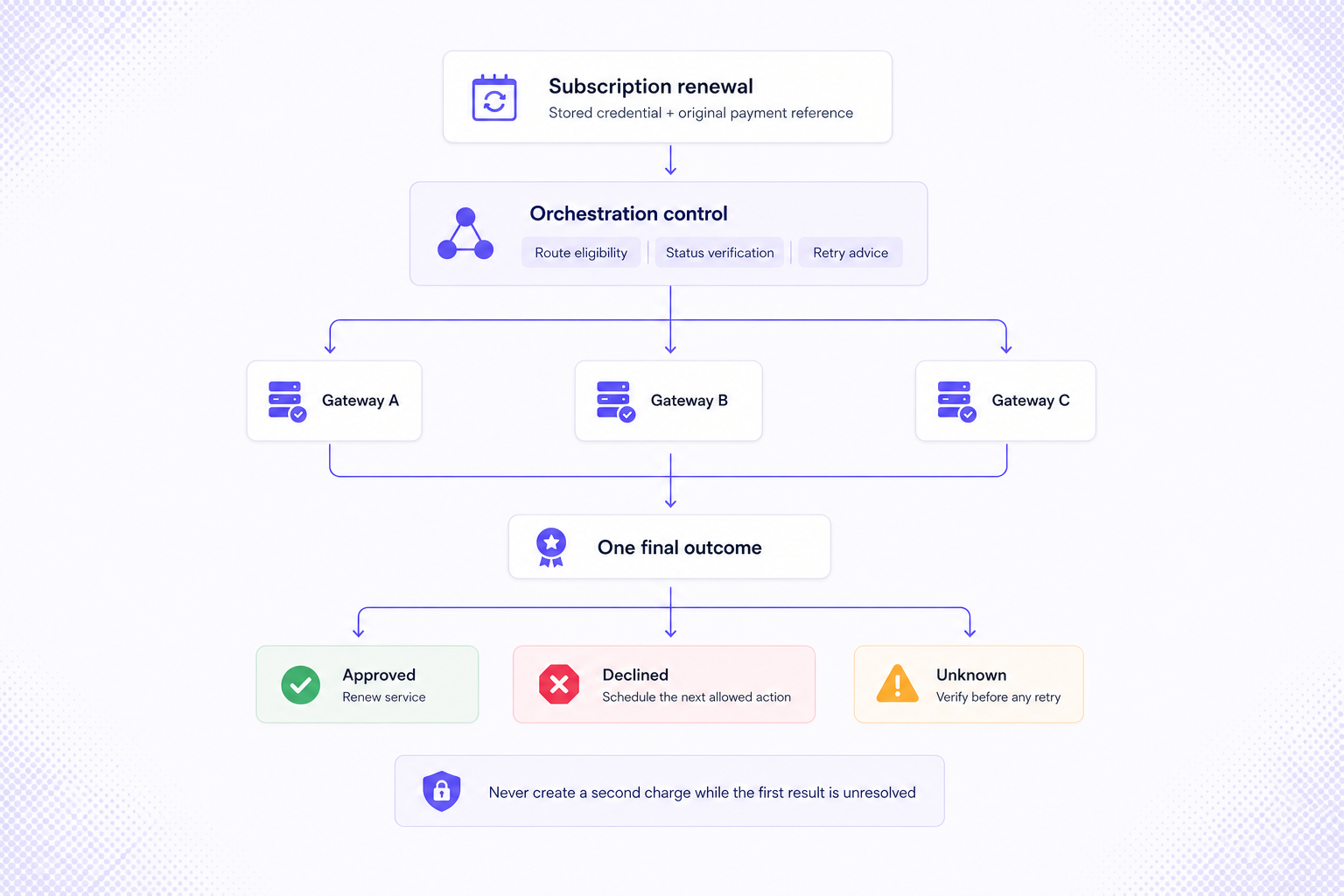
Give every invoice a stable internal identifier and every execution a distinct attempt identifier. Store the route, request time, provider reference, raw response, normalized outcome, and final status for each attempt. Process webhooks idempotently and reconcile delayed events against the same invoice.
Stripe's idempotency documentation illustrates the core API principle: retrying the same request with an idempotency key can return the original result instead of creating a second object. In a multi-provider system, local idempotency must sit above gateway-specific protections because an idempotency key sent to Gateway A is not automatically known to Gateway B.
Use an explicit state model:
- Unpaid: no active attempt is processing and collection may begin.
- Processing: an attempt was submitted and the final result is not known.
- Paid: a definitive successful payment is attached to the invoice.
- Failed: the last attempt definitively failed and policy determines the next eligible action.
- Action required: the customer must authenticate or replace the payment method.
- Under review: an ambiguous result, reconciliation exception, or manual case blocks further execution.
The most important rule is simple: never create another charge while the previous attempt is unresolved. A client timeout is not proof of a processor decline. Query the provider, wait for the webhook where appropriate, and reconcile before changing routes.
5. Match the recovery action to the payment outcome
The phrase retry the payment hides several different actions. A controlled system distinguishes them.
Network and processor advice should override a generic retry schedule. Mastercard Merchant Advice Codes, as documented in Braintree's reference, include instructions such as try again later, do not try again, stop recurring payment, and retry after a specified interval.
That leads to four practical recovery paths:
- Retry later on the same route when the outcome is temporary, another attempt is permitted, and timing is the variable that changed.
- Reroute when the failure is definitively route-specific, another route is eligible, and the original attempt cannot later settle.
- Update the credential when the stored card is expired, replaced, or otherwise stale. Visa Account Updater is one example of a lifecycle service designed for authorized card-on-file relationships.
- Return to the customer when authentication, a new payment method, renewed consent, or another on-session action is required.
Avoid rapid processor hopping after an issuer decline. The same issuer may return the same result through every route, while repeated attempts add fees, trigger retry controls, and make the customer see multiple pending authorizations.
For a broader decline taxonomy, use our guides to reducing failed ecommerce payments and improving payment approval rates. This article's narrower concern is coordinating those actions across recurring billing and multiple gateways.
6. Coordinate smart retries with dunning and service state
Payment recovery and customer communication must share the same timeline.
When a renewal first fails, decide whether the subscriber remains entitled to the service during a grace period. If an automated retry is scheduled, avoid simultaneously telling the customer that the subscription has already been canceled. If the payment later succeeds, stop all outstanding dunning messages and restore the subscription state once.
A useful dunning sequence separates:
- Silent recovery for eligible temporary failures
- Pre-dunning reminders before a known expiration or renewal
- Customer-action messages for authentication or payment-method replacement
- Grace-period warnings tied to the actual service policy
- Cancellation or pause confirmation after automated recovery is exhausted
Use customer-safe language. Raw issuer codes belong in payment operations, not in most customer emails. Tell the customer what they can do without exposing fraud signals or claiming knowledge the issuer did not provide.
Different payment methods also require different recovery policies. Some wallets and bank methods do not support merchant-initiated renewals, portable tokens, or the same retry behavior as cards. Stripe's wallet documentation recommends confirming support for token or billing-agreement creation, merchant-initiated transactions, credential continuity, retries, and dunning when subscriptions are central to the business.
7. Reconcile gateways into one financial truth
Authorization success is not the final accounting state. Payments may be captured later, partially captured, reversed, refunded, disputed, or settled in a different batch and currency.
Normalize provider data without discarding the original fields. Your internal record should connect:
- Subscription and invoice
- Payment and every attempt
- Gateway, processor, acquirer, and MID
- Authorization, capture, reversal, and refund identifiers
- Fees, exchange rates, settlement batches, and payout references
- Dispute or chargeback state
- Customer communication and service-entitlement changes
Reconciliation should be able to explain why an invoice is marked paid, which route collected it, whether the funds settled, and whether another provider still reports an unresolved attempt.
Measure the incremental value of recovery by attempt number and route. If a fourth retry adds almost no recovered revenue but materially increases fees, support contacts, or disputes, the policy should stop earlier.
A practical deployment sequence
Do not activate dynamic cascading for the entire subscription base on day one.
- Map the current subscription, credential, and transaction-reference model.
- Inventory which credentials are usable, migratable, or trapped by provider.
- Define one canonical invoice and payment state above the gateways.
- Normalize gateway outcomes while retaining raw responses.
- Build the eligibility matrix for every route and transaction model.
- Implement idempotency, status verification, webhook deduplication, and reconciliation.
- Start with deterministic routing for a narrow cohort.
- Add controlled retry and rerouting rules one outcome category at a time.
- Connect dunning and service state to the final payment outcome.
- Expand only after approval, duplicates, disputes, fees, and reconciliation all pass review.
Test unhappy paths deliberately: provider outage, timeout after submission, delayed webhook, duplicated webhook, issuer decline, expired card, updated token, authentication required, stopped recurring payment, partial capture, refund, and a provider reporting success after the local system timed out.
How Paysight supports multi-gateway recurring billing
Paysight's payment orchestration platform connects processors, acquirers, and MIDs behind one control layer. For recurring payments, that layer can coordinate route eligibility, transaction history, cascading and retry logic, credential lifecycle tools, and normalized reporting without forcing subscription operations to live inside one processor.
The practical value comes from the complete loop:
- Preserve the subscription and customer agreement.
- Maintain a usable credential and the required transaction context.
- Choose an eligible route for the renewal.
- Record every attempt under one payment state.
- Recover only when the outcome permits another action.
- Return the final result to subscriptions, support, finance, and reporting.
That is what turns multiple gateway connections into payment infrastructure rather than a collection of integrations.
Build recurring billing around continuity, not retry volume
The strongest multi-gateway recurring architecture is not the one that attempts a payment most often. It is the one that knows why it is allowed to charge, which routes are eligible, where the credential can be used, whether the previous attempt is final, and what action is appropriate next.
When those controls are in place, multiple gateways can improve resilience, preserve more legitimate renewals, reduce dependency on one provider, and give operators a unified view of subscription revenue. Without them, adding gateways can multiply duplicates, fragmented data, and customer frustration.
If you want to map your current recurring-payment stack and identify where routing, credentials, or recovery are limiting subscription revenue, talk to Paysight.
Yes, when each route supports the merchant, market, currency, payment method, stored-credential model, and recurring transaction type. The billing system must preserve the original customer agreement and payment reference while maintaining one state for the invoice across all attempts.
Not automatically. Many gateway tokens are scoped to the provider or merchant account that created them. Multi-gateway billing may require gateway-specific token mappings, a portable vault, network-token support, or a secure provider-to-provider credential migration.
No. Rerouting is appropriate only when the first attempt definitively failed, another route is eligible, and the outcome supports a new attempt. Temporary issuer declines may need a later retry, expired credentials may need an update, and hard declines or stop instructions should halt automation.
They provide additional eligible routes when a gateway is unavailable or unsuitable for a particular transaction. Combined with current credentials, controlled retries, account updater services, and customer-friendly dunning, this can recover legitimate renewals that would otherwise fail.
Use one canonical invoice and payment state, local idempotency above the gateways, unique attempt identifiers, webhook deduplication, and status verification. Never submit a second charge while the final status of the first attempt is unknown.
Track first-attempt and eventual renewal approval, recovery by attempt and route, involuntary churn, credential-update recovery, ambiguous results, duplicate prevention, processing fees, settlement, refunds, disputes, and customer contacts.
Paysight provides an orchestration layer across processors, acquirers, and MIDs. It helps operators control route eligibility, preserve transaction history, coordinate cascading and retry logic, use credential lifecycle tools, and normalize payment outcomes for subscriptions, support, finance, and reporting.
.png)


.svg)




Company Reg. No. 760371
VAT No. IE4280069RH


