


Every subscription business has a churn problem. Some have a bigger one than they know, because they are measuring the wrong thing.
Understanding why people cancel subscriptions is the foundation of any retention strategy. But the framing most businesses use misses half the picture. They track cancellations, run exit surveys, and optimize their cancellation flows. What they rarely track is how many subscribers they lose when a cancellation is never submitted because the payment simply failed and nobody followed up.
Subscription churn has two distinct categories with different causes, different signals, and different fixes. Treating them as one problem produces retention strategies that address one source of churn while the other continues undetected.
Why People Cancel Subscriptions
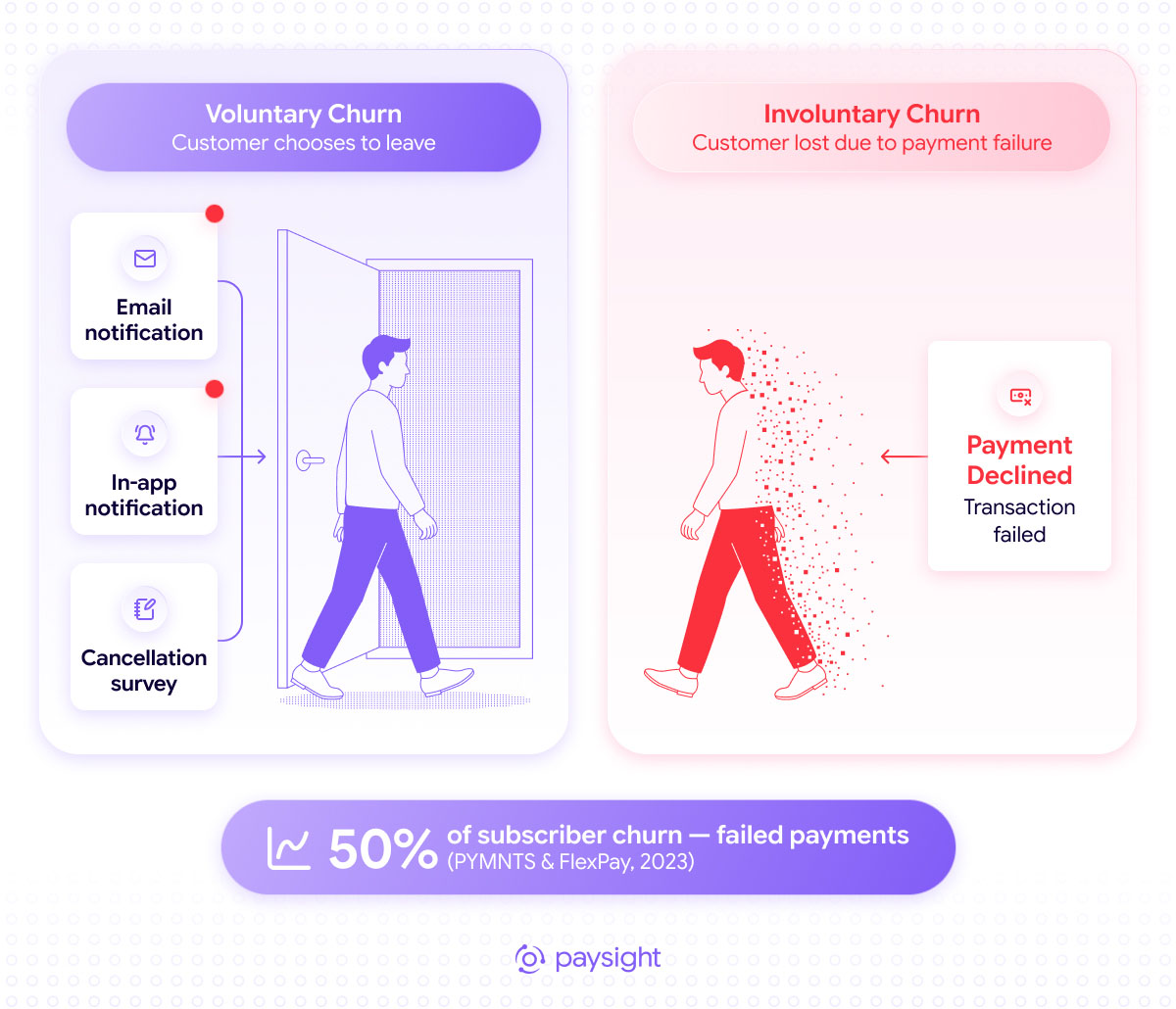
Subscriber cancellations fall into two categories: voluntary churn, where the subscriber makes an active decision to leave, and involuntary churn, where the subscriber is lost to a payment failure or billing issue without ever intending to cancel.
Most retention literature focuses almost entirely on voluntary churn. That is understandable, because voluntary churn is visible, measurable, and triggers familiar responses: exit surveys, save offers, pause flows, win-back campaigns. Involuntary churn is harder to see, rarely triggers those responses, and according to a 2023 PYMNTS and FlexPay study of 200 subscription business executives, accounts for 50% of all subscriber churn.
Voluntary churn: when customers choose to leave
Perceived value has declined
The subscriber joined because the product solved a problem or delivered consistent satisfaction. Over time, the experience became predictable, the product quality felt inconsistent, or competitors offered something more compelling. When the monthly charge starts feeling like overhead rather than a good trade, cancellation becomes easy.
The delivery cadence no longer fits
Replenishment subscriptions live and die by timing. A subscriber who is building up inventory because the delivery arrives faster than they consume the product will eventually cancel, and they will feel justified in doing so. The product itself may be excellent. The frequency is the problem.
Flexibility is too limited
Subscribers who want to skip a shipment, pause temporarily, swap to a different product, or change their delivery schedule expect to be able to do this without friction. If the path to doing any of those things is unclear, difficult, or buried in a support ticket process, cancellation becomes easier than adjustment. A well-designed customer portal with self-serve options reduces this source of churn significantly.
Price increased without a corresponding value increase
Price sensitivity varies by subscriber, but the response to a price increase is almost always the same if the communication is poor: the subscriber feels the increase is arbitrary and re-evaluates whether the subscription is worth it. Price increases that are explained, tied to a real product improvement, or accompanied by a loyalty acknowledgment generate far less churn than ones that arrive without context.
The customer experience was poor
A single bad experience with support, a damaged shipment, or a billing issue that took too long to resolve can push a subscriber who was otherwise neutral toward cancellation. Subscription businesses rely on passive retention: subscribers stay until they have a reason to leave. A bad experience provides that reason.
The subscriber found a cheaper or better alternative
Competitive churn is real, but it is rarely the primary driver. Subscribers who are satisfied do not comparison shop. When competitive churn increases, it is often a signal that perceived value has already declined, and competitors are filling the gap.
Involuntary churn: when payments fail
Involuntary churn does not come from a decision. It comes from a failed transaction that was never recovered.
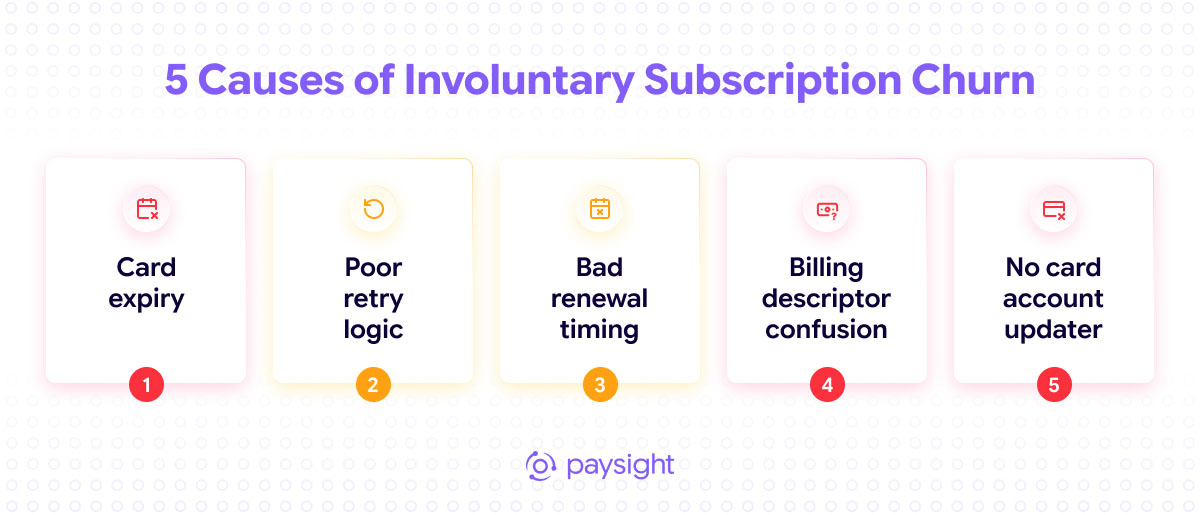
A subscriber's card expires. The bank reissues it with a new number after a fraud event. The account runs low at the wrong point in the billing cycle. The billing descriptor is unrecognizable and the subscriber calls their bank to dispute it. In each of these cases, the subscriber did not cancel. The subscription lapsed because the billing infrastructure failed to handle a predictable situation.
Card expiry and reissuance
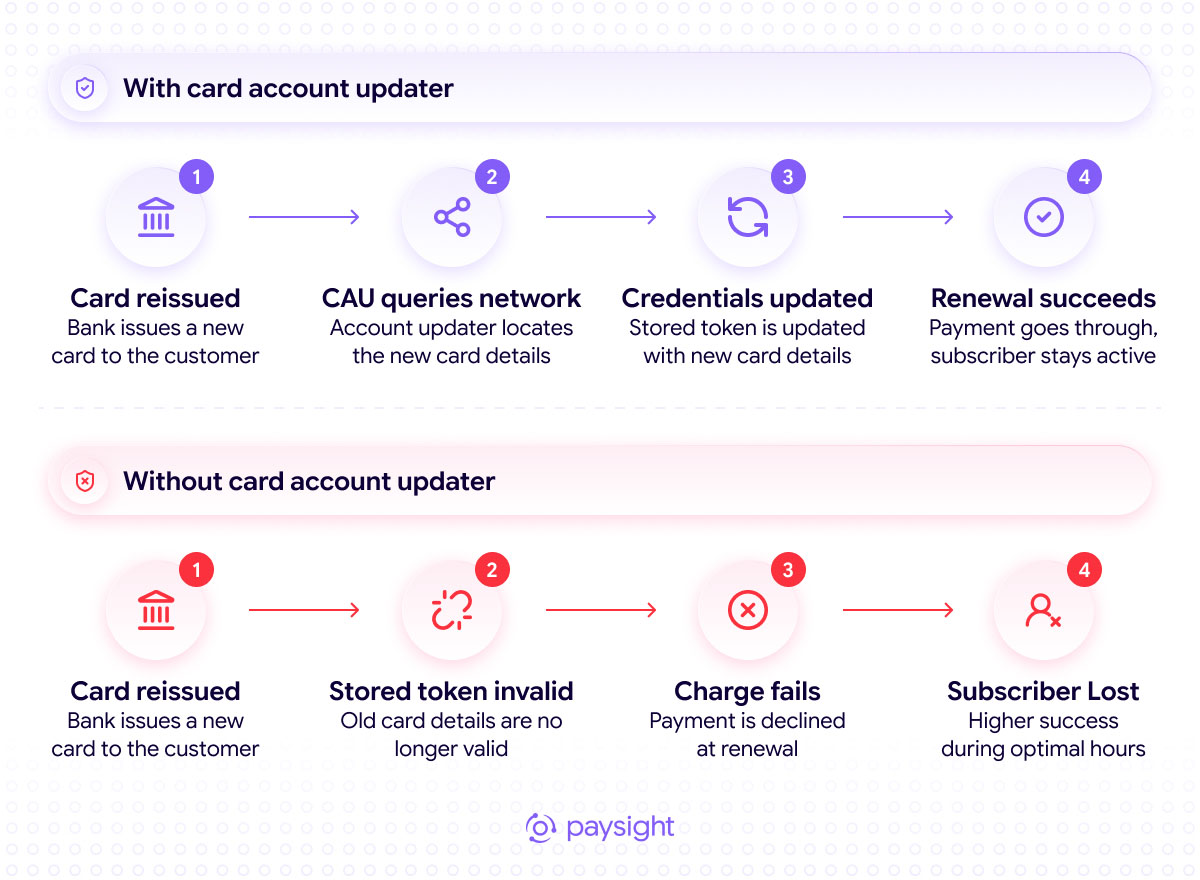
Cards expire every two to five years. Banks reissue cards after fraud incidents, product migrations, and technology upgrades. Each time this happens, any stored token for that card becomes invalid. Without a card account updater running against the network updater services maintained by Visa, Mastercard, Amex, and Discover, the next charge attempt fails. The subscriber receives a dunning email, ignores it or misses it, and lapses. This is the most common and most preventable source of involuntary churn.
Poor retry logic
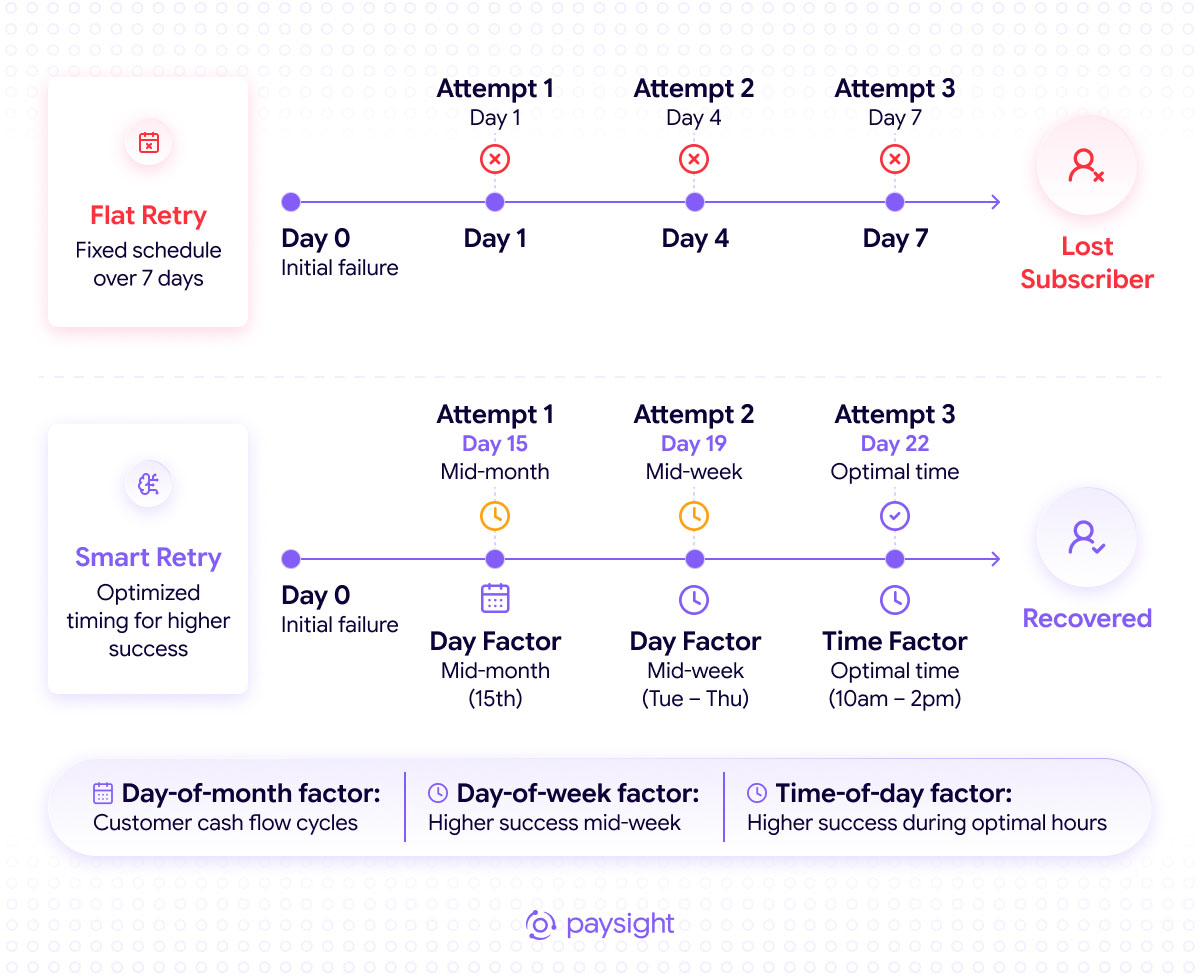
When a charge fails, the timing and sequencing of retry attempts matters more than most operators realize. A retry that fires immediately after a failed charge often hits the same insufficient funds state. A retry on the last day of the month competes with rent and other recurring bills. Retry logic that accounts for day-of-week, time-of-day, and issuer behavior recovers a meaningfully higher proportion of failed charges than a simple fixed-interval retry schedule.
Bad renewal timing
Charges scheduled at the end of the month face predictably lower approval rates than charges scheduled mid-month. Subscribers whose accounts run low before payday are more likely to generate soft declines on month-end billing dates. Shifting renewal timing based on subscriber behavior and card issuer patterns reduces this failure mode without requiring any product change.
Billing descriptor confusion
When a subscriber does not recognize the charge on their statement, they call their bank. The bank opens a dispute, the dispute becomes a chargeback, and the subscriber is lost while the merchant absorbs a chargeback fee. The fix is a billing descriptor that clearly identifies the business and the product: a descriptor that reads as the brand name the subscriber knows, not a parent company name or a payment processor reference string.
No card account updater
This is the most operationally significant gap in most subscription billing setups. A card account updater queries the card network updater services before or at the point of a failed charge and retrieves updated card credentials automatically. The subscriber never re-enters their payment details. The renewal processes against the updated card. Without this, every card reissuance event is a potential lost subscriber.
How To Reduce Subscription Churn
The approach to reducing churn differs by type. Voluntary and involuntary churn require different interventions at different points in the subscriber lifecycle.
Reducing voluntary churn
Build flexibility into the subscription experience
Subscribers who can pause, skip, swap, or change their delivery cadence through a self-serve portal cancel at lower rates than those who cannot. The option to pause is particularly valuable: a subscriber who is traveling, overstocked, or temporarily cash-constrained will choose a pause over a cancellation if the pause is easy to find and use. Making pause visible in the cancellation flow is one of the highest-ROI retention changes a subscription operator can make.
Use cancellation flows with save offers
When a subscriber initiates cancellation, the exit flow is an intervention opportunity. A well-designed save offer presents alternatives before the cancellation is confirmed: a discount, a pause, a product swap, a cadence change. The save offer should be matched to the stated cancellation reason where possible. A subscriber citing price should see a discount. A subscriber citing product buildup should see a skip or frequency adjustment. Generic save offers underperform targeted ones.
Communicate proactively around value
Subscribers who are not reminded of what they are getting for their money are more likely to cancel when the charge appears. Regular communication that surfaces product benefits, highlights usage data, or delivers relevant content keeps the subscription top of mind for the right reasons. This is especially important for subscriptions where usage is invisible to the operator: a supplement subscriber who is not seeing obvious results needs reminders of why the product works and how to use it correctly.
Time renewal reminders well
A reminder that a charge is upcoming gives the subscriber a moment to reconsider, update their preferences, or re-engage with the product before the next billing cycle. It also surfaces any payment detail issues before the charge fails, which reduces involuntary churn as a secondary benefit.
Segment by engagement
High-engagement subscribers and low-engagement subscribers churn for different reasons and respond to different interventions. Segmenting retention efforts by engagement level, purchase frequency, and time since last meaningful interaction allows operators to prioritize and personalize at scale rather than running the same retention campaign across the full subscriber base.
Reducing involuntary churn
Implement a card account updater
This is the highest-impact single change most subscription businesses can make to reduce involuntary churn. A card account updater automatically refreshes stored card credentials against network updater services when cards expire or are reissued. The subscriber does nothing. The charge processes successfully. The operator retains a subscriber who would otherwise have been lost to a billing failure they never caused and may not even be aware of.
Sequence retries intelligently
A failed charge is not necessarily a lost subscriber. Retry logic that attempts the charge at strategically spaced intervals, accounts for day-of-month and time-of-day approval rate patterns, and routes across multiple acquiring relationships recovers a significant proportion of charges that fail on the first attempt. The difference between a flat retry schedule and an optimized one is meaningful at any volume above a few hundred subscribers.
Build a dunning flow that actually communicates
A dunning sequence is a series of communications sent to a subscriber whose payment has failed, asking them to update their payment details. Most dunning flows are underdesigned: a single automated email sent immediately after the failure, often with generic language and a generic link. A dunning flow that communicates what happened, explains clearly what the subscriber needs to do, and sequences across email, SMS, and in-app notifications over a defined window recovers subscribers that a single-email approach loses.
Fix billing descriptors
Audit what appears on your subscribers' bank statements against the brand name they know. If the descriptor is a parent company name, a processor reference, or a truncated string that is not clearly identifiable, change it. Disputes that originate from descriptor confusion are preventable and they damage your chargeback ratio in addition to generating subscriber loss.
Use chargeback alerts to intercept disputes before they complete
When a subscriber initiates a dispute with their bank, there is a 24-72 hour window before the dispute becomes a formal chargeback. A chargeback alert service notifies the merchant when a dispute is opened. Issuing a proactive refund during that window prevents the chargeback from completing, protects the chargeback ratio, and removes the transaction from the involuntary churn count. For subscription businesses where a rising chargeback ratio can trigger processor restrictions, this is an operational necessity.
How To Prevent Subscription Cancellations Before They Happen
Most retention work happens after the subscriber has signaled an intent to leave or after they have already lapsed. Prevention requires moving earlier in the lifecycle.
The most effective prevention mechanisms are structural. Subscriptions that give subscribers real flexibility, communicate value proactively, and bill reliably generate lower cancellation rates across every churn category. A subscriber who has skipped twice, swapped products once, and received regular useful communications from the brand is far less likely to cancel than one who has had no meaningful interaction since their first order.
On the involuntary side, prevention means running card account updaters before billing cycles run rather than waiting for failures to occur. Batch updates that query network updater services weekly or monthly, combined with real-time updates at the point of a declined charge, minimize the gap between a card change and a successful renewal. The subscriber never knows anything changed, and the subscription continues.
The cancellation that never happens is the retention win that never shows up in a save offer dashboard. Operators who build this infrastructure reduce subscription cancellations before any exit flow is ever triggered.
How Paysight Addresses Both Types of Churn
Paysight is a payment orchestration platform. It connects subscription businesses to multiple acquiring relationships and manages how traffic flows between them. The subscription management capabilities within Paysight are built around the specific failure modes that drive involuntary churn, combined with the billing infrastructure that supports voluntary churn prevention.
Card account updater runs against Visa, Mastercard, Amex, and Discover network updater services, refreshing stored credentials before charges are attempted and in real time when charges fail. Subscribers whose cards expire or are reissued continue billing without interruption and without any action required from them.
Smart retry logic sequences retry attempts across optimal time windows, accounting for issuer behavior and day-of-month approval rate patterns. Routing across multiple MIDs means that a decline at one acquirer can cascade to the next, recovering charges that a single-processor setup would abandon.
Dunning flows communicate with subscribers across the window between a failed charge and a subscription lapse, with configurable messaging and timing that increase payment detail update rates compared to single-touch automated sequences.
Chargeback alerts give the 24-72 hour window to issue proactive refunds when disputes are opened, protecting the chargeback ratio and removing disputed transactions from the involuntary churn count.
Billing descriptor management ensures subscribers recognize the charge on their statement, reducing the descriptor confusion that generates disputes and involuntary churn across the subscriber base.
If your involuntary churn is untracked, that gap is likely larger than any voluntary retention initiative currently in flight. Talk to Paysight.
Subscribers cancel for two categories of reasons. Voluntary cancellations happen when a subscriber actively decides to leave, typically because perceived value has declined, the delivery cadence no longer fits, the price increased without a corresponding value increase, or flexibility is too limited. Involuntary cancellations happen when a payment fails and is not recovered, often due to an expired card, poor retry logic, or billing descriptor confusion. A 2023 PYMNTS and FlexPay study found that failed payments account for 50% of all subscriber churn.
Voluntary churn is a deliberate cancellation: the subscriber made an active decision to stop their subscription. Involuntary churn is a lapse caused by a billing failure: the subscriber never intended to cancel but was lost because a payment could not be processed and was not recovered. Both reduce subscriber count, but they require different interventions and respond to different treatments.
Subscription churn is the rate at which subscribers leave a subscription program over a given period, expressed as a percentage of the total subscriber base. It is measured as subscribers lost in a period divided by subscribers at the start of that period. Most operators measure total churn but do not separate voluntary and involuntary churn, which makes it difficult to identify the right retention investments.
Voluntary churn is reduced through flexibility such as pause, skip, and swap options; proactive value communication; well-designed save offers in cancellation flows; and price increase communication tied to real value improvements. Involuntary churn is reduced through card account updaters, intelligent retry logic, dunning flows, clear billing descriptors, and chargeback alert integration. The highest-ROI interventions for most subscription businesses are on the involuntary side, because they address failures that are operational rather than attitudinal.
A card account updater automatically refreshes stored payment credentials when a subscriber's card expires or is reissued by querying the network updater services maintained by Visa, Mastercard, Amex, and Discover. The subscriber does nothing, and the renewal processes against the updated card. Without a card account updater, every card reissuance event is a potential involuntary churn event. With one, it is invisible.
A dunning flow is a sequence of communications sent to a subscriber after a payment failure, asking them to update their payment details. Effective dunning flows communicate clearly what happened, make the payment update process as easy as possible, and sequence across multiple channels such as email, SMS, and in-app notifications over a defined recovery window. Most subscription businesses underinvest in dunning design relative to the recovery rate improvement it delivers.
A billing descriptor is the text that appears on a subscriber's bank statement identifying a charge. When the descriptor does not match the brand name the subscriber recognizes, they may dispute the charge with their bank as unrecognized. That dispute becomes a chargeback, generates a fee, and counts as an involuntary churn event. Clear, recognizable billing descriptors prevent this category of dispute entirely.
When a subscriber opens a dispute with their bank, there is a 24-72 hour window before the dispute completes as a formal chargeback. A chargeback alert notifies the merchant when a dispute is opened. Issuing a proactive refund during that window prevents the chargeback from completing and removes the transaction from the involuntary churn count. It also protects the merchant's chargeback ratio, which affects processor relationships and processing limits.
A 2023 study by PYMNTS and FlexPay found that failed payments account for 50% of all subscriber churn across a sample of 200 subscription business executives. Most subscription businesses do not track voluntary and involuntary churn separately, which means the involuntary portion is often undetected and unaddressed.
Retry logic determines when and how often a failed payment is retried. A flat retry schedule performs worse than optimized retry logic that accounts for issuer behavior, day-of-month approval patterns, and time of day. Routing retries across multiple acquiring relationships adds another recovery layer: a charge declined at one acquirer may be approved at another. The gap between a flat retry schedule and an optimized one translates directly to recovered subscribers at meaningful subscription volume.
.png)


.svg)




Company Reg. No. 760371
VAT No. IE4280069RH


