


The first order is the easy part. The customer chose the product, typed in a card and clicked a button. The first renewal is different: nobody clicks anything. The charge runs on a date the customer may have forgotten, for a product they may not have finished, on a card that may already have changed.
That is why the first renewal is where most subscriptions are lost. Recharge's 2026 analysis of its own platform found that about 61% of voluntary cancellations happen at the first two renewals. After that, churn falls quickly and keeps falling. A brand that gets subscribers through order two has done most of the retention work it will ever need to do.
This playbook covers what to do between order one and order two: how to set the first renewal date, what the reminder should say, how to check the card before the charge, and what to measure every week. It is written for DTC brands selling physical products on 30-, 60- or 90-day cadences, but most of it applies to any subscription with a monthly renewal.
Key takeaways
- Churn is front-loaded. On Recharge's platform, 24.1% of active subscriptions cancel at the first renewal and 27.1% at the second; by the twelfth renewal it is 5.4%.
- Set the first renewal date from how long the first order really lasts, including delivery time, not from a default 30-day calendar.
- Send a reminder about 7 days before the first renewal with the date, amount, and one-click skip and delay options next to the cancel link. Visa requires this for trials and introductory offers.
- Check the card before charge two: run the account updater, confirm the first order stored the card correctly, and make sure the renewal is sent as a merchant-initiated transaction linked to order one.
- Make the charge recognisable. A descriptor customers don't recognise turns a forgotten renewal into a dispute.
- Track first-renewal metrics separately from overall churn: cancellations before charge two, skip and delay take-up, first-renewal approval rate and disputes on order two.
Why the first renewal decides retention
Most churn reports give one monthly number. That number hides where churn happens. Recharge looked at renewal cycles across the brands on its platform from July 2025 to March 2026 and published the active churn rate at each cycle (cycle 1 is the first order, so cycle 2 is the first renewal).
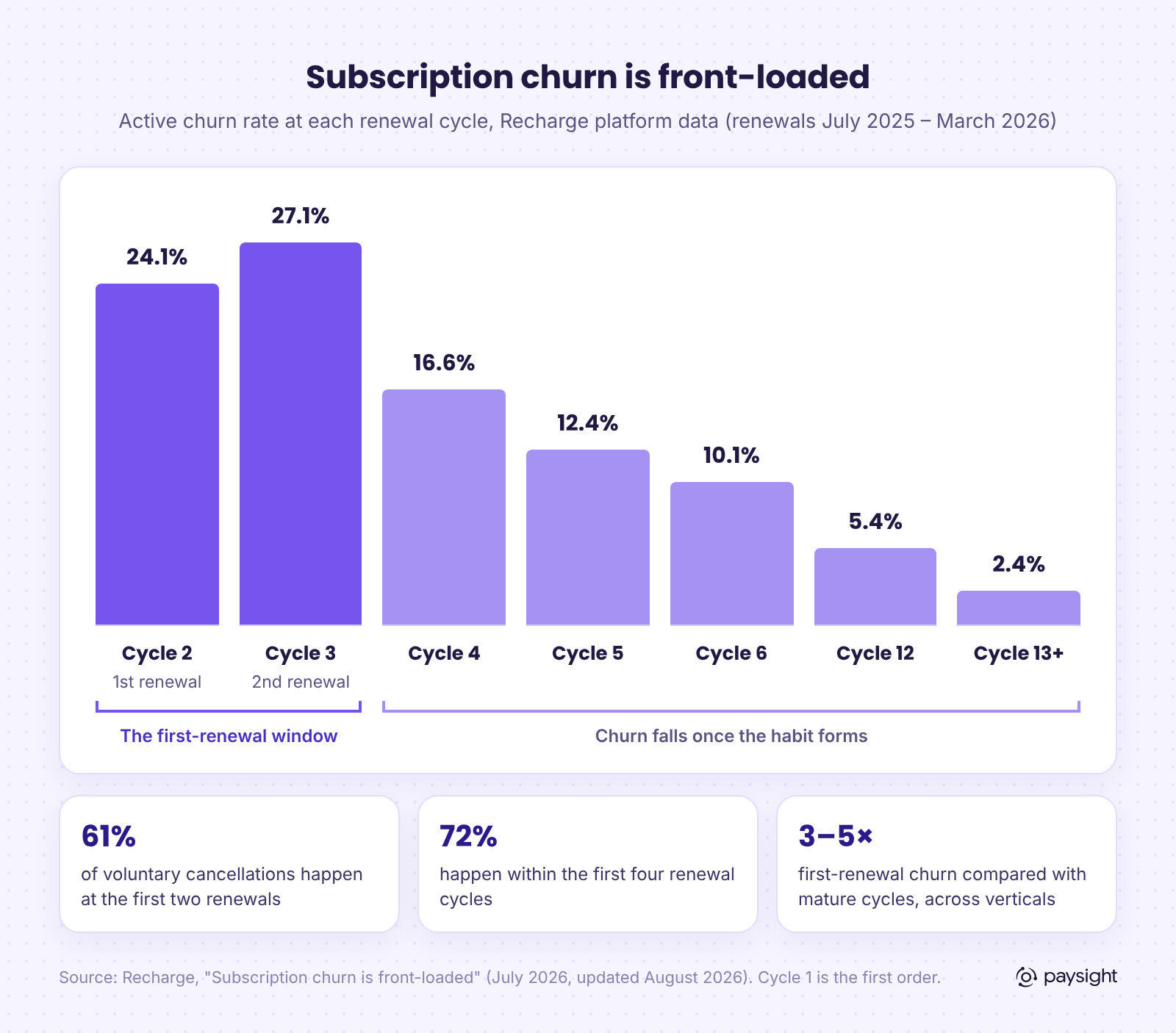
The pattern holds in every vertical Recharge measured. First-renewal churn (cycles 2 and 3) runs three to five times the rate of mature subscriptions (cycle 6 and later):
Source: Recharge, "Subscription churn is front-loaded" (July 2026, updated August 2026).
Two different problems meet at the first renewal. The first is voluntary churn: the customer decides to cancel, usually before the charge, because the product hasn't proved itself yet or because they still have half of the first order. The second is involuntary churn: the customer meant to stay, but the charge declines. Recurly's churn benchmarks (July 2026 data) put ecommerce churn at 4.25%, of which 2.87 points are voluntary and 1.38 points involuntary. The first renewal is where both are highest, because the habit isn't formed and the card hasn't been charged without the customer present before.
If you want the broader picture of why subscribers leave, our guide to why people cancel subscriptions covers both types. The rest of this article focuses on the 30 days before order two.
The first-renewal timeline
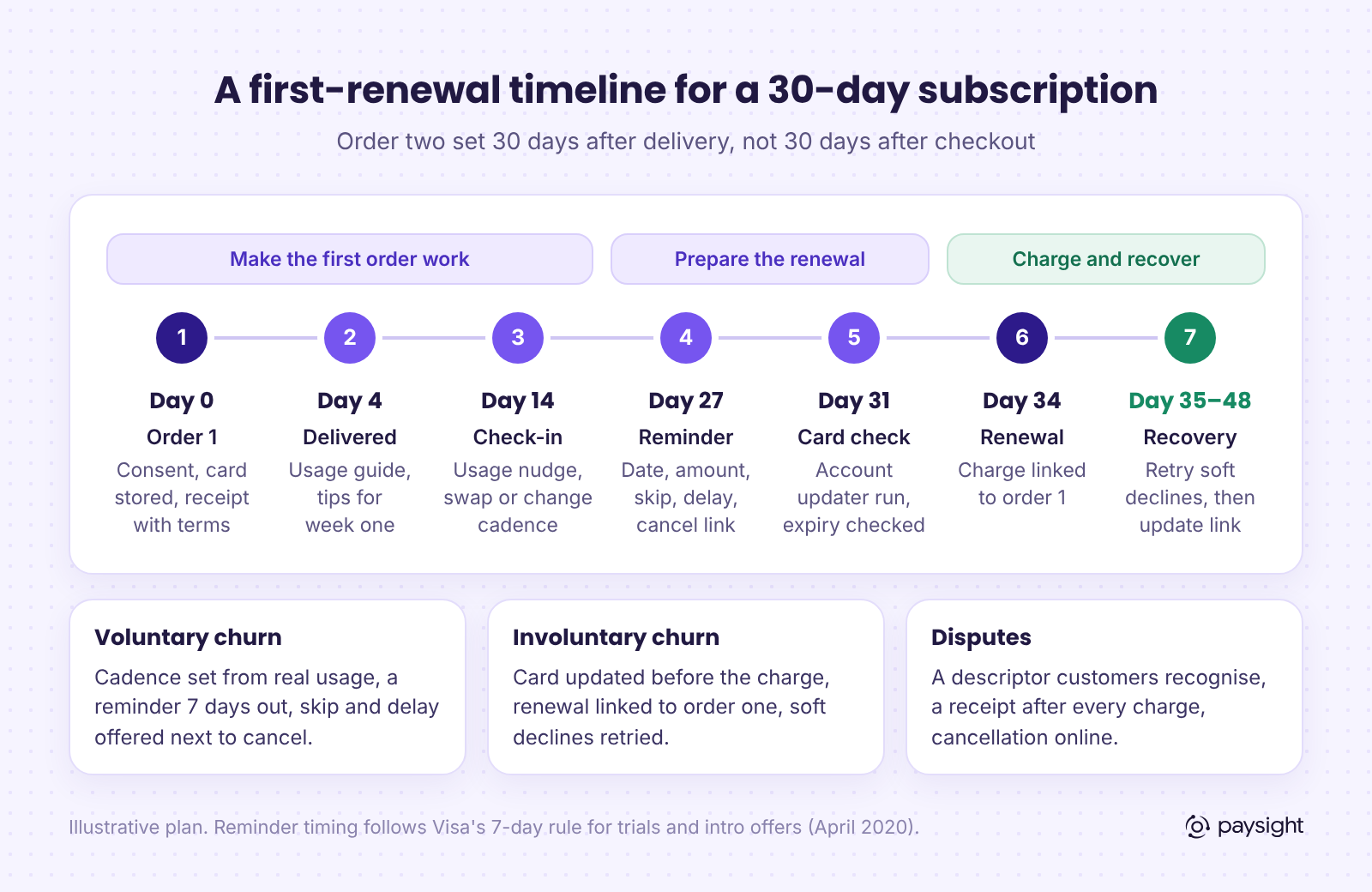
Here is what a first-renewal plan looks like for a 30-day subscription that renews 30 days after delivery (Step 1 explains why). Adjust the days to your cadence and delivery times; the order of the steps matters more than the exact dates.
Step 1: Set the first renewal date from real usage
The most common first-renewal problem is a timing problem. A brand sells a 30-serving tub on a 30-day cadence. The tub takes five days to arrive, the customer misses a few days, and on day 30 they still have a third of it left. The renewal email arrives, they look at the cupboard and cancel. They didn't dislike the product; they had too much of it.
Fix the date before you fix anything else:
- Count from delivery, not from checkout. If median delivery is four days, a 30-day product should renew no earlier than day 34.
- Use real consumption. Look at when repeat buyers of the one-time product reorder. If the median reorder is day 38, a 30-day default is too short.
- Let the customer choose at checkout. Offer two or three cadences with a recommended default, and say when order two will ship ("Your next order ships on 12 December").
- Treat bundles and starter kits separately. A starter kit that includes extra product needs a longer first interval than later orders.
Moving the first renewal a few days later costs a little cash flow in month one. Losing a quarter of new subscribers at order two costs much more.
Step 2: Send a reminder that offers skip and delay
A pre-renewal reminder feels risky because it gives customers a reason to cancel. Some will. But a customer who wants out and gets charged anyway often disputes the charge instead, and a dispute costs more than a cancellation: the refunded sale, a dispute fee and a mark against your dispute ratio. For trials and introductory offers the reminder is also required.
What the rules require
Sources: Visa's subscription rules flyer, Chargebee's summary of Mastercard's 2022 rules and the National Law Review's summary of the California law (linked below). California also added an annual reminder, notice of price changes and a "click to cancel" requirement next to any save offer from 1 July 2025.
At federal level, the FTC's "click-to-cancel" rule was vacated by the Eighth Circuit on 8 July 2025, before it took effect. The FTC reopened rulemaking with an advance notice in March 2026 (comments closed 13 April 2026), and ROSCA and state auto-renewal laws still apply. A reminder before the first renewal is the safe default even when a rule doesn't strictly require it.
What a good reminder looks like
- Timing: about 7 days before the charge. That covers Visa and Mastercard trial windows and gives the customer time to act.
- The facts first: what ships, on which date, for how much, to which address, on which card (last four digits).
- Options in order: delay by 1 or 2 weeks, skip this order, swap product or change cadence, and cancel. Recharge's upcoming-order email, for example, supports one-click delays of +7 or +14 days without logging in.
- A visible cancel link. Hiding it doesn't keep customers; it moves them to their bank's dispute form.
Skip and delay work because most first-renewal cancellations are about timing, not about the product. Recurly's 2026 State of Subscriptions report found that pause usage rose 337% and that 75% of customers who pause eventually return. A customer who delays order two by two weeks is still a subscriber; one who cancels has to be won back.
Step 3: Check the card before charge two
The first renewal is the first time the card is charged without the customer at the checkout. Several things can go wrong that never showed up on order one.
Make sure order one set up the renewal correctly
Under the card networks' stored-credential rules, the first order is a customer-initiated transaction that must be flagged as storing the card for future use. Renewals are merchant-initiated transactions that reference the first transaction's ID, so the issuer can link them to the original consent. Checkout.com's guide notes that issuers are more likely to approve stored-card payments that follow the framework, that Visa introduced assessments for incorrect flagging in November 2025, and that if the first authorisation declines, the stored card should not be used until one succeeds.
This matters most for trials and $0 first orders. If the first order only verified the card, renewal one is its first real charge. Check with your gateway that the verification was stored as the start of a recurring series and that renewals carry the original transaction reference.
Update the card before the charge, not after it fails
Cards expire, get reissued after fraud and get replaced when a bank changes card programmes. Run your card account updater a few days before the first renewal instead of waiting for a decline. Network tokens, where your gateway supports them, update automatically when the card is reissued. If the card on file expires before the renewal date and no update comes back, ask the customer to update it in the reminder email.
Have a retry plan ready
Some first renewals will still decline. Separate soft declines (insufficient funds, issuer unavailable) from hard declines (stolen card, closed account): retry the first on a schedule and ask the customer for a new card on the second. Our guide to soft vs hard declines has a sample 14-day retry plan and the network retry limits. Brands that connect more than one gateway can retry processing-side failures on a second gateway; that is for redundancy and approval rates, never for spreading disputes across accounts.
Step 4: Make the renewal recognisable
A customer who doesn't recognise a charge often calls their bank before they search their inbox. At the first renewal that risk is highest, because the customer has never seen a charge from you that they didn't initiate.
- Descriptor: use the brand name customers know, not the legal entity. Mastercard's 2019 rules for physical-product trials require the website URL or a phone number on the charge descriptor.
- Receipts: send a receipt after the renewal with what was charged and how to cancel. Mastercard requires a receipt with cancellation instructions after every subscription charge, and Visa requires receipts with a cancellation link for trials and introductory offers.
- Self-service: give customers a page where they can find a charge, get a refund or cancel without contacting their bank.
Disputes on renewals count toward your dispute ratios under Visa's and Mastercard's monitoring programmes, so a clean first renewal protects the merchant account as well as the subscriber.
Step 5: Measure the first renewal on its own
A blended monthly churn rate moves slowly and hides first-renewal problems behind loyal long-term subscribers. Track a separate first-renewal dashboard, cut by acquisition channel, offer and product:
Watch the last row closely. Recharge's data shows churn peaking at cycle 3, not cycle 2. A tactic that only delays cancellations (a deep second-order discount, for example) will show up as a good first renewal and a bad second one.
A first-renewal checklist
- First renewal date set from delivery time and real consumption, and shown at checkout.
- Order confirmation with the renewal date, amount and a cancel link.
- An onboarding email after delivery on how to use the product.
- A reminder about 7 days before order two with skip, delay, swap and cancel.
- Card account updater run before the charge; customers with expiring cards asked to update.
- Order two sent as a merchant-initiated transaction linked to order one.
- A soft-decline retry plan and a card-update link for hard declines.
- A descriptor customers recognise and a receipt after the charge.
- First-renewal metrics reviewed weekly, including order-three survival.
Where Paysight fits
Paysight is a platform to launch and manage subscriptions on the gateways and merchant accounts you connect, such as Stripe, NMI and Finix. It is not a payment processor and does not hold funds; the charges run on your own accounts.
For the first renewal, that means subscription, transaction and customer data in one place, so you can see who is due for order two, which first renewals declined and on which gateway. Paysight runs retries and routing across the gateways you connect, keeps stored cards current with a card account updater, and gives customers care portals where they can look up a charge, request a refund or cancel without filing a dispute. Cadence, reminders and onboarding content are still decisions only your team can make; ask us how they fit with your setup.
Sources
- Recharge: Subscription churn is front-loaded: the first reorder matters more than acquisition (July 2026, updated August 2026): churn by renewal cycle, 61% and 72% figures, vertical comparison
- Recurly: Churn rate benchmarks (July 2026 data): ecommerce total, voluntary and involuntary churn
- Recurly via Business Wire: 2026 State of Subscriptions (14 January 2026): pause usage up 337%, 75% of pausers return
- Visa: Trial subscription updates (effective 18 April 2020): consent, 7-day reminder, receipts, online cancellation
- Chargebee: Mastercard rules for subscriptions (effective 22 September 2022): reminder windows, receipts, cancellation
- Davis+Gilbert: Mastercard announces new free trial rules for merchants (February 2019): physical-product trials, pre-charge notice, descriptor
- National Law Review: California expands automatic renewal legislation (October 2024): July 2025 amendments and existing reminder windows
- Greenberg Traurig: Eighth Circuit vacates FTC's click-to-cancel rule (11 July 2025)
- Cooley: FTC issues new advance notice of proposed rulemaking on negative option marketing (19 March 2026)
- Checkout.com: What is Visa's stored credential framework? (accessed November 2026): initial and subsequent transactions, flagging assessments from November 2025
- Recharge: Upcoming order email (accessed November 2026): one-click delay options
Early. Recharge's 2026 analysis of renewals on its platform found that about 61% of voluntary cancellations happen at the first two renewals and about 72% within the first four. Active churn was 24.1% at the first renewal and 27.1% at the second, falling to 5.4% by the twelfth.
About 7 days before the charge is a good default. Visa requires a reminder at least 7 days before a free trial or introductory price ends, and Mastercard requires one 3 to 7 days before a free trial ends. Seven days meets both and gives the customer time to skip, delay or update their card.
It depends on the offer and where the customer lives. Visa and Mastercard require reminders for free trials and introductory offers, Mastercard also requires them before charges on billing intervals of 6 months or more, and California requires reminders for trials longer than 31 days and for terms of a year or more. The FTC's click-to-cancel rule was vacated in July 2025, but state laws and ROSCA still apply. This is not legal advice; check your offer with counsel.
Use it carefully. A discount can get a subscriber through order two, but Recharge's data shows churn peaking at the second renewal (cycle 3), so a deep one-off discount can simply move the cancellation one order later. Fix the renewal date and offer skip and delay first, and measure order-three survival before scaling any discount.
The first renewal is the first charge made without the customer at the checkout. Common causes are expired or reissued cards, a first order that only verified the card or was not stored as the start of a recurring series, and insufficient funds. Run the card account updater before the charge, check the stored-credential setup with your gateway, and retry soft declines on a schedule.
A stored credential is a card saved for future charges. Under the card networks' framework, the first order is flagged as storing the card, and later renewals are sent as merchant-initiated transactions that reference the first transaction. Issuers are more likely to approve renewals that follow this framework, and Visa has assessed incorrect flagging since November 2025.
Paysight is a platform to launch and manage subscriptions on the gateways and merchant accounts you connect; it is not a payment processor. It puts subscription, transaction and customer data in one place, runs retries and routing across your connected gateways, keeps stored cards current with a card account updater, and offers care portals where customers can look up a charge, request a refund or cancel without a dispute.









Company Reg. No. 760371
VAT No. IE4280069RH


