


Most chargebacks start as a phone call or a tap in a banking app. A subscriber sees a renewal they don't recognise, or forgot they agreed to, and asks their bank to reverse it. Between that moment and the chargeback landing in your processor's dashboard there is a gap of hours or days. Chargeback alerts live in that gap: the card networks tell you a dispute is coming, and you can refund before it becomes a chargeback.
Three products dominate that gap: Ethoca Alerts, owned by Mastercard, and Verifi's CDRN and Rapid Dispute Resolution (RDR), owned by Visa. They are often sold as one bundle, but they work differently, cover different cards and count differently toward Visa's VAMP and Mastercard's ECM thresholds. For a subscription brand that bills the same card every month, those differences decide whether alerts protect your merchant account or just add a fee to every refund.
This guide compares the three, adds the data-sharing tools that stop disputes earlier, and ends with a handling playbook for renewals. Prices and rules are as of November 2026.
Key takeaways
- Ethoca Alerts (Mastercard) and Verifi CDRN (Visa) send you a notice from participating issuers before a dispute becomes a chargeback; you decide whether to refund. Ethoca's stated objective is a refund within 24 hours; Verifi gives up to 72 hours for CDRN.
- Verifi RDR is not an alert you act on. You set rules in advance and Visa resolves matching disputes automatically, for full refunds only.
- Published per-alert prices from resellers run from about $13.50 to $29 as of August 2026, charged on top of the refund itself.
- Resolving a dispute early does not erase a fraud report. Since March 2025, Visa counts fraud-coded pre-disputes resolved through Verifi in the VAMP ratio again; only non-fraud ones stay excluded.
- For subscriptions, an alert refund is only half the job: cancel or pause the subscription too, or the next renewal invites the next dispute.
- Alerts reduce disputes by refunding early. They are not a way to hide a dispute problem, and they do nothing about the cause.
- Resolvo, our chargeback product, puts deflection, Ethoca and Verifi alerts and representment in one place; on Paysight, an alert refund also cancels the subscription automatically.
Where chargeback alerts sit in a dispute
A card dispute moves through four stages. The cardholder questions a charge with their bank (the inquiry). The issuer opens a dispute. On Visa, the issuer submits it through Visa Resolve Online. Then it is filed as a chargeback, your acquirer debits you, and your only option is to fight it with evidence (representment). Each prevention tool works at a different stage, which is why they are not interchangeable.
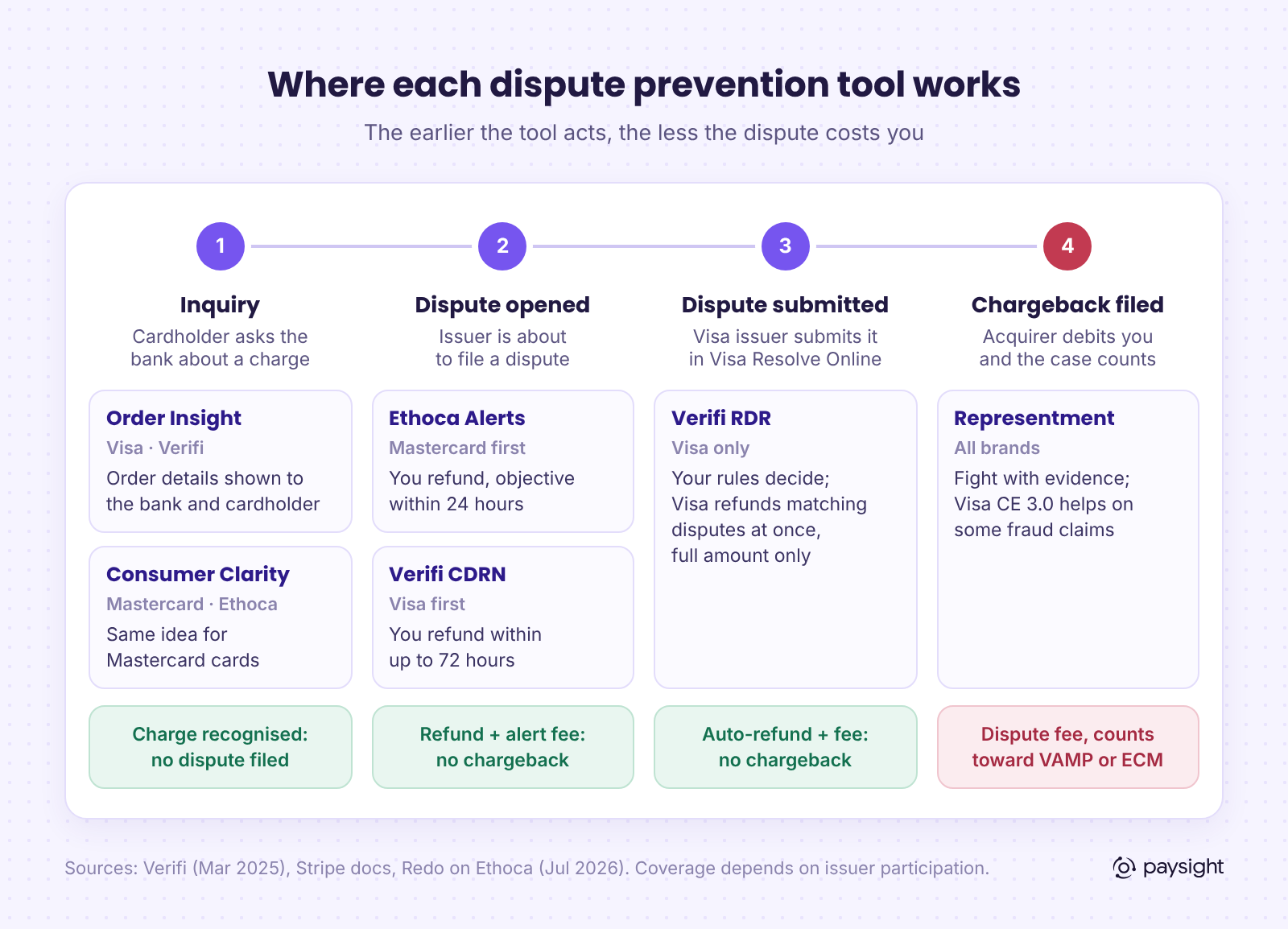
The earlier the tool acts, the cheaper the outcome. A cardholder who recognises the charge never files anything. An alert costs a fee plus the refund. A chargeback costs the refund, a dispute fee, staff time and a mark against your ratio; Mastercard puts the average chargeback at $94 (August 2026).
Ethoca vs Verifi CDRN vs RDR at a glance
Prices are published reseller rates from Redo, Chargeback.io and Disputely, checked in August 2026; the low end is Redo's top volume tier (over 10,000 alerts a month per network). Your processor's price can differ. Many resellers charge per alert received, whether or not you refund; Chargeflow is an exception that charges per deflected chargeback. No alert price includes the refunded order value. If you would rather not manage three enrolments and three dashboards, Resolvo brings Ethoca and Verifi alerts into one place (more on that below).
Ethoca Alerts: Mastercard's alert network
Ethoca started as an independent fraud-collaboration network and has been part of Mastercard since 2019. Issuers send it cases their cardholders have confirmed: either confirmed fraud or a customer dispute that the bank has not yet decided. Ethoca matches the case to your descriptor and passes it to you, usually through your acquirer, gateway or an alert reseller. Most Shopify and DTC brands never connect to Ethoca directly.
When an alert arrives, you have three choices: refund the transaction, stop fulfilment if the order has not shipped, or decline the alert and let the dispute run. Ethoca's own FAQ sets the objective as a refund or stopped settlement within 24 hours, so alerts that sit unread over a weekend often turn into chargebacks anyway. For a confirmed-fraud alert, Ethoca also suggests looking for linked orders from the same fraudster and cancelling them.
Mastercard says Ethoca Alerts helped prevent more than 39 million chargebacks in 2025. What matters for you is your own coverage: which issuers send alerts is not published in advance, so compare alerts received with chargebacks received after a month or two.
Verifi CDRN: Visa's alert network
The Cardholder Dispute Resolution Network works like Ethoca from your side. A participating issuer notifies Verifi that a cardholder wants to dispute a charge, Verifi notifies you, and you have up to 72 hours to refund and stop the chargeback from being filed. Verifi's strength is Visa, and especially US Visa issuers. Verifi also says CDRN reaches participating issuers on other card brands, but in practice most brands use it for Visa and Ethoca for Mastercard.
Two practical points. First, the fee is usually charged whether or not you refund, so many declined alerts mean paying for notices you don't use. Second, Ethoca and CDRN overlap on some Visa disputes. One industry analysis puts the overlap at roughly 15–20% of Visa disputes. If both networks alert you about the same order and you refund both, you credit the customer twice. Check refund status by order ID or acquirer reference number before every alert refund, not by amount and date.
Verifi RDR: rules instead of alerts
Rapid Dispute Resolution skips the decision step. You set rules in advance, for example "refund every dispute under $30" or "refund every non-fraud dispute on renewals". When a participating issuer starts a Visa dispute in Visa Resolve Online, Visa checks it against your rules and, if it matches, resolves it immediately with a refund. No one on your team touches it, and the dispute never becomes a chargeback.
The limits are worth knowing before you enrol:
- Full amount only. Stripe's documentation notes that Verifi does not support partial resolution or disputes on transactions already refunded. If you refunded half an order, RDR can't help with the other half.
- Every match is a loss you chose. RDR refunds every case that fits a rule, including disputes you would have won. Write rules narrowly: by amount, reason type and product.
- Enrolment needs your acquirer details. RDR uses your BIN, CAID and billing descriptor. Get them from your processor for every MID you bill renewals on; a MID that is not enrolled sends nothing.
- Stripe users get it built in. Stripe's dispute prevention runs RDR and Ethoca Alerts through Radar rules, with no separate integration, and disputes resolved through RDR carry no separate dispute fee.
Order Insight and Consumer Clarity: stopping disputes earlier
Alerts react to a dispute that already exists. The two data-sharing tools try to stop it at the inquiry. When a cardholder asks their bank about a charge, the issuer can pull purchase details from you in real time and show them in the banking app or to the call-centre agent: product description, order date, shipping address, your customer-service contact and your cancellation terms. Visa's version is Order Insight (through Verifi); Mastercard's is Ethoca Consumer Clarity.
This matters for subscriptions because many renewal disputes are recognition problems, not fraud. A customer who sees "Monthly coffee subscription, renewal 4 of 12, cancel online at…" in their banking app has less reason to dispute. Mastercard's research found that 67% of consumers would dispute fewer transactions if more purchase details were available in banking apps, and 48% have disputed a charge they later realised was legitimate.
Order Insight also connects to Visa's Compelling Evidence 3.0. If the cardholder has earlier undisputed transactions with you that match on device and identity data, the issuer can block a "fraud" dispute from being filed at all. Stripe's documentation describes the test as at least two prior transactions with matching IP addresses and a matching email or delivery address. Renewals charged without the customer present may not carry a customer IP, so ask your provider which of your transactions qualify. Visa introduced a fee for successful CE 3.0 auto-qualifications on 17 April 2026.
How alerts count toward VAMP and ECM
This is where most comparisons oversimplify. Visa's VAMP ratio adds fraud reports (TC40) to disputes (TC15) and divides by settled card-not-present transactions; since 1 April 2026 a merchant in the US, Canada, the EU and Asia Pacific is Excessive at 1.5% with at least 1,500 counted events in a month. Mastercard's ECM tier starts at 100 chargebacks and a 1.5% ratio. Our guide to VAMP and ECM thresholds covers both programmes in detail. Here is how each prevention tool affects the counts:
Two caveats. Visa's fact sheet ties every exclusion to the timing of its monthly data extract, so an alert resolved in early April for a March dispute may not help March. And acquirers apply these rules with some variation, so ask yours in writing which tools it treats as excluded and in which month. The practical lesson is that alerts are strongest against non-fraud disputes: "I cancelled", "I didn't know it would renew", "I don't recognise this". Against true fraud, prevention at checkout (3D Secure, fraud screening) matters more than any alert.
What an alert costs on a subscription renewal
Alerts are not free, and on low-priced renewals they can cost more than the chargeback they prevent. Take a $40 monthly renewal disputed as "cancelled subscription":
On the money alone, the two are close. What the alert buys is ratio headroom and fewer chargebacks on your processor's books, which is what keeps a merchant account open. If your dispute ratio is far below every threshold and your win rate on renewal disputes is high, alerts on every card may not pay. If your ratio is climbing toward your acquirer's limits, or your acquirer has already warned you, they usually do. Many brands set a floor: no alert refunds under, say, $10, where the fee is larger than the order.
Which should a subscription brand use?
If you take American Express, note that it is largely outside these networks; Amex runs its own pre-dispute programme for US businesses. And if you are in a high-risk category, your acquirer may require an alert service as a condition of the account.
A handling playbook for subscription alerts
Most subscription alerts are about a renewal the customer meant to cancel or forgot about. Refunding is the easy part; the steps below stop the same customer disputing again next month.
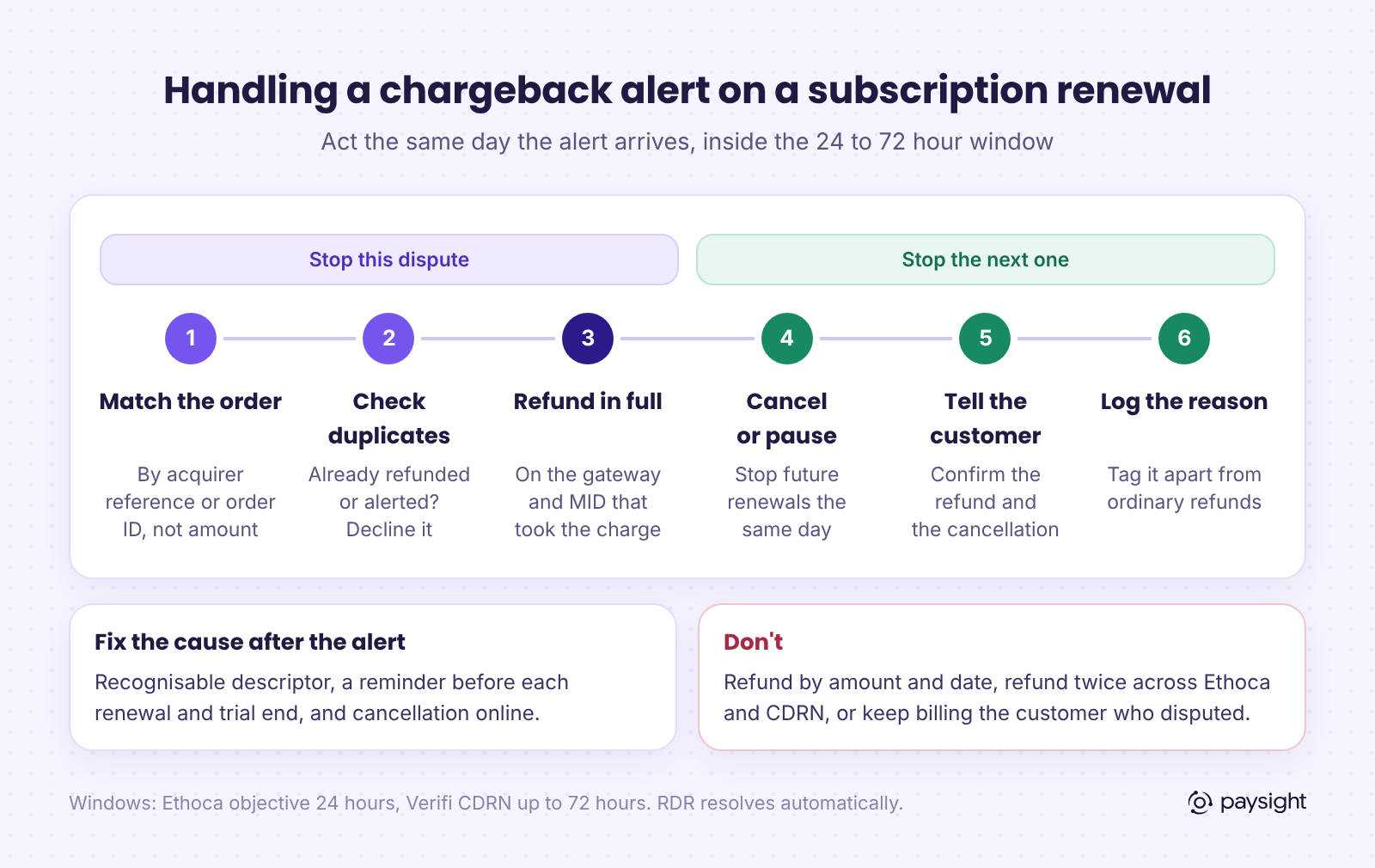
- Match by reference, not by amount. Use the acquirer reference number or order ID; renewals of one plan share the same amount.
- Check for duplicates. If the order is already refunded or alerted through another network, decline instead of refunding twice.
- Refund the full amount on the original transaction, through the gateway and MID that took the charge.
- Cancel or pause the subscription the same day, unless the customer asks to continue. Someone who disputed this renewal will dispute the next.
- Tell the customer with a short confirmation of the refund and cancellation.
- Log the reason. Alert refunds look like normal refunds in most dashboards; tag them so you can see which plans, offers or descriptors drive disputes.
Then fix the cause: usually a descriptor customers don't recognise, no reminder before a renewal or trial end, or a hard-to-find cancellation path. Our first renewal playbook covers reminders and descriptors in detail. If your alert volume does not fall after you fix them, alerts are hiding a product or offer problem, not solving it. On Paysight, steps 1, 3 and 4 (matching, refunding and cancelling) run automatically when an alert arrives, as described below.
Mistakes to avoid
- Letting alerts sit. An alert answered after the window is a fee for nothing. Automate with rules, or staff the queue every day, including weekends.
- Enrolling one MID out of several. Alerts match on descriptor and acquirer details. If you run more than one gateway or MID for redundancy, enrol each one you bill renewals through.
- Using alerts to manage the ratio instead of the business. Acquirers see alert volume too. A falling chargeback count with rising alert refunds still tells them customers are unhappy.
How Resolvo and Paysight handle chargeback alerts
Resolvo is our chargeback product, built alongside Paysight (it started life as Paysight Alerts). It covers every stage in this guide from one place: deflection with transaction details that help cardholders recognise a charge before they dispute it, real-time Ethoca and Verifi alerts so you can refund before a chargeback is filed, Visa Compelling Evidence 3.0, and tracking, recovery and representment for the chargebacks that still get through. It is built for the brands this article is written for: subscription businesses exposed to renewal disputes, high-risk ecom brands under processor scrutiny, and operators on Stripe, Shopify Payments or several MIDs who need to keep dispute ratios low to avoid payout holds and shutdowns.
For subscription brands that bill through Paysight, most of the handling playbook above runs on its own. Paysight's mitigation API lets the alert service find the transaction and the subscriber, refund the charge on the gateway that took it and cancel the subscription in the same call, so the next renewal never fires. It accepts Ethoca, CDRN and RDR alerts, and alert providers such as Chargebacks911, Kount, ChargebackHelp and Disputifier can use it. When Visa has already refunded a dispute through RDR, Paysight records the refund against the order and still cancels the subscription, so your refund and churn reports stay accurate. If the order was already refunded, the subscription is cancelled anyway.
Paysight is not a payment processor and never holds funds: refunds run through the gateways and merchant accounts you connect, such as Stripe, NMI or Finix. Neither product makes a high-dispute offer acceptable to your acquirer, but together they turn alerts from a daily manual queue into rules you set once, with every alert, refund, cancellation and chargeback visible next to the subscriber it belongs to.
Sources
- Visa, Visa Acquirer Monitoring Program fact sheet (2025; thresholds from 1 April 2026)
- Chargeback Gurus, Visa announces new change to VAMP rules (13 March 2025)
- Riskified, VAMP changes again: what merchants need to know (updated 20 May 2025)
- Mastercard, How Ethoca helps prevent chargebacks (11 August 2026)
- Mastercard, How Ethoca helps prevent first-party fraud (11 August 2026)
- Ethoca, Ethoca Alerts for merchants (April 2021)
- Verifi, Say "No" to chargebacks with pre-dispute solutions (updated 6 March 2025)
- Stripe, How dispute prevention works (accessed November 2026)
- Redo, Chargeback alerts rate card (17 August 2026)
- Redo, How Ethoca alerts work, and how they fail (22 July 2026)
- Chargeback.io, What is Verifi? (24 July 2026)
- Beast Insights, Chargeback alerts compared (updated 31 October 2026)
- PaymentBrief, Visa and Mastercard chargeback rules 2026 (updated 31 October 2026)
A chargeback alert is a notice from a card network service, such as Ethoca (Mastercard) or Verifi CDRN (Visa), that a cardholder has asked their bank to dispute one of your transactions. It arrives before the dispute becomes a chargeback, so you can refund the customer and stop the chargeback from being filed. Alerts come only from issuers that take part in the network.
Ethoca is owned by Mastercard and is strongest on Mastercard cards; Verifi is owned by Visa and is strongest on Visa cards. Both were acquired in 2019. Ethoca's objective is a refund within 24 hours of an alert, while Verifi gives up to 72 hours for CDRN. Verifi also offers RDR, which resolves Visa disputes automatically against rules you set in advance. Most brands that take both card brands use both.
CDRN sends you an alert and you decide whether to refund, within up to 72 hours. RDR has no decision step: you set rules in advance (for example by amount or dispute type), and Visa resolves every matching dispute immediately with a full refund. RDR is Visa only, cannot resolve partial amounts, and refunds disputes you might have won, so write its rules narrowly.
It depends on the dispute type. Non-fraud disputes resolved through Verifi RDR or CDRN within the same month are excluded from the VAMP ratio. Since March 2025, fraud-coded pre-disputes resolved through Verifi count again, and a fraud report (TC40) filed by the issuer still counts after any refund. An Ethoca alert refunded in time stops the chargeback, but not the fraud report. Ask your acquirer in writing how it treats each tool.
Published reseller prices in August 2026 ran from about $13.50 to $29 per alert: roughly $22 to $29 for Ethoca and $13.50 to $25 for Verifi CDRN and RDR, depending on provider and volume. Many resellers charge per alert whether or not you refund. The fee is on top of the refund itself, so on low-priced renewals an alert can cost more than the chargeback fee it prevents.
Not automatically. Check first that the order has not already been refunded or alerted through another network, and consider a minimum amount below which the alert fee outweighs the benefit. When you do refund, refund the full amount on the original transaction and cancel or pause the subscription, or the next renewal is likely to be disputed too. Then log the reason so you can fix the descriptor, reminder or cancellation issue behind it.
Yes, through Resolvo, our chargeback product built alongside Paysight. Resolvo brings real-time Ethoca and Verifi alerts, deflection, Visa Compelling Evidence 3.0 and representment into one place. For subscription brands billing through Paysight, an alert can refund the charge on the gateway that took it and cancel the subscription in the same step, so the next renewal is never disputed. Paysight itself is not a payment processor: refunds run through the gateways and merchant accounts you connect.






Company Reg. No. 760371
VAT No. IE4280069RH


